

How to Choose Wall Art for Patterned Wallpaper: Scale, Edge, and Visual Hierarchy
Quick answer
Choose wall art for patterned wallpaper by treating the wallpaper as an active visual field, not a neutral background. First describe what the wallpaper already contributes: repeat scale, information density, direction, light-dark structure, and motif. Then choose one deliberate difference inside the artwork, such as broader forms against a tight repeat or irregular movement against a rigid grid. Check whether the artwork remains identifiable along all four outer edges. Finally, review the complete room and remove or move one competing layer before rejecting the art.
This sequence is FIELD / GAP / EDGE / EDIT. It prevents a common mistake: choosing by color match alone and discovering that the canvas either disappears into the pattern or creates a second pattern of equal strength.
Patterned wallpaper does not automatically require minimalist, neutral, small, or framed art. A sparse pale work can vanish on a tonal pattern, while an active composition can succeed when its scale and boundary are clearly different. The answer may be one canvas, a different position, or no additional art on that wall.
What this guide decides—and what it leaves to other guides
This article assumes that the wallpaper is already installed or firmly selected. It decides how to shortlist a canvas by its relationship to that fixed field.
It does not teach wallpaper installation, recommend mounting hardware, provide universal size formulas, reconstruct a gallery wall, or assume that a mat or frame is included with a canvas. Use the dimensions, edge content, panel configuration, and hardware information on the individual listing. Delegate footprint calculations to the wall art size guide and grouped layouts to the gallery wall guide.
The four stages have separate jobs:
- FIELD records the wallpaper without changing anything.
- GAP identifies one controlled difference inside the candidate artwork.
- EDGE tests only the boundary where canvas meets wallpaper.
- EDIT changes placement or surrounding room layers while holding the wallpaper and candidate art constant.
If a pairing fails, identify the first failed stage. Changing color, scale, position, framing, and accessories at once may improve a photograph, but it does not reveal which decision solved the problem.
FIELD: record what the wallpaper already contributes
Do not begin with a style label such as traditional, dramatic, playful, or modern. Those words express an impression but do not produce a useful art brief. Describe observable behavior instead. If the candidate is abstract, the same discipline applies when you audit abstract wall art against the room's visual density.
Start with repeat scale. A tight floral, dot, or small geometric repeat may appear as texture from the doorway although its motifs are clear nearby. A medium repeat remains legible at normal room distance. A mural-like design may contain only a few dominant forms and behave more like a composition than a background.
Next record information density: leaves, line intersections, figures, hard contours, and gaps between motifs. A two-color wallpaper can be dense, while a multicolored mural with broad fields can be comparatively open. Color count is not a substitute for density.
Identify direction. Stripes may pull vertically; a repeated branch may climb diagonally; a grid may distribute attention evenly; a scenic paper may have a strong horizon. Direction matters because artwork can accidentally continue the same movement until wall and canvas appear to be one uninterrupted pattern.
Separate hue from value structure. Record whether the field is light with dark marks, dark with pale motifs, or tonal. Two surfaces can share a hue yet remain distinct through light-dark separation; different hues can still merge when their values and edge strength are similar.
Finally, decide the wallpaper's motif authority. Does it read as background texture, repeated ornament, or a complete scene with its own focal area? Scenic wallpaper may not need another focal point. A small repeat may accept one confidently bounded canvas more easily, but that remains a test, not a rule.
Review the wall from close range, the primary seat or standing position, and the doorway or longest ordinary view. End FIELD with one factual sentence:
Small-scale, high-contrast black-and-cream botanical repeat, evenly distributed, with no broad quiet interval.
Do not choose art yet. FIELD produces evidence, not a recommendation.
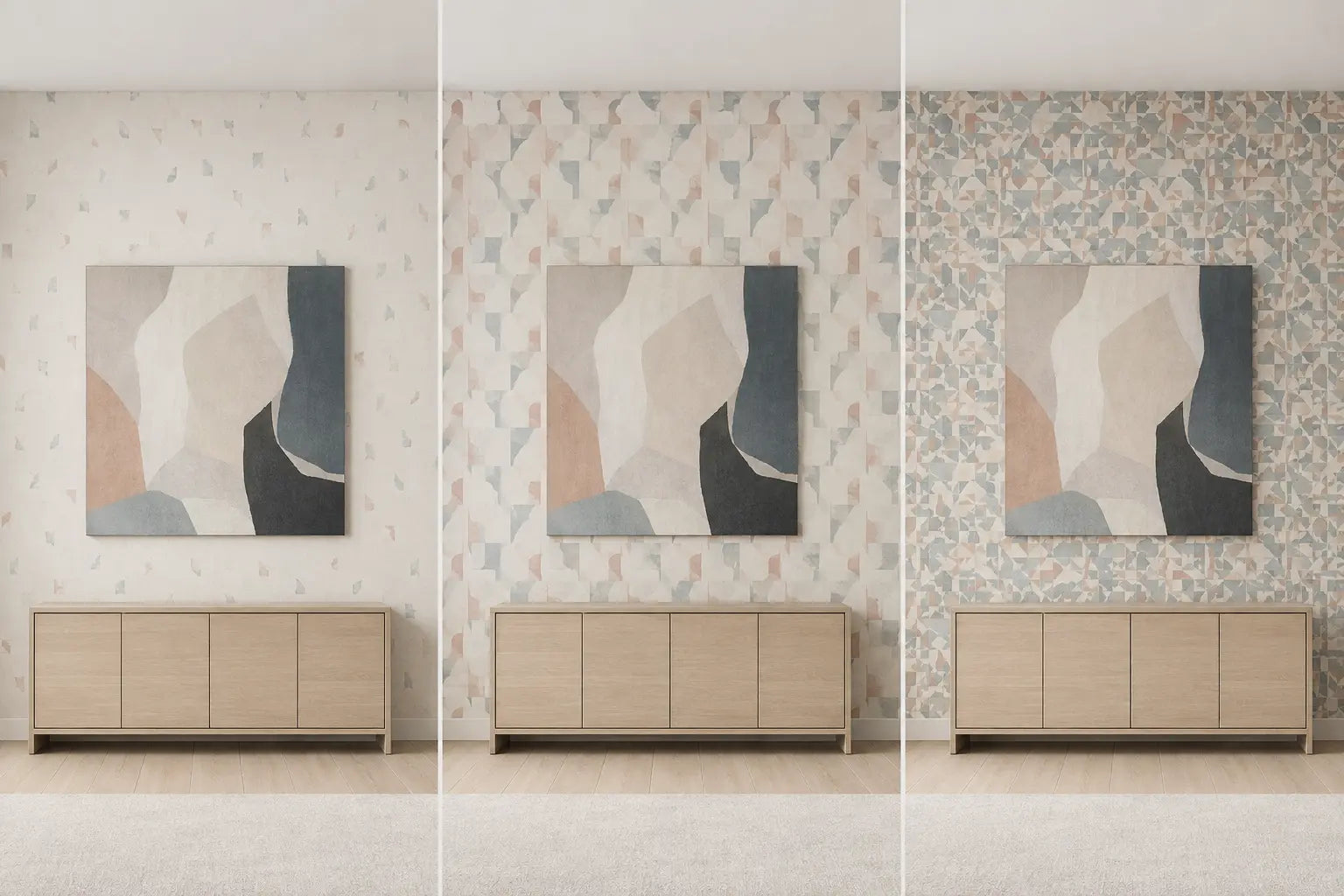
GAP: choose one deliberate difference inside the artwork
GAP is the difference between the wallpaper's information and the internal composition of the canvas. It is not empty wall space around the artwork, and it is not the frame.
There are four useful separation channels.
Scale gap compares visual forms. Broad connected shapes can register clearly against a tight repeat. Against an oversized mural, a compact focal form may work in a quieter interval with a stable edge. Compare the forms inside each surface, not merely “large art” with “large pattern.”
Density gap compares how information is distributed. A canvas with three broad forms differs from wallpaper containing dozens of small marks even when colors connect. A detailed image can work on a tonal stripe when it has strong focal structure rather than evenly scattered detail.
Directional gap changes the dominant movement. Curves can interrupt a rigid grid. A horizontal composition can counter a strong vertical stripe. Irregular contours can distinguish art from repeated mechanical geometry. The direction does not have to be opposite; it only needs to avoid an accidental continuation at equal strength.
Motif gap changes what kind of information is represented. Abstract or architectural imagery can separate from narrative wallpaper, but floral art is not prohibited on floral wallpaper. Two related motifs can work when their scale, density, focal structure, or direction differs deliberately. A blanket “never mix motifs” rule would reject many viable pairings without inspecting them.
Choose one channel as the primary GAP. A second can support it, but do not force every attribute to contrast. Decide which relationship you want:
- Separate: the canvas is clearly independent from the wallpaper.
- Bridge: one hue, material association, or motif family connects them while another variable creates separation.
- Intensify: both surfaces are active by choice, but one retains clear authority.
Color can bridge rather than solve the pairing alone. Repeat one restrained hue, then distinguish the art through value, density, direction, or form scale. Copying every wallpaper color into art and accessories creates more signals and can weaken the focal point.
Reject a candidate when its wallpaper and artwork repeat similar mark size, density, direction, and contrast unintentionally. Also reject a decision based only on a cropped product mockup. The crop may hide the outer image field, nearby furniture, or the exact wallpaper area where the work will sit.
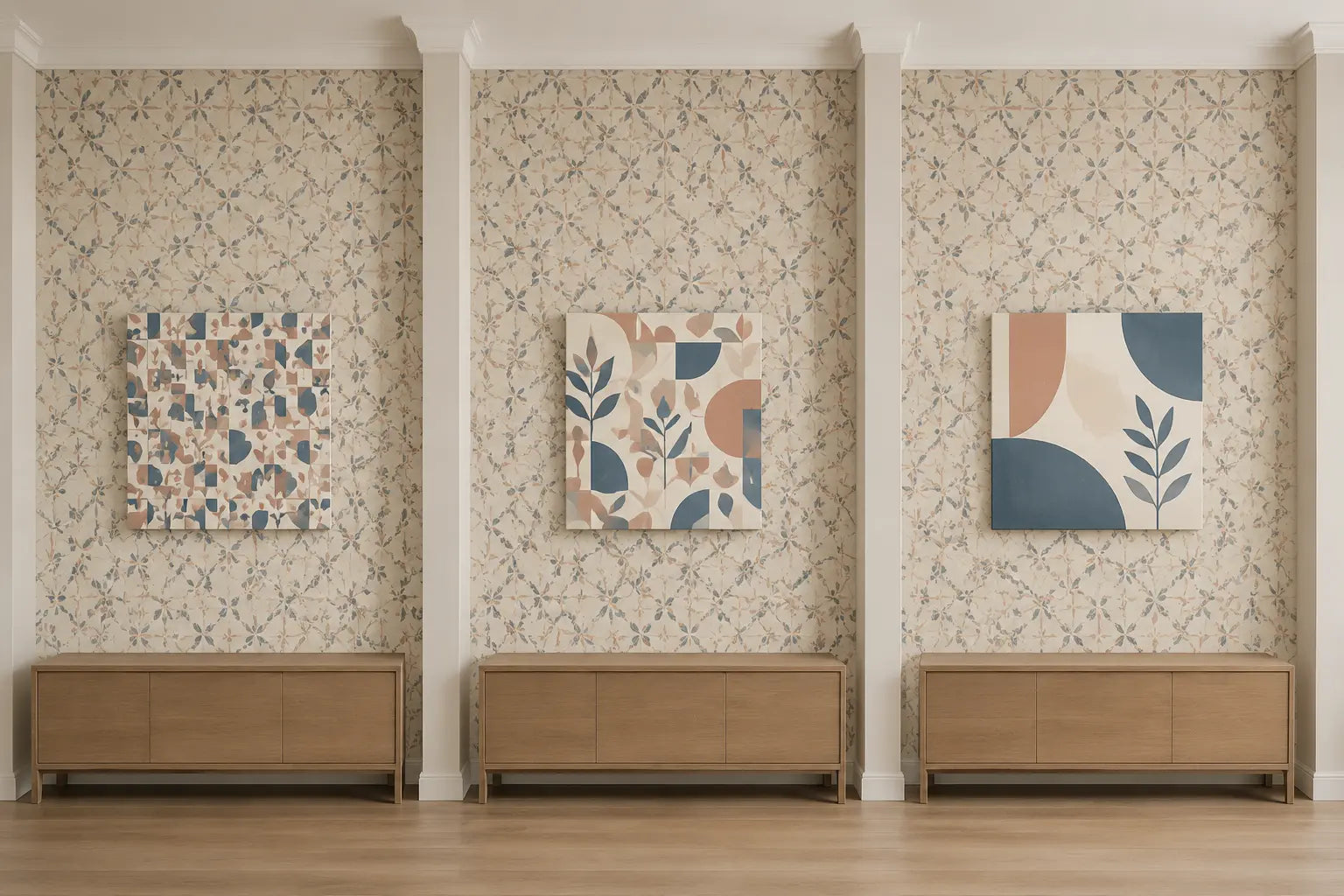
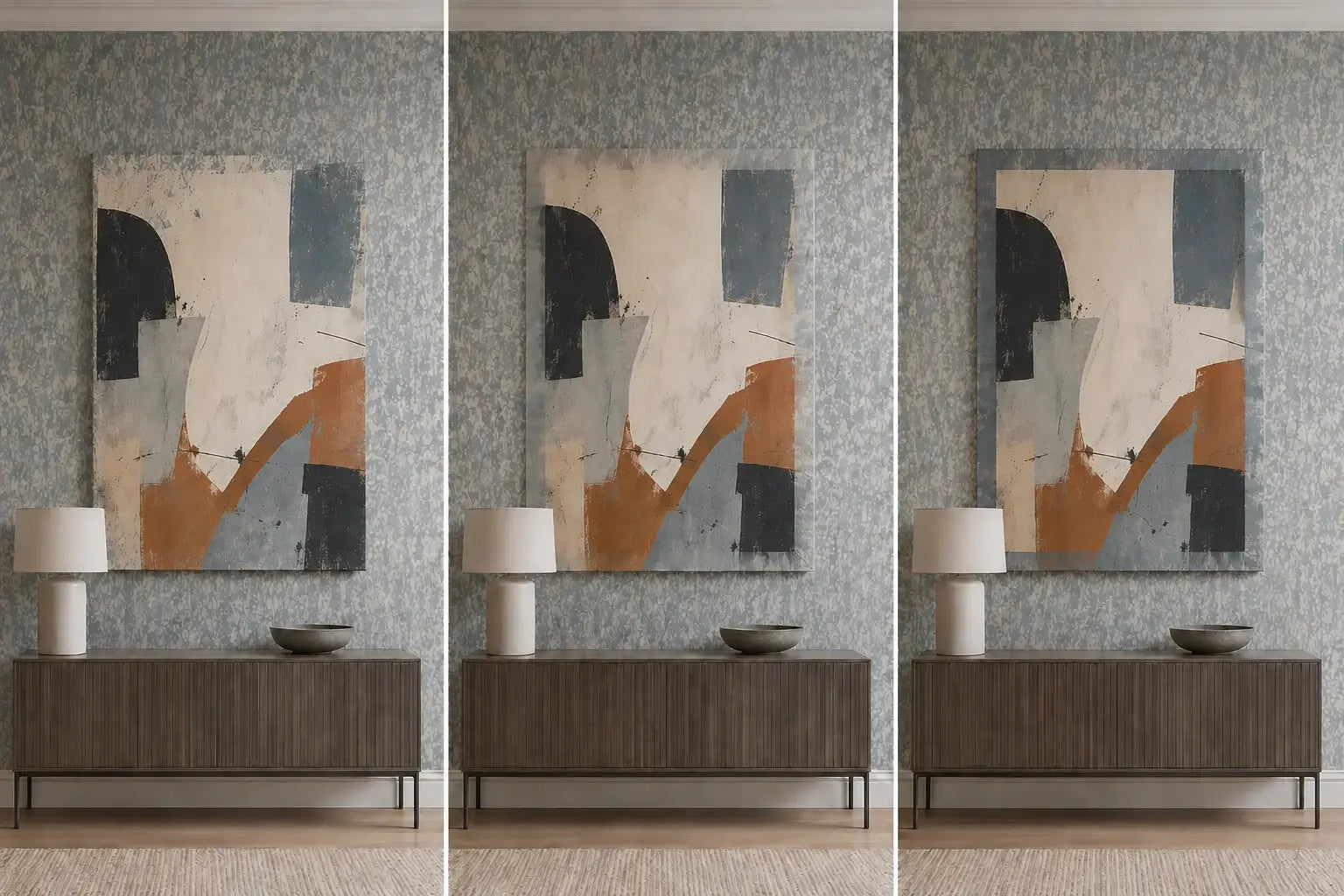
EDGE: make the canvas boundary legible
A strong internal GAP does not guarantee a successful installation. The artwork can still dissolve where its perimeter meets the wallpaper.
Trace all four sides of the proposed canvas in an uncropped image. EDGE asks whether the boundary is readable at the normal viewing distance. It does not judge the entire room and does not recalculate artwork size.
A canvas may establish its boundary through a calm printed outer field, internal negative space, a clear value change, a simple outer silhouette, or large connected forms that do not repeat the wallpaper at the perimeter. An actual frame or float treatment can also create separation, but use that solution only if the selected product genuinely includes it. Advice written for matted paper prints should not be silently transferred to an unframed canvas.
Inspect four common failures:
- Small motifs appear to continue from wallpaper into the image.
- Dark wallpaper lines align with dark lines at the canvas edge.
- Grid intersections or stems meet canvas corners and create accidental extensions.
- A pale tonal canvas loses its outline against a pale tonal repeat.
The opposite problem is possible too. A very hard black outline around a pale work may look disconnected when the intended relationship was a quiet bridge. EDGE is not a demand for maximum contrast. It is a requirement that the boundary express the chosen relationship deliberately.
Make a paper rectangle in the exact outer ratio or place an accurate product image into a photograph of the wall. Do not add a false white border during the mockup. Step back to the primary view and check whether all four sides remain understandable. If the internal GAP succeeds but the perimeter fails, compare a candidate with calmer edge content or a clearer value boundary before changing the whole room.
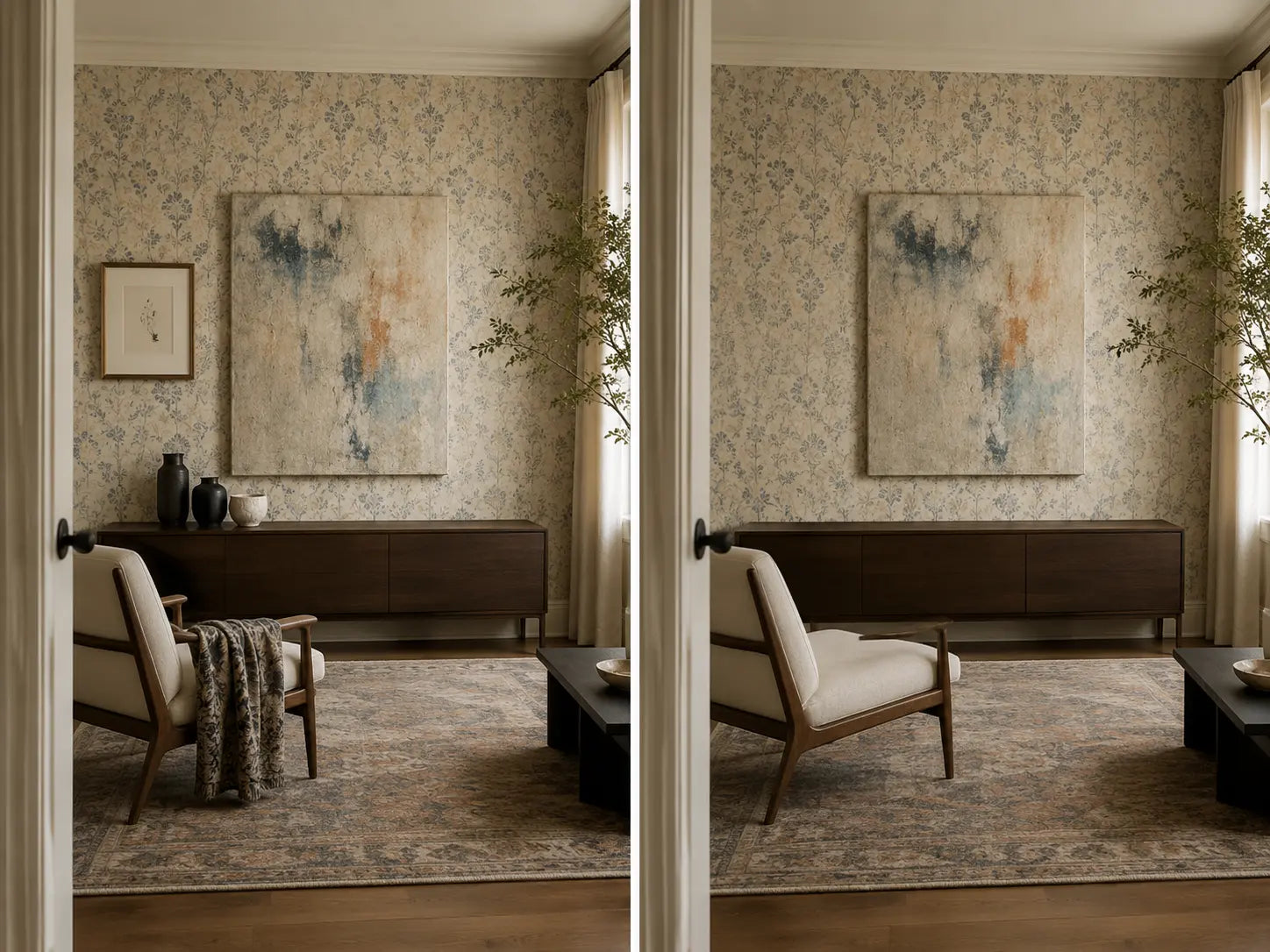
EDIT: test the complete sightline
EDIT begins after the wallpaper, internal GAP, and canvas EDGE are defined. Keep the wallpaper and candidate artwork fixed. Now determine whether the full room can support both.
A close crop excludes the elements that often change the result: patterned curtains, rug, bedding, shelving, mirrors, lamps, tall console objects, a second artwork, door trim, or wallpaper continuing around a corner. Photograph the proposed installation closely, then take a second image from far enough away to include the normal sightline.
If the close image works and the wide one fails, alter one surrounding variable. Remove a second artwork. Temporarily replace a patterned throw with a plain one. Move a lamp or vase that touches the canvas outline from the primary view. Preserve an empty wallpaper interval instead of filling it with another object. Move the canvas to a less interrupted section of the same wall.
This is a diagnostic test, not an instruction to make every room minimal. A collected room can support wallpaper and complex art when hierarchy is intentional; a sparse room can fail when both repeat the same small high-contrast information.
Retest from the entrance and the primary seat or standing position in daylight and under the ordinary evening lighting used in the room. Change one variable per trial. The outcome should be explicit:
- KEEP when all four stages pass.
- MOVE when GAP and EDGE work but the location creates a collision.
- REDUCE when the pairing succeeds after one surrounding layer is removed.
- REJECT when the art still disappears or competes after the smallest reasonable edit.
If rejection is necessary, return to the first failed stage. Do not restart every decision.
| Visible conflict | First stage | Controlled test | Reject when | Retest from |
|---|---|---|---|---|
| Canvas merges internally | GAP | Hold footprint and palette; change only mark scale or density. | Forms still repeat the wallpaper at equal strength. | Close view and doorway. |
| Perimeter disappears | EDGE | Hold the composition; compare a calmer or clearer outer field. | Any side remains unreadable at normal distance. | Primary seat and evening light. |
| Pair works only in a crop | EDIT | Remove or move one competing room layer. | The wide sightline still has equal focal centers. | Entrance and primary position. |
| Wallpaper is already complete | FIELD | Compare the room with and without the canvas. | Art interrupts the wallpaper's established focal structure. | Full-room view. |
Six evidence-led room decisions
1. Small-scale floral wallpaper in a bedroom
Evidence: The tight floral repeat reads as texture from the doorway, but individual leaves become clear from the bed. Patterned bedding adds another layer of similarly small information.
Decision: Test broader connected forms and one restrained color bridge. Look for a calm outer image field rather than assuming a neutral subject will be calm.
Reject: Another evenly distributed small botanical pattern with no focal structure and no stable edge.
Retest: Check from the doorway and bed, then remove the patterned throw before rejecting the canvas. Repeat under bedside lighting.
2. Large botanical wallpaper beside a dining table
Evidence: Oversized leaves already create several dominant shapes and a clear focal area. The wallpaper behaves more like a mural than a small repeat.
Decision: Use a different direction or subject structure on a lower-activity interval. Position may matter more than greater contrast.
Reject: A placement that cuts across the wallpaper's main form and creates two equal focal centers.
Retest: Compare the same canvas in two positions from both seated and standing views before changing the artwork.
3. Geometric wallpaper in a home office
Evidence: A repeated grid, vertical shelving, and cabinet divisions create many hard aligned edges.
Decision: Compare an irregular composition, curved movement, or geometry with a clearly different interval. Repeat one color only if the structural GAP remains visible.
Reject: A canvas whose grid frequency continues the wallpaper and cabinetry by accident.
Retest: Review from the desk and doorway. Use a grayscale photograph to inspect value and edge alignment, then return to color for the final decision.
4. Low-contrast tonal stripe in a living room
Evidence: Wallpaper and canvas are both restrained, yet the artwork disappears because their values and outer-edge softness are similar. The failure is not excessive busyness.
Decision: Keep the tonal palette if desired, but choose a clearer perimeter value or stronger connected form.
Reject: Adding brighter accessories while leaving the failed canvas boundary unchanged.
Retest: Compare daylight with normal evening light. Confirm that the main composition and all four sides remain legible without relying on a close photograph.
5. Scenic or mural-style wallpaper
Evidence: The wallpaper already contains a horizon, subject, directional movement, and focal composition. It does not behave as a neutral field waiting to be filled.
Decision: Let the mural complete the wall or move art to a quieter surface where both retain authority.
Reject: Adding a canvas only because every wall is expected to contain an object.
Retest: Compare the complete room with and without the canvas. Keep it only if the hierarchy becomes clearer rather than merely fuller.
6. Collected maximalist sitting room
Evidence: Wallpaper, patterned rug, books, objects, and several frames distribute attention across the same view.
Decision: Test one bounded canvas with a clear internal GAP, then EDIT one secondary layer while keeping the wallpaper and canvas constant.
Reject: A generic multi-piece cluster that adds more boundaries but has no collection logic. A meaningful group needs its own plan and should be tested as one complete outer envelope rather than as several unrelated objects.
Retest: Photograph the whole sightline from the main seat. Restore the removed layer only if art, wallpaper, and collection still retain a readable order.
Build a buying brief before opening product pages
Write the decision in observable terms:
- FIELD: Describe repeat scale, density, direction, value, and motif authority in one sentence.
- ROLE: Choose separate, bridge, or intentionally intensify.
- GAP: Name one primary internal difference.
- EDGE: State what the perimeter must do.
- EDIT LIMIT: Record what can realistically move or be removed.
- PRIMARY VIEW: Name the seat, doorway, bed, table, or desk from which the work must succeed.
- LIGHT: Check the ordinary daytime and evening conditions.
- REJECT SENTENCE: Define one visible failure, such as “small dark marks merge with the wallpaper along the left and lower edges.”
Shortlist protocol
Shortlist three exact works, compare them in the same photograph at the same proposed footprint, then confirm current dimensions, crop, panel configuration, edge content, and options on each listing.
Once the brief is complete, browse by the composition the wall needs—not by the assumption that one style always works with pattern.
Frequently asked questions
1. Can I hang canvas art directly on busy wallpaper?
Yes. The canvas needs a deliberate internal GAP and a readable EDGE, but it does not automatically need a mat, white border, or decorative frame. Test the exact product image and perimeter rather than applying framed-print advice to every canvas.
2. Should the artwork colors match the wallpaper?
They can connect without matching completely. Repeat one useful hue, temperature, or small accent, then distinguish the art through value, form scale, density, or direction. Copying the full wallpaper palette into several room objects is not required for cohesion.
3. Is minimalist art always the safest choice?
No. A sparse pale canvas can disappear on low-contrast wallpaper, and a complex canvas can work when its focal structure, scale, and perimeter differ clearly. Inspect the exact composition instead of treating “minimalist” as a guarantee of low visual activity.
4. Can floral art work on floral wallpaper?
Yes. The two layers can share a motif when their repetition scale, density, direction, focal structure, or boundary differs deliberately. Reject accidental similarity, not the subject category itself. A floral-on-floral pairing can separate, bridge, or intentionally intensify.
5. Is one large canvas better than a gallery wall on wallpaper?
One canvas introduces one outer boundary, which can be easier to distinguish on a repeated field. It is not universally better. A meaningful collection can work when the group has a clear envelope and hierarchy; calculate and test that group separately.
6. Why does the artwork disappear from across the room?
Find the failed stage. The internal forms may have insufficient GAP, the perimeter may fail EDGE, or the installed footprint may be too weak for the viewing distance. Do not solve all three at once. Route exact footprint questions to the dedicated size guide.
7. Is it acceptable to leave patterned wallpaper without art?
Yes. Scenic wallpaper may already complete the wall, and an uninterrupted patterned interval can preserve hierarchy around artwork elsewhere. Add a canvas only when it has a defined visual job; an unfilled wall is not automatically an unfinished wall.
8. How can I test wall art before buying?
Use a paper rectangle in the exact outer ratio or place an accurate product image into an uncropped room photograph. Review close and full sightlines, daytime and evening light, and at least two routine viewpoints. Change one variable in each comparison.
Sources note
Design guidance was cross-checked against practical discussions from Emily Henderson, Simply Framed, and Hygge & West. Their examples support testing scale difference, boundary, color connection, and surrounding space, but they are not universal formulas.
Research on measuring visual clutter and laboratory visual crowding provides limited perceptual context for evaluating a target among surrounding features. It does not establish an ideal wallpaper pairing, fixed interior spacing, or a wellness effect. The FIELD / GAP / EDGE / EDIT method is therefore a practical editorial decision tool, not a scientific score.