

Wall Art With Built-In Shelves: How to Balance Art, Books, and Open Space
Quick answer
Treat fixed built-in shelves as architecture, not decoration. First identify the usable wall bay created by shelf edges, doors, lighting and real sightlines. Then compare the visual load of the books and objects with the visual load of the artwork. Preserve enough open wall for both the canvas edge and the built-in edge to remain clear, and test the result from the routes people actually use.
Use BAY / LOAD / AIR / WALK: define the placement field; compare shelf and artwork density; adjust one complete footprint at a time; then verify the shortlist from normal approaches and room states. Record one pass and one rejection so later shopping stays evidence-led. The strongest result is not automatically the most symmetrical, the largest or the emptiest. It is the option whose artwork remains distinct without making the shelves look accidental, crowded or disconnected. Another wall—or no new artwork—can be the correct result.
Choose the field
Assign visual roles
Test the footprint
Verify in use
Why built-ins change the wall art decision
A blank wall lets you compare artwork with one broad surface. Built-ins divide that surface into architectural zones. Vertical shelf sides create firm lines; cabinet tops create horizontal anchors; books, ceramics, lighting and open cubbies add many smaller shapes. Even when the wall is physically large, the section that can hold art may be a central plaster bay, a narrow field beside one cabinet or an adjacent wall that reads with the shelves from the doorway.
This changes the purchasing question. You are not only asking whether the art suits the room. You are deciding which field should own it, how much visible competition that field can support, and whether the art should lead, organize or quietly support the built-in elevation. Measuring total wall width can produce a technically impressive number that ignores the actual shelf boundaries.
Begin with the fixed geometry and the ordinary shelf state, not a preferred image. The wall art size guide can resolve general scale after you have defined the real bay. For this decision, the bay comes first.
Photograph one front view and one ordinary approach view. Keep the shelves as they normally look. Mark doors, lights, controls, monitor edges and any area that must remain accessible. That evidence prevents a neat close-up from hiding a weak whole-room decision.
BAY / LOAD / AIR / WALK
Each pass has a different output. Change one variable, keep the rest stable, photograph the result from a marked position and record a visible pass or rejection. That discipline is more useful than repeatedly changing the art, size, shelf display and camera angle at once.
Define the architectural field
Map fixed boundaries: outer shelf sides, cabinet tops, open niches, adjacent corners, door movement, light fittings and the main approaches into the room. A built-in may create one obvious central bay, several narrow side fields or a low horizontal field above cabinetry. Do not assume that the geometric center of the full wall is the useful anchor; an asymmetrical shelving wall may create a stronger center inside one open field or around a seating group.
- Evidence: front and approach photographs plus every genuinely usable wall field.
- Held constant: artwork candidate, footprint, orientation and ordinary shelf contents.
- Changed variable: horizontal anchor or candidate bay, one comparison at a time.
- Pass: the field reads as an intentional destination from both important views.
- Reject: the canvas appears trapped, belongs to another zone or works only in a tight crop.
- Retest: move the same full-size template to the next viable anchor without resizing it.
Once the field is chosen, use the wall art hanging-height guide for the separate vertical and installation decisions.
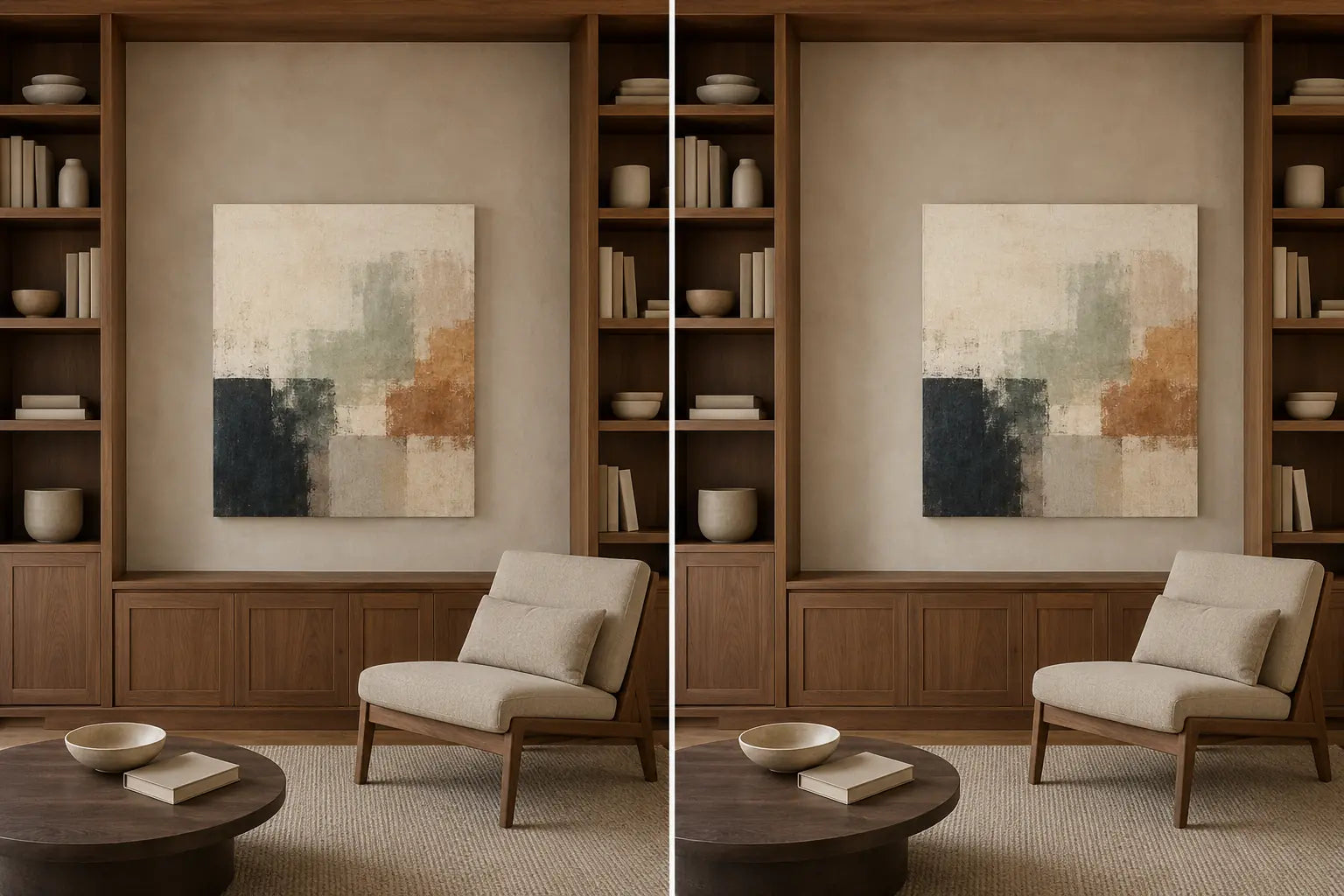
Compare visual weight, not object count
Visual load is the amount of attention an area asks for. A shelf with many quiet, similar book spines can read more calmly than one with fewer but highly contrasting objects. Artwork behaves the same way: several broad connected fields may feel quieter than a smaller composition built from many hard edges and concentrated accents. Count alone cannot describe that difference.
Photograph the shelves in their normal state. Do not empty them to make a candidate succeed unless that edited state is realistic to maintain. Compare artwork alternatives at the same size, in the same bay and under the same light. Change only internal composition density.
- Evidence: shelf color variation, silhouettes, contrast, repeated lines and visible pauses.
- Held constant: bay, footprint, orientation, viewpoint, light and shelf display.
- Changed variable: artwork shape and mark density.
- Pass: the art remains identifiable while the shelving still reads as one coherent unit.
- Reject: every region demands equal attention, or the canvas disappears into shelf activity.
- Retest: compare a quieter composition or a clearer dominant shape at the same footprint.
If abstract work is on the shortlist, use the abstract wall art guide for subject-specific selection rather than matching shelf colors mechanically.
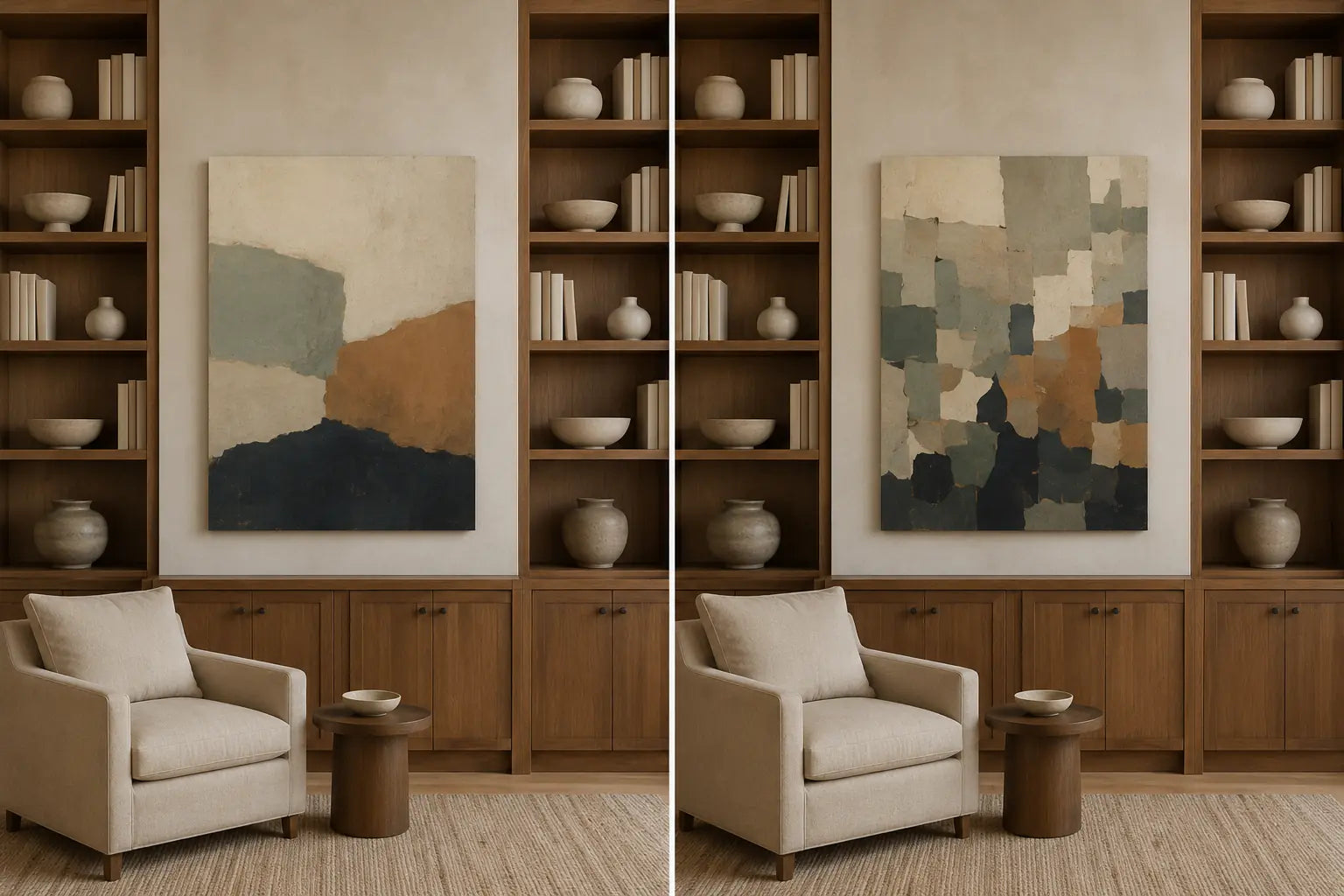
Protect useful open wall
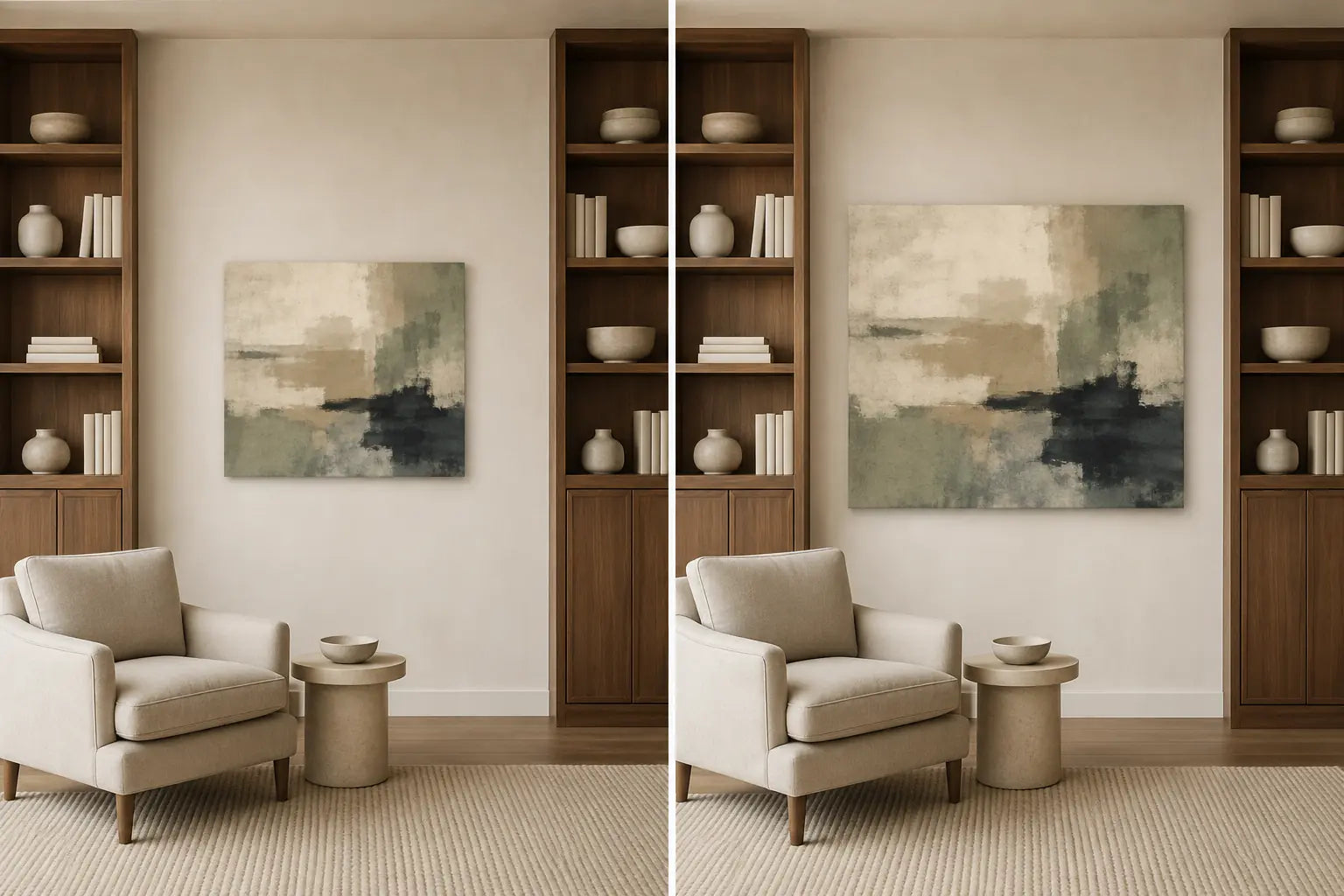
Air is not an arbitrary number of inches. It is the visible wall that lets the artwork perimeter and built-in boundary remain legible. Too little open wall can make a canvas look squeezed into leftover space; too much can make it feel unrelated to the architecture. The useful amount depends on the bay shape, shelf activity, canvas edge, view and furniture below, so a universal shelf-edge clearance would be false precision.
Make two complete templates of the same composition at credible footprints. Keep the center, aspect ratio and bay constant. Compare the outer relationships rather than looking only at the image center. If orientation is the uncertain variable, run it as a separate round; the wall art orientation guide owns that broader decision.
- Evidence: wall reveal, shelf-edge hierarchy and whether the bay retains a clear shape.
- Held constant: artwork design, aspect ratio, center, shelf contents, viewpoint and light.
- Changed variable: proportional canvas footprint.
- Pass: the art feels contained by the field without looking compressed.
- Reject: an edge nearly merges with the casework or leaves an accidental wall sliver.
- Retest: compare the next smaller or larger footprint with the same center and design.
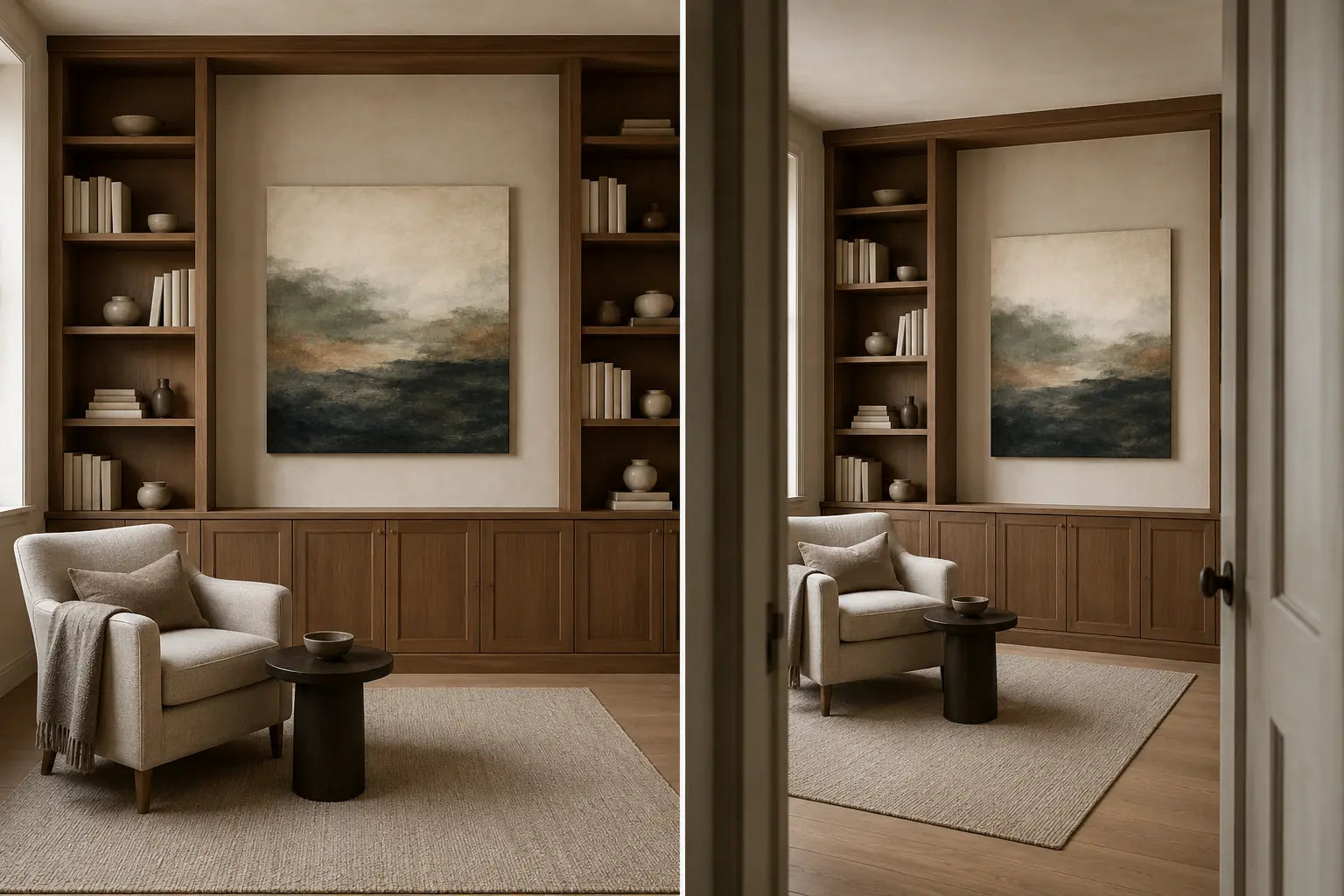
Verify the shortlist in use
A straight-on elevation can conceal a weak decision. Built-ins are often seen from a doorway, a seat or an adjoining zone. From those positions, shelf depth and side panels change the apparent bay, while foreground furniture can overlap elements that seemed separate in the front view. A clean editorial angle is not proof that the everyday view works.
Place the final template and follow the ordinary route. Photograph one marked position at a time. Run cabinet-door, desk and evening-light checks in separate passes so you know which change caused the result.
- Evidence: approach views, seated views, partial sightlines and ordinary working states.
- Held constant: artwork, bay, footprint, hanging position, shelves, furniture and light.
- Changed variable: camera/viewing position.
- Pass: the canvas remains attached to the intended field and keeps a clear role.
- Reject: it collides visually with an edge, disappears behind objects or belongs to another zone.
- Retest: adjust one position or footprint, then repeat the same marked route.
If the shelving wall is visible across several zones, use the open-plan wall art guide to decide whether another focal point already leads the shared view.
Built-in shelf and wall art router
Use the observed condition to choose the first comparison. Do not treat the table as a style rule; it is a route to a fair test.
Swipe or use the horizontal scrollbar to review all table columns.
| Observed condition | Artwork role | Hold constant | Test next | Reject when |
|---|---|---|---|---|
| Clear bay between two built-ins | Lead within one field | Shelves and artwork design | Two complete footprints | Art looks pinched or unrelated |
| Dense books and varied objects | Organizing counterweight | Bay and footprint | Quieter internal density | Art repeats every shelf signal |
| Sparse pale shelving | Primary focal point | Bay, size and viewpoint | Clearer dominant shape or contrast | Canvas dissolves into cabinetry |
| One-sided asymmetrical built-in | Independent room anchor | Template dimensions | Bay center versus furniture center | Compromise position owns neither |
| Built-in desk and monitor | Supporting focal point | Working setup | Narrow bay or adjacent wall | Main image area is hidden |
| Strong doorway view | Arrival signal | Finalists and room state | One marked viewpoint at a time | The chosen field disappears on approach |
Controlled room scenarios
Each scenario names a visible decision and a genuine rejection. Keep the stated variables stable before retesting.
Central bay between symmetrical built-ins
Evidence: Matching shelf towers bound one central wall field; ordinary books add comparable weight on both sides.
Decision: Treat the central bay—not the complete millwork span—as the canvas field.
Reject: The canvas leaves thin filler strips of wall even though its center is exact.
Retest: Hold center and image constant; compare the next smaller footprint.
One built-in on an asymmetrical wall
Evidence: Shelving owns one side while the open wall continues toward a chair, doorway or corner.
Decision: Choose whether art answers the shelf-defined field or the furniture group before judging scale.
Reject: A compromise center belongs to neither field and succeeds only in a crop.
Retest: Move one unchanged template between the two anchors and repeat both views.
Artwork above fixed base cabinets
Evidence: A cabinet top supplies a horizontal line while shelf sides create a second, narrower field.
Decision: Test whether the canvas relates primarily to the cabinet or to the open bay above it.
Reject: It floats between alignments or visually merges with permanent display objects.
Retest: Hold subject and center; compare one alternate footprint or orientation in a separate round.
Built-in desk with a monitor
Evidence: Shelves surround a work niche; the monitor obscures the lower wall and the view changes when seated.
Decision: Prefer a separate narrow bay or adjacent verified wall with a readable focal area.
Reject: The image’s main information disappears behind the normal working setup.
Retest: Keep the desk in use and compare from seated, standing and ordinary video-call camera views.
Dark library with dense books
Evidence: Dark wood, varied spines, objects and repeated shelf lines already create concentrated activity.
Decision: Test one canvas with larger connected shapes and a distinct value structure.
Reject: Fine detail and repeated small geometry turn the elevation into one undifferentiated field.
Retest: Keep footprint and palette range; reduce internal shape density and check the evening state.
Freestanding bookcase beside the target
Evidence: The cabinet can move and its stability, anchoring or final position is not confirmed.
Decision: Settle and secure the furniture according to its manufacturer before using it as a visual boundary; mount art only on a verified wall surface.
Reject: Attaching art to unverified furniture or aligning a permanent installation to a temporary edge.
Retest: After the furniture plan is fixed, repeat BAY with access and circulation visible.
Build a brief before choosing a canvas
A useful brief turns “I like this image” into a room-specific shortlist. Record evidence before a product page introduces scale assumptions or an attractive mock-up.
- Save front, seated and primary approach photographs from marked positions.
- Record the width and height of each genuinely usable wall bay—not the entire room wall.
- List fixed boundaries: shelf sides, cabinet tops, doors, lights, outlets, vents, controls and monitor edges.
- Photograph the shelving in its normal occupied state and classify the visible load as quiet, mixed or dense.
- Name one artwork role: lead, organize or support.
- Prepare two plausible full-size footprints with the same center and aspect ratio.
- Describe the candidate’s dominant shape, value separation, edge activity and internal density.
- Record separate BAY, LOAD, AIR and WALK results, including the rejected option and reason.
- List wall, cabinetry and hardware questions that need supplier or professional confirmation.
- Confirm the exact finished dimensions and available format only after the visual shortlist is stable.
If the brief points to canvas as the right format, browse Artesty canvas art after the bay, role and tested footprint are defined.
Frequently asked questions
Should wall art be centered between built-in shelves or on the whole wall?
Center it between the shelves only when that opening is the intended architectural field. If the shelving is asymmetrical or a seating group creates a stronger anchor, compare the same template on both centers from the front and the ordinary approach. Total wall width should not override a clearly bounded bay.
How much space should I leave between a canvas and a bookshelf edge?
There is no portable universal number for this visual relationship. Compare complete footprints and look for enough visible wall to keep both edges distinct. Reject a narrow accidental sliver, but do not assume that more empty wall is always better. Installation and access clearances are separate conditions to verify.
What size canvas works in a narrow wall bay between bookcases?
Start with the usable bay, then test at least two exact paper outlines at the same center. Include the finished canvas edge and any surrounding frame in the outline. The passing size remains readable without crowding casework; it does not come from applying a whole-wall ratio to the narrow field.
Should artwork match the color of built-in shelves or wood?
No exact match is required. Decide whether the artwork should connect or separate. It can repeat one restrained temperature or material note, or create deliberate value contrast. What matters is that the canvas keeps its role while the cabinetry still reads as one coherent architectural element.
Can detailed artwork work beside full bookshelves?
Yes, when the bay, scale and viewing distance support it. Hold footprint and palette stable, then compare internal density. If the art and shelf contents become equally granular from the normal view, try larger connected forms or a clearer dominant area rather than automatically buying a smaller canvas.
Is one large canvas or a gallery wall better with built-ins?
Neither is automatically better. One canvas creates one outer boundary and can organize a shelf-heavy elevation. A group introduces more edges, gaps and alignment decisions, which may work in a quiet broad field. Test a one-piece footprint first; move to a multi-piece plan only when the field genuinely benefits from that rhythm.
Can I hang canvas art directly on a bookcase or built-in cabinet?
Do not assume a cabinet face, shelf back or freestanding bookcase is a suitable mounting surface. Construction, movement, weight, wiring and manufacturer restrictions vary. This guide plans wall-mounted art around fixed shelving; any furniture-mounted installation needs specific approval and appropriate professional or manufacturer guidance.
How should I test art when shelf displays change over time?
Use the shelf state that is normal and sustainable, then repeat LOAD when the display changes materially. Keep the canvas footprint, camera and light fixed for the comparison. If the artwork only succeeds when shelves are temporarily emptied, it is not a robust purchase decision for the room you actually use.
Sources and qualifications
This method applies observable design concepts—field, hierarchy, visual load, open wall, orientation and sightline testing—as editorial decision tools rather than fixed formulas. The generated comparisons are original visual aids, not Artesty product photographs, measured experiments, installation instructions or evidence of current product availability.
The article does not provide structural, electrical, fire, conservation or cabinetry-specific instructions. Product documentation, site conditions and qualified advice take precedence wherever mounting, heat, light, access, concealed services or furniture stability are involved. Aesthetic test results never certify a location for installation.