

Wall Art Between Windows: How to Balance Trim, Daylight, and the View
PLOT / ALIGN / NAME / EXAMINE
Quick answer
Choose wall art between windows by treating the wall as an architectural interval, not as leftover space. First, PLOT the complete field: window trim, actual clear plaster, handles, shades, curtains, nearby furniture and the normal view from each window. Next, ALIGN an exact artwork outline to one declared reference—the clear wall field, a strong trim line or the room zone—rather than splitting the difference between unrelated centers. Then NAME the hierarchy: decide whether the artwork, the exterior view or another room feature should lead, and give the other elements supporting roles. Finally, EXAMINE the unchanged candidate with shades and curtains in their normal positions, across daytime and evening conditions, and from the primary approach and seated view. Reject any option that depends on staged curtains, competes with both windows, receives direct sun, or reads correctly from only one camera angle. When the interval is too narrow, visually unstable or already complete, choose another wall—or make no purchase. The useful result is a defensible boundary, not a universal size or centering rule.
A changing aperture
Why the wall between windows needs its own decision method
Two windows do more than leave a rectangle between them. Their trim creates vertical rails, their heads and sills establish horizontal lines, and their views add changing color, brightness and depth. Curtains may narrow the apparent wall when open or cover it when closed. The composition changes even when the wall does not.
That makes this a boundary problem first. A canvas can fit the measured plaster yet appear pinched by trim, disconnected from furniture or overpowered by the view. A narrow interval can still hold art when a deliberate shape registers to the clear field. The answer comes from visible evidence, not a prescribed fraction of window width.
This article decides whether art belongs between two windows and defines the relationship it must pass. It does not replace the whole-home wall art selection guide, specify hardware, redesign window treatments or promise that every format suits every opening. PANE records the field, alignment owner, visual leader and room states.
Begin with the possibility that the wall needs nothing. Windows may already frame a strong view, while curtains or architecture supply enough rhythm. “Another wall” and “no purchase” are successful outcomes when supported by the room.
One observable variable at a time
The PANE method: PLOT / ALIGN / NAME / EXAMINE
PANE is an original editorial decision aid, not a validated scientific scale. Each stage produces a record that the next stage can test.
PLOT — record the complete architectural field
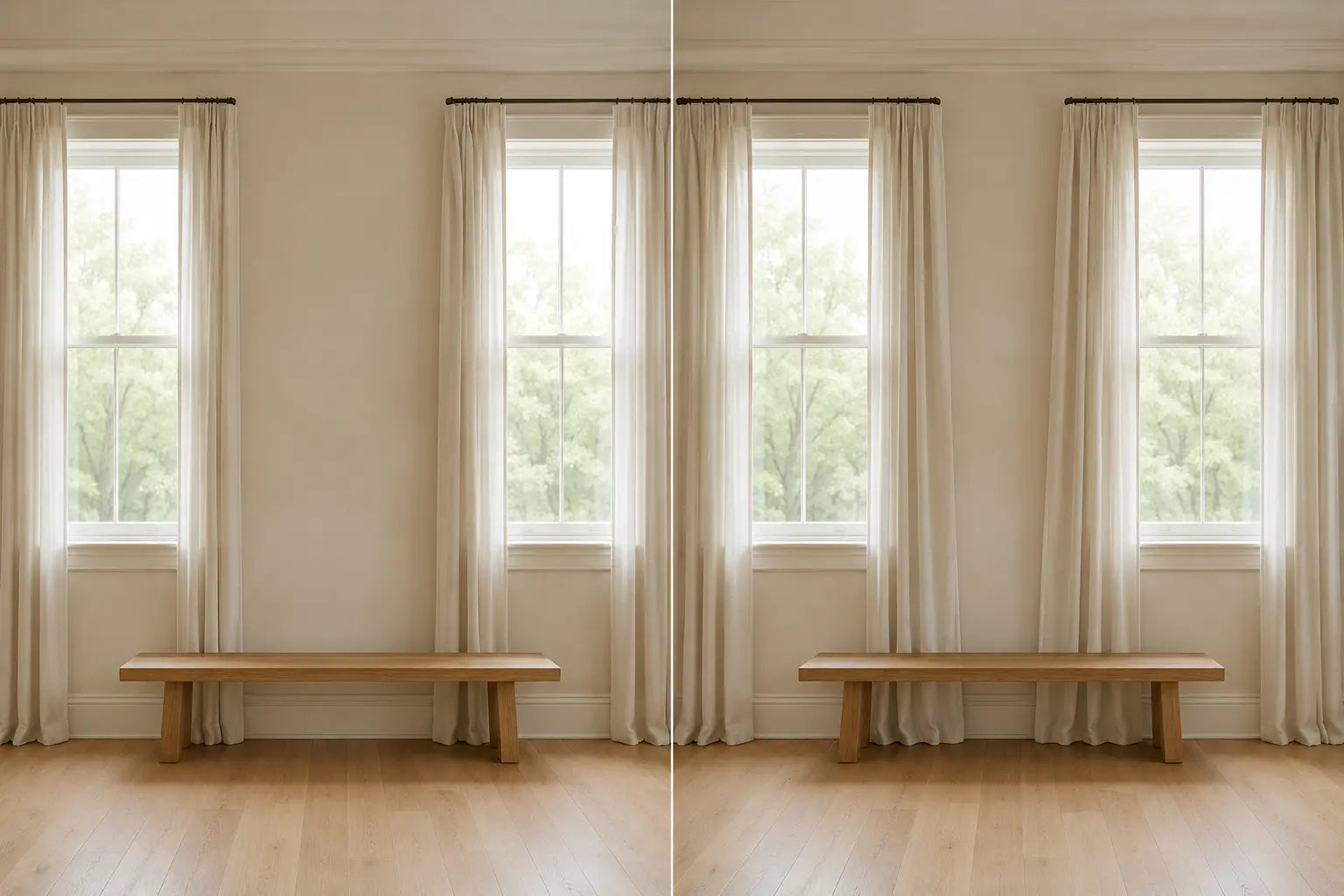
Photograph the wall straight on from the primary view, then from one meaningful approach. Record outer trim, exposed plaster, heads, sills and fixed molding. Add ordinary curtain, shade and handle states. A styled photograph with fabric pulled aside is not proof of normal clearance.
Separate what is fixed, variable and temporary. Trim is fixed. Curtains, shades and exterior brightness vary but are expected. A prop added for a photograph is temporary. Only fixed and regular-use evidence should control the boundary.
Draw the complete candidate envelope: one canvas, one framed work, a pair, or all panels plus every proposed gap. It must stay visibly independent of trim and normal treatment states. Where picture-frame molding adds another grid, use the paneled-wall art method; do not quietly combine two coordinate systems.
ALIGN — choose one registration line
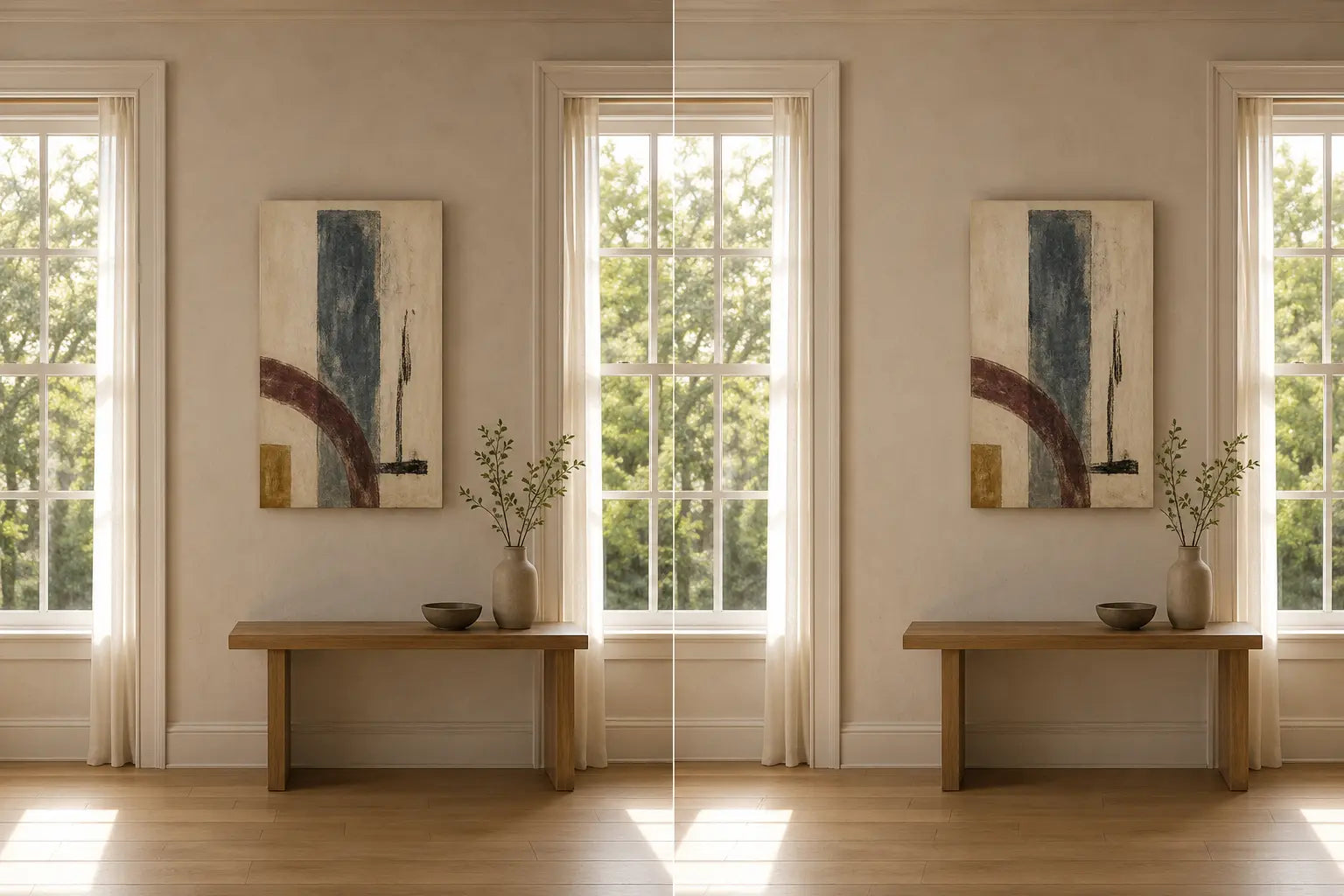
Alignment makes the artwork look placed rather than stranded. First test the center of the clear wall between inner trim edges. This is a comparison, not a rule: a molding bay, fixed console or room-zone axis may be more legible. Choose one owner.
Do not average incompatible centers. With unequal windows, the plaster, full-wall and furniture centers may differ. An unexplained midpoint aligns convincingly with nothing. A deliberate offset needs visible evidence, such as a fixed furniture zone or dominant return wall.
Test orientation and footprint separately. The vertical, horizontal and square wall art guide owns shape, while the wall art size guide helps create exact outlines. PANE asks whether the resulting envelope registers without borrowing space from trim, fabric or the view.
NAME — assign the visual hierarchy
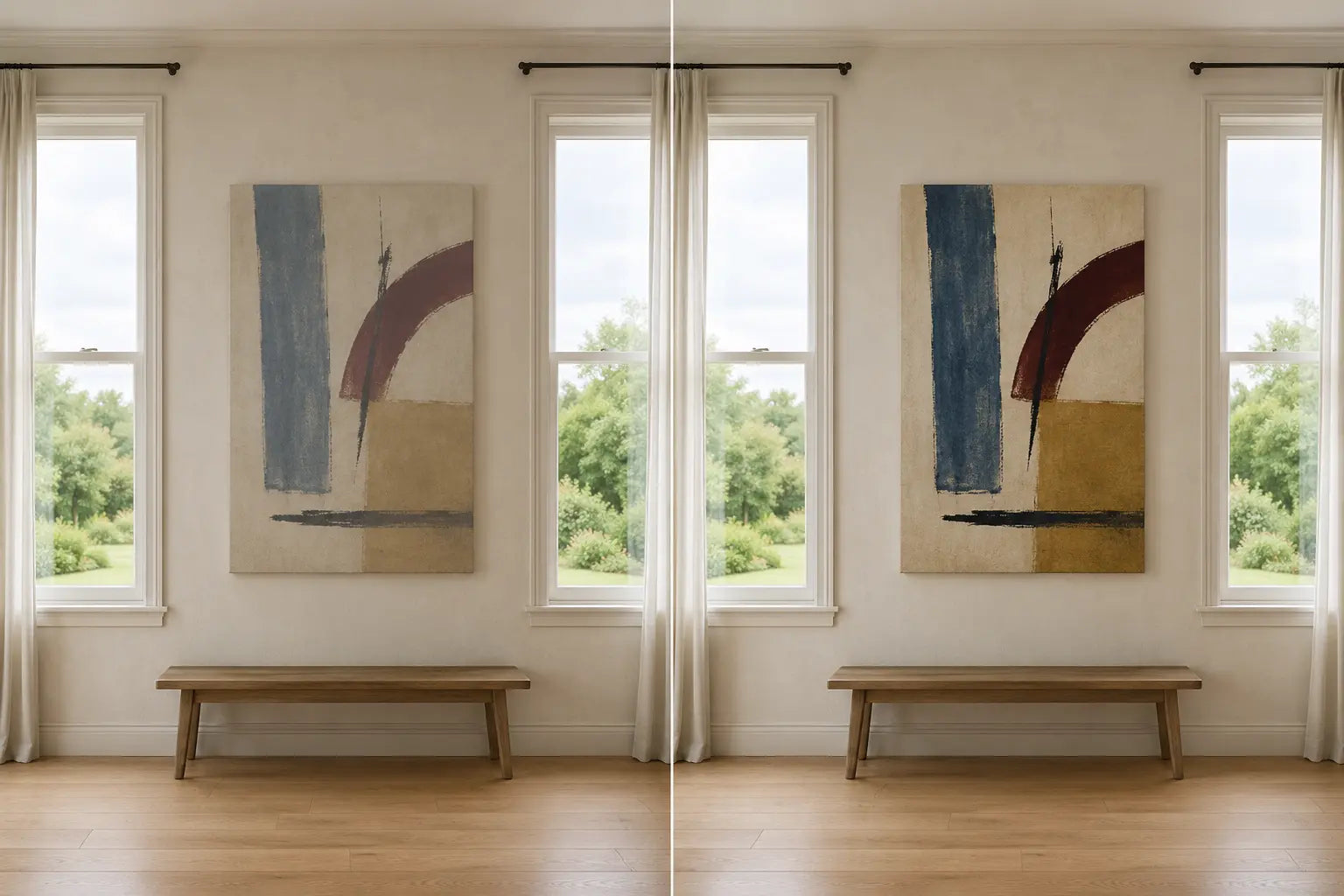
Windows and artwork will not hold equal attention all day. A bright view may lead at noon; a vivid canvas may lead after dusk. Name the hierarchy instead of asking the artwork to compete harder.
A useful sentence identifies leader, support and bridge: “The garden view leads by day, the quiet canvas holds the center, and muted green connects them.” The reverse can also work. A bridge may be a secondary hue, direction, tonal interval or open space. Exact exterior-color matching is fragile because the view changes.
Consider format only after hierarchy is clear. Canvas and framed work can differ in edge, glazing, reflection and finished footprint; the canvas versus framed print guide owns that decision. PANE asks whether the actual object can perform the named role beside bright openings.
EXAMINE — test the unchanged candidate across normal states
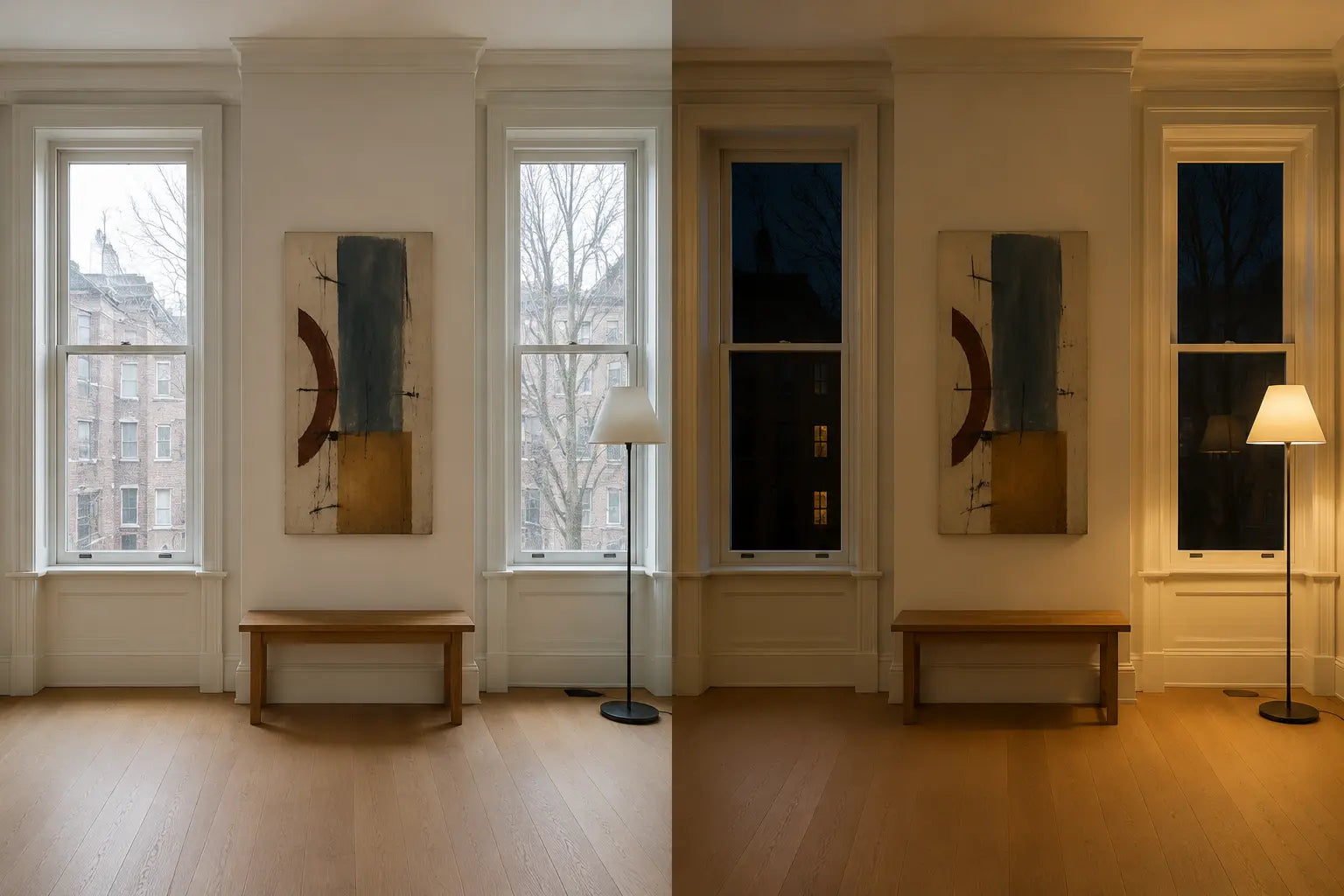
Place a full-size outline in the chosen envelope. Keep image, size, center and orientation unchanged while testing normal curtain and shade positions, daytime and evening conditions, and the route from approach to primary seat. Seek stable ownership and hierarchy, not identical appearance.
Treat direct sunlight as a preservation gate, not a dramatic effect. The Canadian Conservation Institute’s basic care guidance for paintings advises avoiding direct sunlight and favors indirect or reflected daylight. If direct sun reaches the location, reroute the work or obtain material-specific conservation advice.
Change one variable in each retest. If art feels squeezed, compare a smaller envelope without changing the image. If it disappears beside the view, compare tonal hierarchy without moving it. If it floats, compare another registration line while keeping size constant. General numerical placement belongs to the wall art height guide.
Six conditional rooms
Six real-room scenarios
Each scenario ends with a one-variable retest. That prevents a new subject, size, center, curtain arrangement and camera position from being judged at once.
Scenario 01
Two matching windows with a calm central bay
- Evidence
- The windows match, their inner trim edges are parallel, and quiet plaster remains visible when curtains rest normally. A low console belongs to the central zone; the exterior view has moderate contrast.
- Decision
- Register art to the clear-plaster center first. Compare vertical and compact square envelopes that leave each window legible. If the view leads, give art a stable middle role through broad forms and controlled contrast.
- Reject
- A wide work appears to push under trim, a token-small work cannot hold the center, or the arrangement needs curtains pulled farther aside than in daily use.
- Retest
- Keep art, center, light and objects fixed. Change only the outer footprint. View each option straight on and from the entrance.
Scenario 02
Unequal windows and an off-center furniture zone
- Evidence
- One window is wider, the clear-plaster center differs from the full-wall center, and a desk or console extends more strongly to one side. Three plausible axes appear.
- Decision
- Plot all three lines and choose the axis most legible from the primary position. If fixed furniture defines a real zone, align to it while keeping the envelope between trim. State the offset as intentional.
- Reject
- A compromise center is visibly wrong to both clear field and furniture, or the nearest trim margin becomes accidental from the entrance.
- Retest
- Hold art, footprint, height and room state constant. Move only the horizontal center between the two strongest lines and compare from the same views.
Scenario 03
Full-length curtains narrow the wall when open
- Evidence
- Fabric stacks occupy plaster beside each window, folds vary slightly, and the measurable wall is wider than the visually available wall. Closed curtains create another boundary.
- Decision
- Define the art field from the smallest normal clear interval, not bare-wall dimensions after staging fabric. Prefer an independent envelope readable in open and closed states. Let curtain color be context, not a required match.
- Reject
- Art appears tucked behind fabric, needs perfectly mirrored folds, or becomes an isolated patch when curtains close. Changing the window treatment is not a minor variable inside this test.
- Retest
- Keep candidate and camera fixed. Change only curtains between ordinary positions. If the boundary disappears, revise the envelope or choose another wall.
Scenario 04
Strong garden or city views dominate by day
- Evidence
- Both windows reveal detailed views, and exterior brightness is much stronger during the day than the interior wall. At night, the openings become quieter or reflective.
- Decision
- Name a coherent changing role: the view leads by day, while canvas anchors after dusk. Choose structure that remains legible without trying to out-detail the landscape. Use one bridge cue rather than copying seasonal color.
- Reject
- A candidate competes with both views through equal detail and contrast, vanishes during the primary use period, or depends on direct sunlight reaching its surface.
- Retest
- Keep art, envelope, shades and objects unchanged. Change only observation time between day and evening. If hierarchy becomes confused rather than reversed, test one tonal variable.
Scenario 05
The interval is seen across an open-plan route
- Evidence
- The wall belongs to a living zone but is first seen from dining or entry. From the close seat, windows frame art; from the route, one opening overlaps visually with another focal point.
- Decision
- Declare one primary view and one secondary check. Keep the art if it remains part of the intended zone along the route. Use the open-plan wall art method to decide which wider zone should lead.
- Reject
- The placement looks balanced only from a staged frontal photograph, merges with another artwork from the approach, or makes two zones demand equal attention.
- Retest
- Keep installation and room state constant. Change only viewer position along the route. If ownership fails during ordinary passage, reroute the art.
Scenario 06
The clear interval is very narrow or already active
- Evidence
- Trim, switches, a vent, pronounced molding or a strong view leaves little stable plaster. Even a compact outline nearly touches architectural edges, and the windows already provide rhythm.
- Decision
- Compare a compact single work with another wall and no purchase. Keep a narrow vertical only if it has clear margins and a meaningful role. Otherwise, let the architecture remain complete.
- Reject
- A miniature is chosen only because it fits, gaps in a multi-piece arrangement disappear at normal distance, or the proposal requires relocation of fixed controls or unsafe improvisation.
- Retest
- Keep image and room unchanged. Move only the proposed location to the strongest alternative wall. Accept a clear improvement; if neither location passes, pause.
Evidence before preference
Decision router
Use the router after PLOT. Choose the row that matches the strongest evidence and run its first comparison without changing subject, furniture styling or several room variables at once. A passed first test removes one uncertainty; it does not prove the purchase. Carry the survivor through ALIGN, NAME and EXAMINE, and record the first state in which it fails.
On narrow screens, scroll horizontally to read all table columns.
| Visible room evidence | First comparison | What it isolates | Reject or reroute when |
|---|---|---|---|
| Matching windows and stable clear plaster | Two exact footprints on the same center | Whether scale, not alignment, causes the problem | Both press into trim or neither holds the interval |
| Unequal windows or offset furniture | Same envelope on two declared axes | Which reference line owns the zone | Each position looks like an unexplained compromise |
| Curtains cover part of the wall when open | Same candidate in two normal curtain states | Whether the real clear field is stable | Fabric visually overlaps or traps the artwork |
| Exterior view leads in daylight | Same candidate by day and in ordinary evening light | Whether hierarchy can change without becoming confused | Art competes with both openings or disappears when it matters |
| Several zones share the sightline | Fixed installation from approach and primary seat | Whether the interval belongs to the intended room zone | Ownership reverses during an ordinary route |
| Narrow, interrupted or active interval | Compact work versus another wall versus no purchase | Whether the location deserves an object | Physical fit is the only argument for keeping it |
If a segmented option survives, compare its complete outside boundary with one continuous work of the same envelope. The one large canvas versus three-panel guide owns the wider format decision; PANE only tests whether added divisions remain calm beside repeated window edges.
Write before browsing
Pre-purchase brief
Write the brief before building a large shortlist. Use observations and failure conditions, not a mood-board description. Date photographs or note the time and window state so a comparison can be reconstructed.
- Primary interval: identify the two windows and exact wall field being tested.
- Fixed boundaries: record inner trim edges, heads, sills, molding and architectural limits.
- Variable boundaries: note ordinary curtain stacks, shade positions and hardware silhouettes.
- Primary view: name the approach, seat or work position where the decision matters most.
- Secondary check: choose one honest sightline the arrangement must survive.
- Registration line: complete “The artwork aligns to ___.”
- Leader: name artwork, view or another feature as first attention; assign supporting roles.
- Bridge cue: select one secondary hue, direction, tonal interval or open-space relationship.
- Candidate envelope: record complete outside width and height, including frame, every panel and every gap.
- Window and light states: list normal treatment positions, representative day/evening views, and whether direct sun reaches the location.
- Failure sentence: specify “squeezed by trim,” “dependent on staged curtains,” “competes with the view” or another visible reason.
- Fallback: revise one variable, use another wall or make no purchase.
For a pair or panel set, gaps belong inside the envelope from the beginning. Use the canvas-panel spacing guide for that separate calculation, then return to PANE. Verify actual product dimensions and presentation rather than assuming every image is available in every configuration.
Eight concise answers
Frequently asked questions
What size wall art fits between two windows?
There is no dependable universal percentage because trim, curtains and the viewing axis change the usable field. Plot the smallest normal clear interval, make exact templates for two or three envelopes and reject any option that borrows apparent space from fabric or trim. The winning size remains independent across normal room states.
Should the artwork be centered between the windows or on the wall?
Center it on the clear interval as the first comparison when the windows form the strongest bay. Use another axis only when fixed architecture or a real furniture zone visibly owns the composition. Do not average several centers; declare one registration line and test it from primary and secondary views.
Can art be wider than the plaster between the inner trim edges?
Physical width alone is not the decision. An object that visually extends into trim or curtain territory can make the interval feel compressed even without literal overlap. Test the complete envelope at full size. If boundaries remain unclear in ordinary use, choose another footprint or wall.
Is vertical art always best between windows?
No. A vertical work often echoes a narrow interval, but a square or restrained horizontal can be stronger when the clear field, furniture zone and view support it. Choose orientation independently, then test the envelope against trim and window states instead of treating shape as a preset rule.
Should wall art match the curtains or the outdoor view?
Exact matching is unnecessary and can be unstable as light, seasons or textiles change. Name a leader and use one bridge cue: a secondary hue, tonal relationship, direction or amount of open space. The artwork should still make sense when curtains close or exterior color changes.
How do I handle direct sunlight between windows?
Check the location at different times before treating it as viable. If direct sun reaches the proposed artwork, reroute it or seek material-specific conservation guidance. A shade used sometimes should not be assumed to provide permanent protection, and a sunlit photograph is not evidence of a safe display location.
Can I use two small artworks or a triptych between windows?
Yes, but judge the group as one complete envelope including every gap. Repeated divisions can echo the architecture or create excess rhythm beside two windows. Compare the segmented group with one continuous work at the same outer size so format is the only changed variable.
What if nothing looks right in the interval?
Treat that as evidence, not failure. The windows may already complete the wall, normal curtains may erase the field, or another wall may offer stronger ownership. Record why candidates fail, compare one alternative location and pause if no stable envelope remains.
The defensible result
Final decision
Keep the candidate only when four statements are true: the complete field is plotted honestly; the envelope aligns to one visible reference; artwork, view and architecture have named roles; and the unchanged proposal survives normal window, light and viewpoint states. If one statement fails, revise only the variable connected to that failure. If the interval remains unstable, preserve the windows as the finished composition.
After the PANE brief passes, browse Artesty canvas art and canvas prints and compare only options whose actual envelope, presentation and available dimensions fit the approved field.