

Wall Art With Indoor Plants: How to Balance Canvas, Leaves, and Open Wall
Real houseplants are not static decorations. A canvas can share their changing field without copying every leaf or filling every open patch—if art, foliage, furniture, and negative space keep clear roles.
Quick Answer
Choose wall art with indoor plants by testing the canvas against the plants’ real, changing outline rather than a styled photograph. First, SITE the living element in its genuinely suitable room position; then name whether the artwork belongs to a sofa, console, wall bay, or plant group and what should lead. Next, TRACE the complete outside edges of the canvas, pots, foliage, furniture, trim, and ordinary access paths. Then, EDIT one visual variable at a time—such as artwork contrast, internal direction, or quiet-area location—while the plants and room remain unchanged. Finally, MONITOR the same candidate through normal views and observed plant states before buying. Keep the canvas only when its owner stays clear, important image content remains readable, foliage does not look trapped against its edge, and some open wall still separates competing silhouettes. If growth, care access, pets, or architecture makes the field unstable, use another wall or buy nothing. STEM is a repeatable visual-selection method, not a plant-care schedule, mounting formula, or universal size and height rule.
What a Canvas-and-Plant Composition Must Actually Solve
Searches for “wall art with plants” often mix three different intentions: botanical pictures, preserved plant walls, and real houseplants arranged beside conventional art. This guide owns the third. It asks how a canvas should join living foliage already in a room. It does not claim that leafy subject matter is required, that houseplants purify a home, or that one arrangement will suit every species and exposure.
Separate the visual problem from the biological one. Plant health, care, toxicity, and support belong to qualified horticultural guidance and the specific product instructions. Mounting and wall capacity belong to applicable product and building instructions. STEM begins only after both locations are independently suitable.
A canvas may belong to a sofa while a tall plant acts as punctuation, or to a console with foliage in the foreground. It may occupy a bay between plant masses. Name the owner before judging palette; otherwise, “balance” becomes a request to fill every open patch.
Use the whole-home wall-art selection guide to decide whether this is the right wall at all. Shortlist candidate dimensions with the wall-art size guide, and handle vertical attachment planning with the wall-art hanging-height guide. STEM does not replace either specialist decision.
Do not treat a plant as a green swatch. It contributes a pot, stems, gaps, shadows, and an irregular contour; a canvas contributes a stable rectangle and internal marks. Contrast, repetition, or separation can connect them. Leaf imagery and exact green matching are optional.
The STEM Method for Wall Art With Indoor Plants
SITE — Fix the Living Element, Then Name the Owner
Begin with the plant in a location supported by its real conditions, care needs, circulation, and household constraints; never move it to an unsuitable position for symmetry. Then complete: “The artwork belongs to [owner],” and “[leader] leads; [supporter] supports.” Owner and leader may be furniture, a wall bay, the plant group, art, or one plant silhouette.
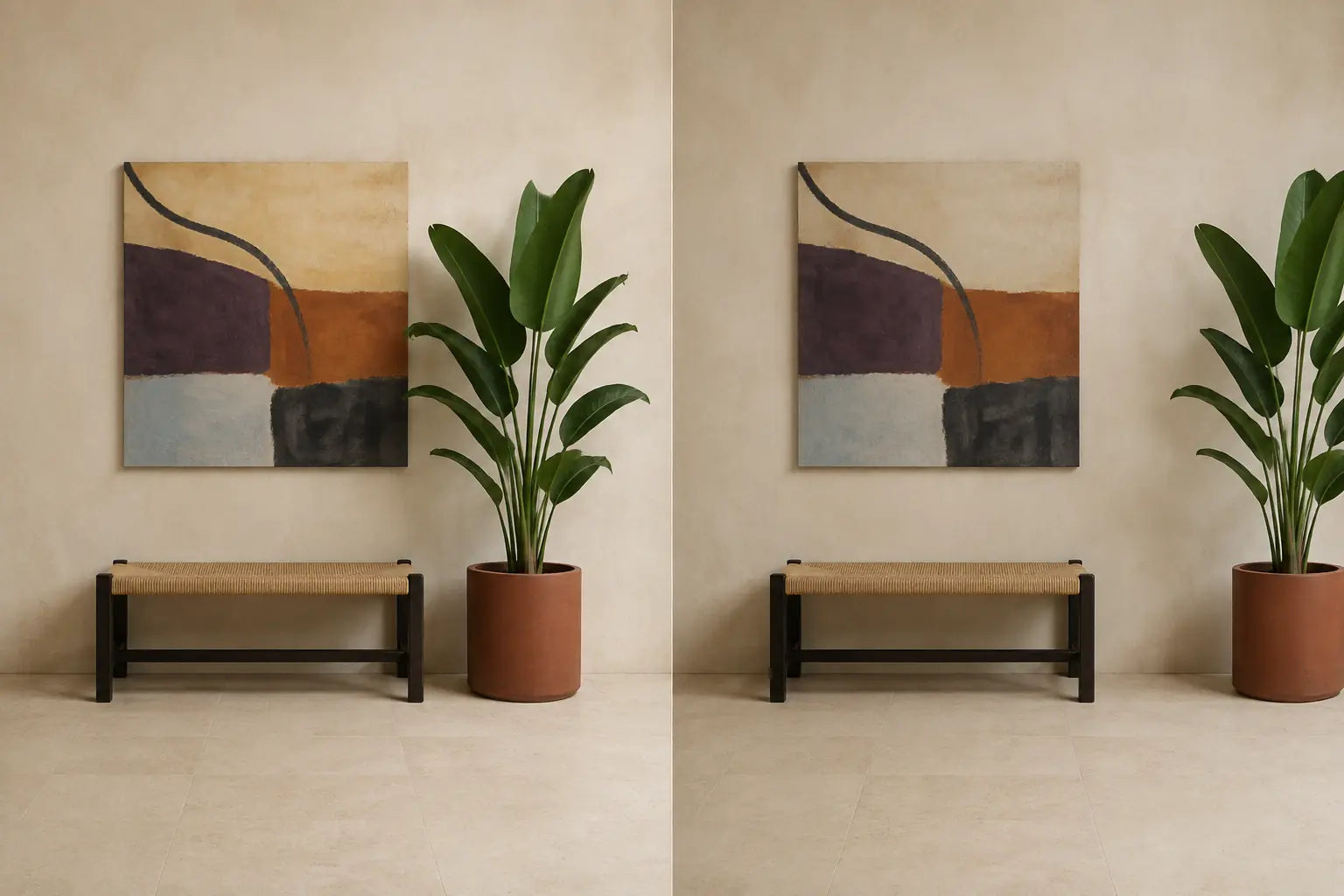
Photograph the ordinary room from its main approach and compare artwork registrations only after the plant site is fixed. The controlled study moves the plant only to reveal how strongly its position changes the shared silhouette; it does not identify a suitable site.
Pass when the plant has one viable normal site and another observer identifies the same owner and leader. Reject available-plaster logic, a plant moved for the mockup, or art centered between unrelated objects. Output one plant site, owner, hierarchy sentence, and registration line.
TRACE — Map Every Complete and Normally Changing Edge
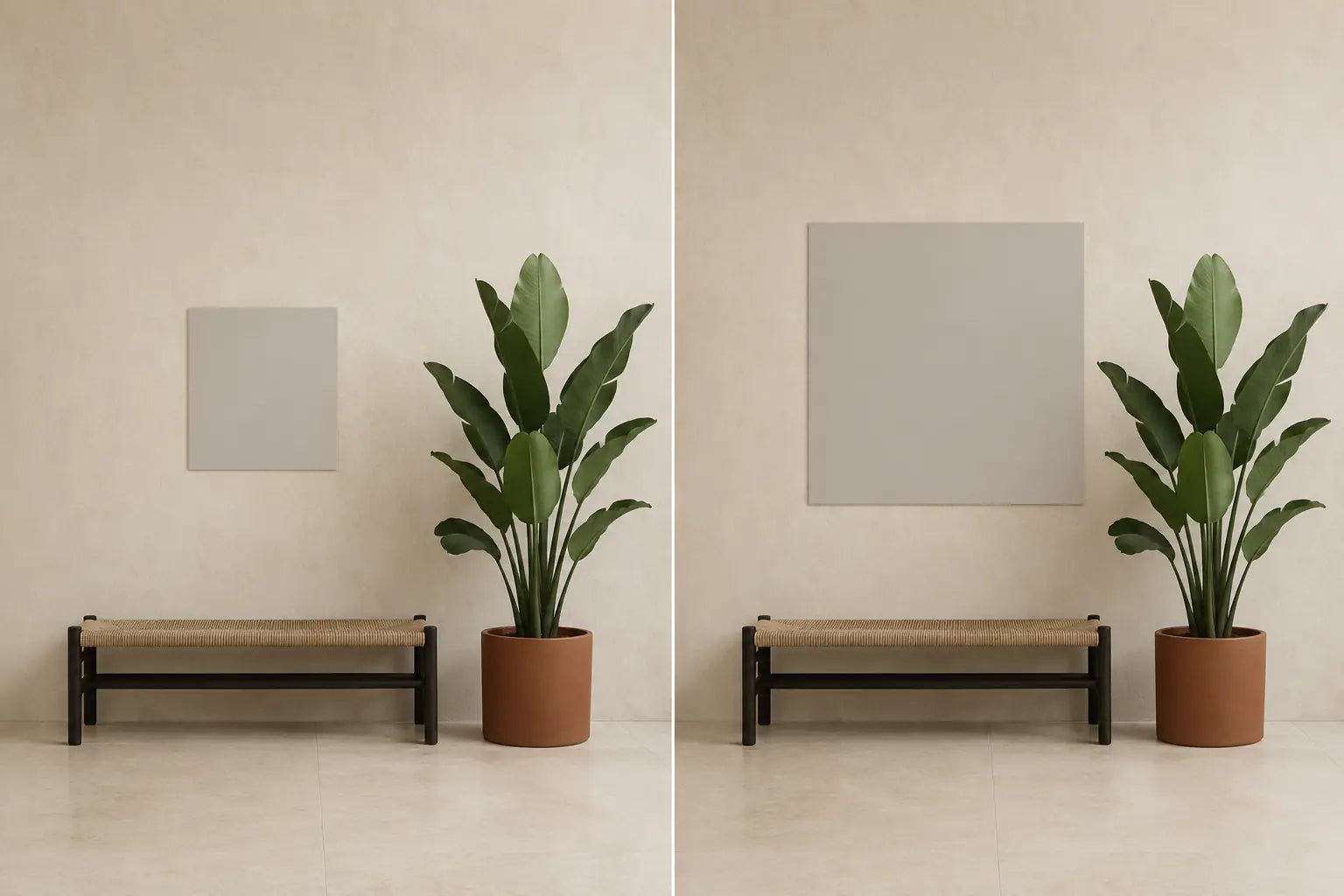
Trace the complete outside boundary of the canvas or frame; for a grouping, include every outer edge and gap. Map the plant field as it appears: pot, stand, stems, leaves, support, nearby furniture, trim, doors, curtains, and ordinary care access. Do not alter a plant merely to make a mockup pass.
Use paper templates or a digital overlay in actual candidate proportions. If the silhouette commonly changes, mark its current ordinary state and a fuller observed state. This is a decision buffer, not a growth prediction.
Look for relief, not only non-contact. Occasional visual overlap may work if important content stays clear. Pass when art and ordinary foliage remain legible; reject a sparse staged plant, hidden access, or cropped pot. Output one footprint, plant envelope, and clear-edge list.
EDIT — Change One Artwork Variable, Not the Whole Room
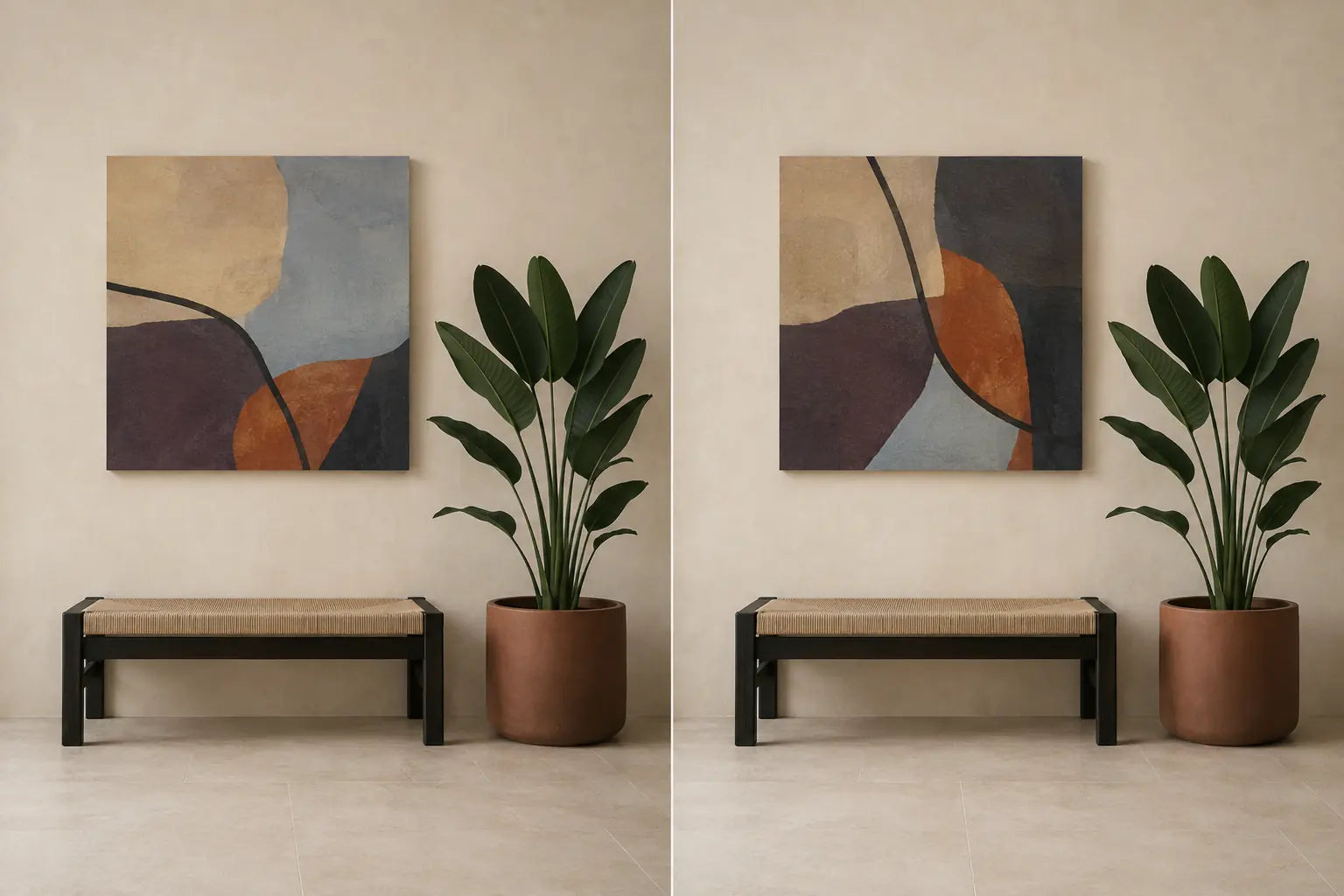
After SITE and TRACE leave a viable footprint, compare one variable: tonal range, mark density, direction, or quiet-area location. Hold dimensions, position, plants, furniture, camera, and room state. In a square footprint, two variants can isolate internal directional emphasis while the outside rectangle, palette, shape count, and contrast family remain stable.
Detailed art can echo foliage or compete with it; quieter art can create relief or disappear on approach. A secondary hue may connect the field, but exact green matching can flatten it. Compare color only under the room’s ordinary light after the footprint has passed.
Pass when you can name the leader, connecting cue, and area of relief. Reject art chosen only because it depicts leaves, a crowded palette match, or a multi-variable comparison. Output one approved image variable and hierarchy statement.
MONITOR — Keep the Candidate Fixed and Test Normal States
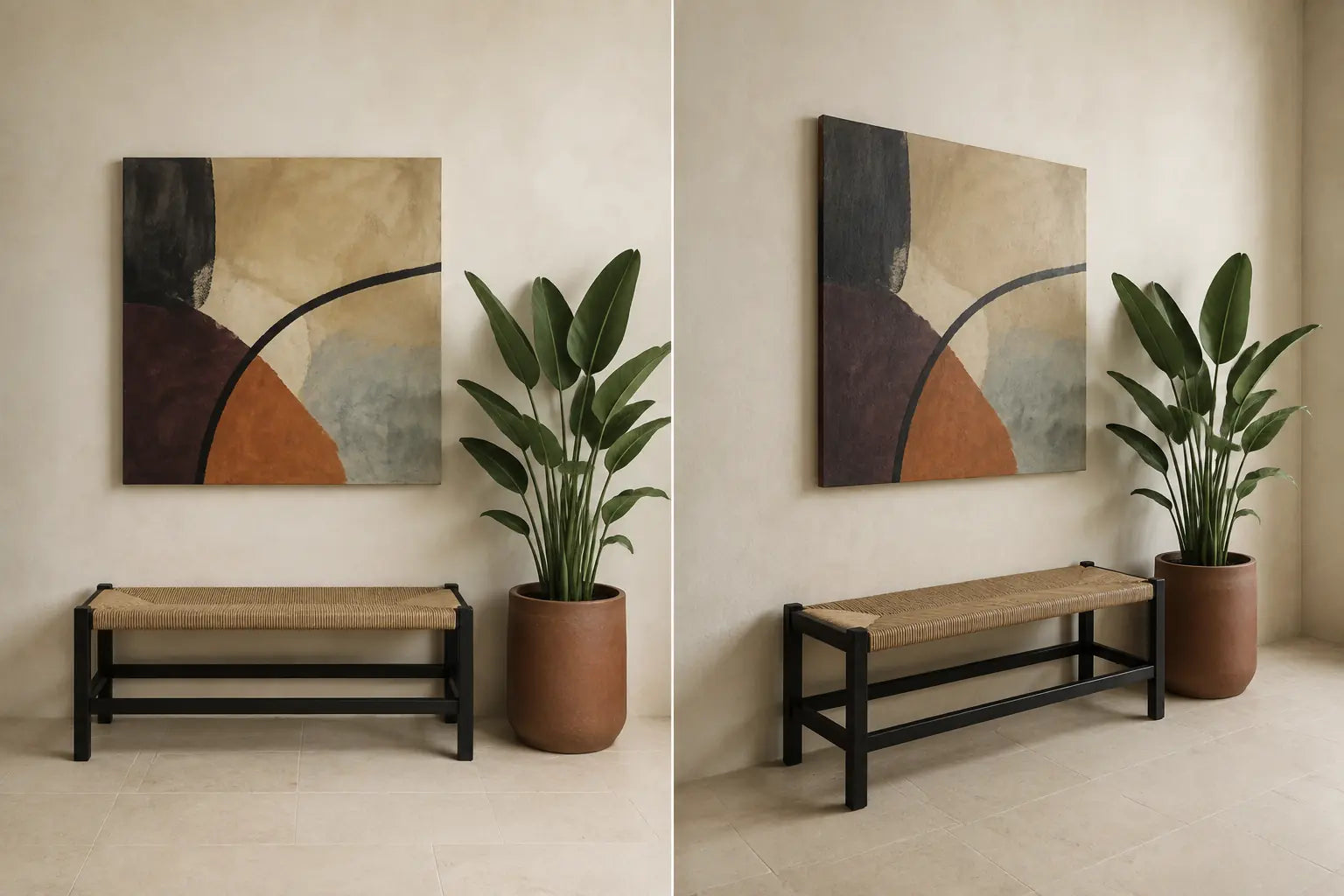
Keep canvas, position, and furniture fixed; check the entrance, main seat, and an oblique path. Observe only plant positions that already occur in normal use.
Comparison photographs expose a result that works only when a leaf, curtain, or pot is staged; they do not predict growth. Record the first failure: lost ownership, crowding, obscured content, blocked access, or equal rivalry.
Pass when the candidate keeps a clear owner, readable content, and relief through important views and observed states. Reject routine appearance-only restyling or an ignored care constraint. Output: keep, revise one art variable, use another wall, or buy nothing.
Decision Router: Start With the Strongest Visible Condition
Do not adjust everything at once. Find the strongest condition you can observe, run the first comparison below, and keep the listed variables constant. A passing row removes one uncertainty; the surviving candidate still has to complete STEM.
On narrow screens, scroll this table horizontally to compare every decision column.
| Strongest visible evidence | First controlled comparison | Hold constant | Reject or delegate when |
|---|---|---|---|
| Sofa axis and combined plant-group center disagree | Same canvas on each declared registration | Image, footprint, vertical position, plants | Neither line visibly owns the composition |
| Foliage crowds one canvas edge | One smaller footprint or revised registration | Plant state, image, furniture, viewpoint | The solution depends on moving or altering the plant for decor |
| Art and foliage have equal visual intensity | Quiet versus stronger tonal range at one footprint | Main hue families, position, plant field | Both remain rivals or the art disappears on approach |
| A trailing plant changes the lower silhouette | Same outline through observed ordinary states | Canvas, furniture, main camera | Care, support, or installation—not art selection—controls the result |
| Window and plant share the field | Same candidate in normal room views and light states | Plant and canvas positions | Glare, preservation, or plant suitability needs specialist guidance |
| One canvas and a grouping both fit | Compare complete outside boundaries | Owner, center line, room state | Arrangement mechanics become the main question |
If no row yields a stable candidate, stop. Open wall may be what lets plant, canvas, and furniture remain readable.
Six Real-Room Scenarios
A Floor Plant Beside a Sofa With Art Above the Seating
- Evidence
- The sofa supplies a strong horizontal owner while the floor plant rises at one end. From the entrance, the combined silhouette can feel visually heavier on the plant side even when the sofa itself is centered.
- Decision
- SITE the canvas to the sofa, then compare the same candidate on the combined axis. Declare whether the plant is punctuation or part of the group. Preserve wall between rival edges.
- Reject
- Reject moving the plant outward only for the photograph, centering art on the entire wall without regard to the sofa, or adding a second object solely to manufacture symmetry.
- Retest
- Keep the room fixed. Change only registration, then check the entrance, seat, and oblique approach. If ownership fails, test quieter art or another wall.
A Console With Several Plants and a Canvas Above
- Evidence
- Pots create multiple bases while foliage crosses at different heights. The styled top can change more often than the console or artwork, so a frontal image may overstate a temporary arrangement.
- Decision
- Treat the console as owner and plants as a changing foreground. Choose whether the canvas leads or forms a calm back plane. Keep important content clear of common overlap.
- Reject
- Reject evaluating only an unusually cleared console, matching every pot and artwork color, or placing the canvas by a generic gap rule. Do not turn care access into a decor variable.
- Retest
- Restore the normal load and keep the candidate fixed. Check the doorway and route past it. Change only contrast or registration if foliage masks the focal area.
A Trailing Plant Near the Edge of a Canvas
- Evidence
- A descending stem can cross the artwork’s outer rectangle or create a near-tangent at one corner. Its path may be deliberately supported, but it is not a permanent graphic line.
- Decision
- TRACE the observed trailing envelope and preserve a quiet area in the artwork where occasional overlap will not erase the subject. Alternatively, register the canvas away from the trail and let open wall separate them.
- Reject
- Reject arranging, cutting, or fastening growth for the sole purpose of passing the composition. Reject an image whose only focal feature sits behind the ordinary trail. Plant support and care choices require appropriate guidance outside STEM.
- Retest
- Keep both locations unchanged. Compare observed plant states and main views. If the relationship fails, revise the art’s quiet-area distribution or use another wall.
A Plant-Filled Window Wall With a Narrow Art Bay
- Evidence
- Window trim, curtains or shades, changing daylight, and plants create several nested boundaries. The narrow wall section may appear available in one photograph while fabric or foliage occupies it in ordinary use.
- Decision
- Establish the stable architectural bay first. Test one honest vertical or compact footprint inside the surviving wall field, and decide whether the view, plant silhouette, or canvas should lead. For a true pier between windows, use the wall-art-between-windows guide.
- Reject
- Reject a candidate measured with curtains staged once, an outline that crowds trim, or a composition that requires claims about plant exposure or artwork preservation beyond qualified instructions.
- Retest
- Keep the field fixed. Observe normal window-treatment and light states from the seat and approach. If the bay is unstable, leave it open or choose another wall.
A Dense Indoor-Jungle Corner With One Available Wall
- Evidence
- Several pots, leaf scales, stands, and heights create an irregular mass. The visible plaster may look like a hole to fill, yet it may be the only relief in an already dense corner.
- Decision
- Name one leader. If foliage leads, test quiet supporting art with a visible margin. If art leads, compare only mark density or contrast; do not edit the plants.
- Reject
- Reject filling every gap, assuming a botanical subject will automatically harmonize, or choosing art from a close-up photograph that removes the room’s broader density.
- Retest
- Keep the ordinary plant load. Compare the same canvas from approach and seat, then change one art variable. If neither can lead, keep the negative space.
A Bedroom Plant-and-Art Group With Pets or Children
- Evidence
- A floor pot, stand, cord, reachable leaves, furniture, and artwork may share a compact path. Visual balance is secondary when product instructions, toxicity, stability, or mounting conditions are unresolved.
- Decision
- Pause STEM and confirm the field through qualified sources and current instructions. Once independently approved, treat the bed or dresser as owner and keep the canvas optional.
- Reject
- Reject any composition that depends on an unstable stand, reachable hazardous material, improvised furniture anchoring, unverified plant safety, or moving a safety-critical item for appearance.
- Retest
- Resume only after the non-decor gates are resolved. Keep the safe field unchanged and compare one canvas footprint or image variable at a time. If no stable wall remains, another wall or no purchase is the correct outcome.
Your Pre-Purchase Canvas-and-Plant Brief
Write this brief from photographs of the room in ordinary use, not from an isolated mood board. It should let another person repeat the comparison and identify why a candidate passed or failed.
- Owner: complete “The artwork belongs to ___.”
- Leader and support: name the canvas, plant, furniture, or architecture that leads, then name the supporter.
- Primary views: entrance, main seat, doorway, corridor, or another route that matters.
- Stable edges: sofa, console, bed, trim, window, doorway, built-in, and canvas boundary.
- Observed changing edges: the plant silhouettes and positions that genuinely occur in normal use.
- Plant-care boundary: record the qualified guidance and product instructions that determine location or access; do not rewrite them as styling rules.
- Complete art footprint: outside width and height, including any frame, panels, and gaps.
- Registration line: furniture axis, architectural bay, or another declared owner line.
- Artwork variable: contrast, mark density, directional movement, or quiet-area location—only one per comparison.
- Open-wall role: state where negative space separates silhouettes and whether it must remain.
- First failure: the exact view or observed state where ownership, readability, relief, access, or safety fails.
- Decision: keep, revise one art variable, use another wall, or buy nothing.
Verify the current product page for the exact format, outside dimensions, and presentation you shortlist; a displayed image may not be offered in every configuration. If the approved field could hold either one continuous work or several pieces, route arrangement mechanics to the one-large-canvas-versus-three-panel guide or the gallery-wall planning guide. Do not invent panel spacing inside STEM.
When the brief passes, explore Artesty canvas prints and shortlist only current formats whose full outside boundaries fit the approved field.
Frequently Asked Questions
1. Does wall art beside houseplants need to be botanical?
No. Botanical imagery can create intentional repetition, but abstraction, landscape, portraiture, geometric work, and many other subjects can coexist with plants. Test the complete object, hierarchy, and mark density instead of treating subject as a shortcut.
2. Should the artwork match the green leaves?
Exact matching is unnecessary. A shared secondary hue can connect the group, while contrast can preserve separation. Hold footprint and plant field constant, then compare one color or tonal variable under the room’s real light.
3. How much space should remain between a plant and a canvas?
There is no universal gap. Trace the actual canvas boundary and observed foliage envelope. Seek enough visible relief for both silhouettes and normal access, then follow all relevant care, mounting, and product instructions independently.
4. Can leaves overlap the artwork in the view?
Visual overlap can work when it is occasional, intended, and does not erase important content or create an operational problem. Do not force or alter a plant to produce the effect. MONITOR the unchanged candidate in normal states.
5. Is one large canvas better than several small pieces near plants?
Neither wins automatically. Compare each option’s complete outside boundary, including every gap, while holding owner and room state constant. Dense foliage may benefit from one clear rectangle, but the local test decides.
6. What size and height should I use above a plant-filled console?
First SITE the canvas to the console and TRACE the ordinary foreground. Then use the dedicated size and hanging-height guides for those calculations. Return to STEM to verify the result from important views.
7. What if the plant grows into the planned artwork field?
Do not use this article to predict growth or prescribe pruning, training, or relocation. Follow qualified guidance for that plant. If your observed changing envelope makes the canvas field unstable, revise the artwork footprint, choose another wall, or stop.
8. What changes when pets or children use the room?
Safety and product instructions become gates before visual selection. Confirm plant toxicity, furniture stability, access, containers, and mounting through appropriate current sources. Resume STEM only with the approved field unchanged.
Sources, Qualification, and Final Decision
The Royal Horticultural Society’s guidance for choosing houseplants supports siting a plant for its real conditions before treating it as a composition anchor; it is not reproduced here as a care schedule. The ASPCA’s searchable toxic-and-nontoxic plant resource supports the narrow reminder to verify specific plants around companion animals; it does not approve a room layout. For potential human exposure, America’s Poison Centers advises identifying the plant and contacting poison specialists rather than relying on appearance; use its plant-poisoning guidance for that safety boundary, not as decor advice. Follow current local guidance and professional advice where applicable.
For paintings and their supports, Smithsonian Museum Conservation Institute care guidance supports keeping a decorative canvas outside routine watering, dripping, wet-leaf and splash paths without inventing a universal distance. For artworks and other light-sensitive collection materials, the Library of Congress care guidance on light explains that light damage is cumulative and that sunlight is difficult to control. This conservative preservation context supports checking ordinary exposure and following the maker’s current care information. It does not predict the lifespan of every canvas or prescribe a residential light level.
STEM is an original editorial decision aid. Its generated comparisons are illustrative, not measured experiments, product photographs, horticultural evidence, plant-growth predictions, mounting instructions, or evidence that a pictured work is currently available. Plant suitability and care vary; confirm them independently. Artwork availability, format, construction, and outside dimensions must be verified on the current product page.
Keep the canvas only when it has a stable owner, its complete footprint has relief from observed plant edges, the hierarchy is intentional, and the unchanged candidate survives normal views and states. If any safety, care, access, or mounting condition remains unresolved, pause. If the composition still depends on staging after those gates are cleared, revise one named artwork variable, choose another wall, or buy nothing.