

Wall Art Above a Piano: Scale, Clearance, and Everyday Use
Quick answer
Fixed instrument
Choose wall art above a piano by treating the instrument as a working, changing anchor—not as a console table that always looks the same. First, CLEAR the visual field: separate the fixed cabinet from removable objects, the bench, loose music and anything staged only for a photograph. Next, LEAD: decide whether the piano or the artwork should claim first attention, then connect them through one deliberate cue rather than matching every color or using a compulsory music theme. Build the complete ENVELOPE of the proposed canvas, pair or panel set and compare that outline with the piano cabinet and any stronger architectural bay. Finally, FUNCTION-CHECK the unchanged candidate with the music rest, score and regular lamp in their normal states, from the room entrance and the position where the piano is used. Keep the artwork only if it remains connected, readable and calm in everyday use. If the piano is angled away from a wall, the wall is broken by openings, or every viable outline fails, choose another wall—or buy nothing yet.
A changing anchor
Why a piano wall needs its own decision method
An upright piano can look like broad furniture when closed, yet its visible outline changes as soon as someone uses it. A music rest may rise into the wall field. An open score adds a pale rectangle and repeated lines. A lamp can create an asymmetrical vertical. Family photographs or small objects may appear and disappear. The bench moves, while the cabinet does not. A wall-art decision made from one carefully cleared photograph can therefore fail on an ordinary practice day.
This article has one narrow job: selecting art for an upright or cabinet-style digital piano positioned against a wall. It does not replace the whole-home wall-art selection method, calculate a universal artwork size, prescribe an installation height, or decide how a piano should be placed. Here, the useful evidence is the relationship between a fixed instrument, its changing working silhouette and the wall visible around both.
The piano is not automatically the correct center. Windows, a doorway, an alcove or built-ins may control the zone; a compact digital piano may occupy only part of a wide wall. Ask which visible boundary owns the artwork when the room is in use—not what usually goes above a piano.
CLEF produces a cleared field, a named leader, an exact outer envelope and a functional result. That record shows why a candidate belongs—or why another wall is stronger.
CLEAR / LEAD / ENVELOPE / FUNCTION-CHECK
CLEF: four stages for choosing wall art above a piano
01 / CLEAR
CLEAR — separate the fixed field from temporary objects
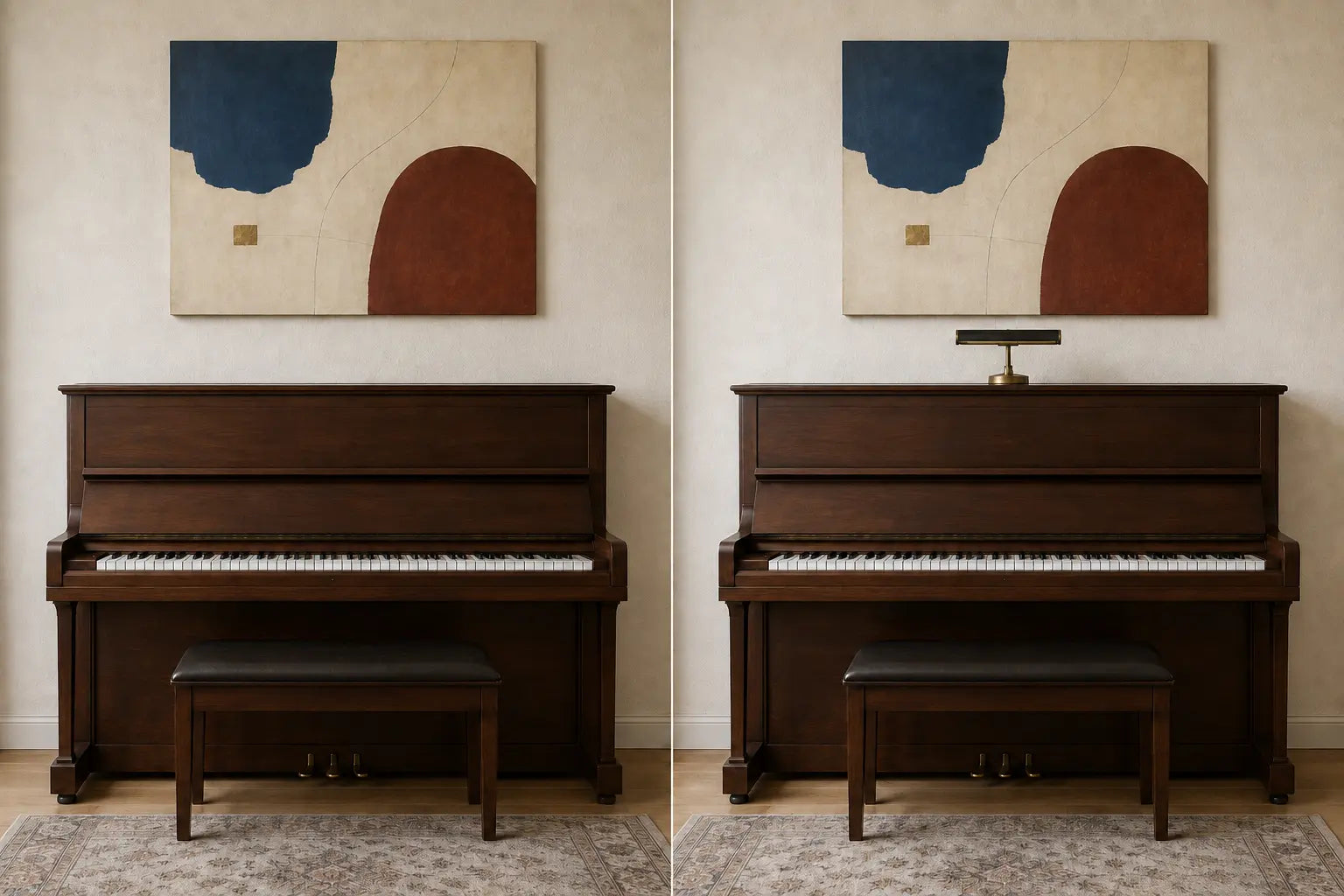
Begin with two honest views. The first shows the fixed cabinet and always-visible components. The second shows the normal playing state: music rest, current score, regular lamp and persistent items. Do not clear everything for an idealized shopping photograph, but do not let mail, a temporary vase or a movable bench become a permanent reference.
Mark three categories: fixed, regular-use and temporary. Fixed elements define the stable lower anchor. Regular-use elements define a second silhouette that the artwork must survive. Temporary objects should neither dictate the artwork nor hide a weak relationship. If there is no stable clear field after sorting, pause the purchase.
CLEAR output: one sentence naming the fixed anchor, plus two photographs from the same primary viewpoint. The two images should differ only in the piano's normal state.
02 / LEAD
LEAD — decide which element should claim attention first
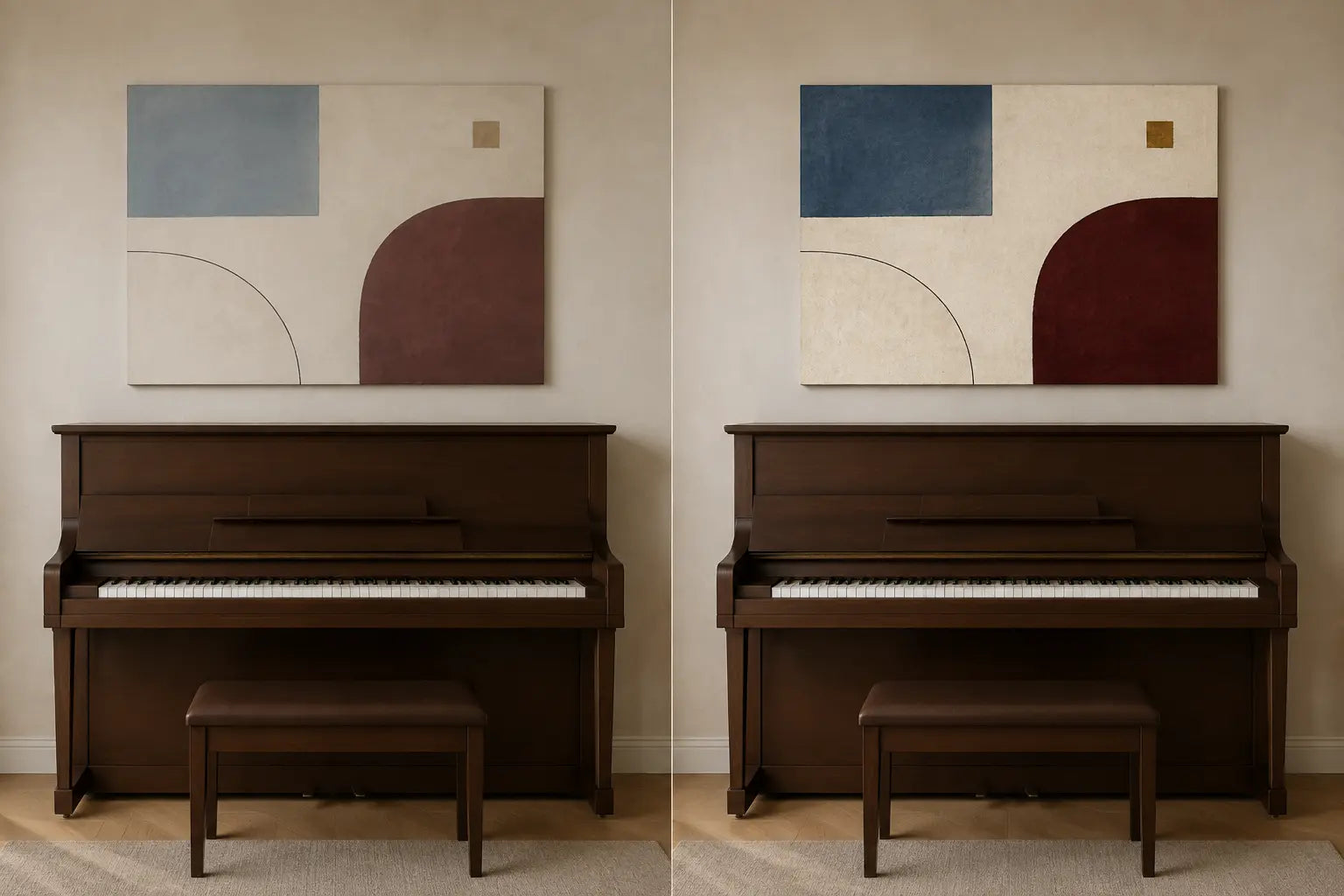
A piano and an artwork can both be prominent, but they should not accidentally compete through the same contrast, density and scale. Name the intended leader before choosing a subject. “The dark upright leads; the artwork provides a lighter, quieter field” is a usable brief. So is “The artwork leads through color; the wood piano remains the warm base.” “They should both stand out” is not specific enough.
Connect leader and support through one cue: a secondary hue, a light-dark relationship, wood warmth, a directional line or open space. A black piano does not require black-and-white art. A walnut piano does not require a brown composition. Music imagery is optional, not evidence of fit. For the broader subject and density decision, use the abstract wall art for living rooms guide.
LEAD output: one hierarchy sentence and one bridge cue. Reject a candidate that needs new accessories to explain its connection.
03 / ENVELOPE
ENVELOPE — compare the complete outside footprint
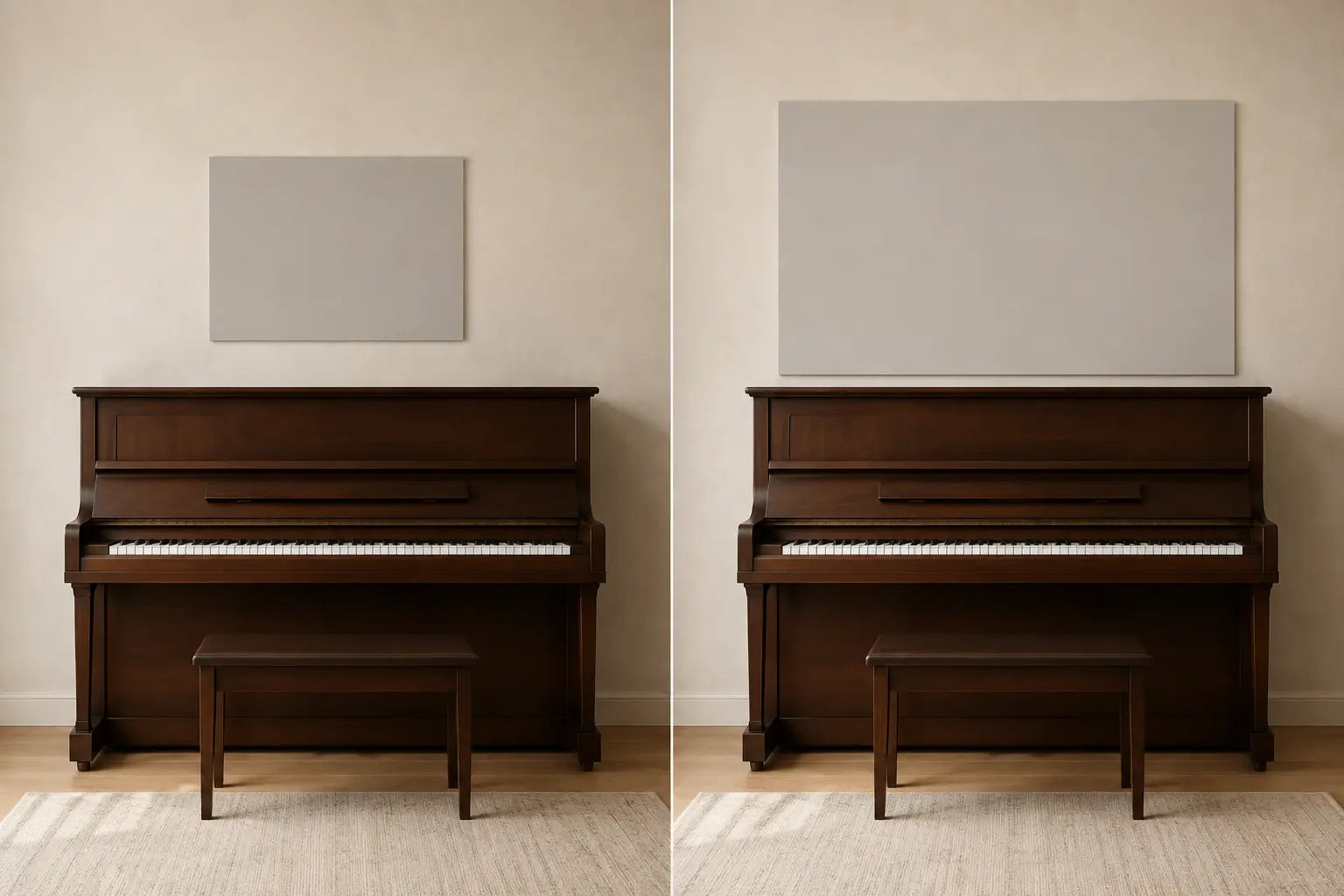
Define the envelope as the full canvas, complete pair, or every panel plus every planned gap. Compare that outside outline with the fixed cabinet and any stronger architectural boundary: window trim, an alcove, a return wall or built-in storage.
Do not choose a percentage merely because the piano resembles a console. Use the Artesty wall art size guide to generate exact outlines, then judge them here in both piano states. Keep size separate from shape. The vertical, horizontal and square wall-art framework owns orientation; CLEF asks whether the selected shape still belongs to this instrument wall.
Centering on the cabinet is a useful first comparison when the piano owns the zone, but it is not mandatory. An offset can work when architecture supplies a visible reason. A compromise between piano center and wall center usually connects to neither.
ENVELOPE output: two or three exact outer outlines, each labeled with its carrier and failure condition.
04 / FUNCTION-CHECK
FUNCTION-CHECK — test the unchanged candidate in everyday use
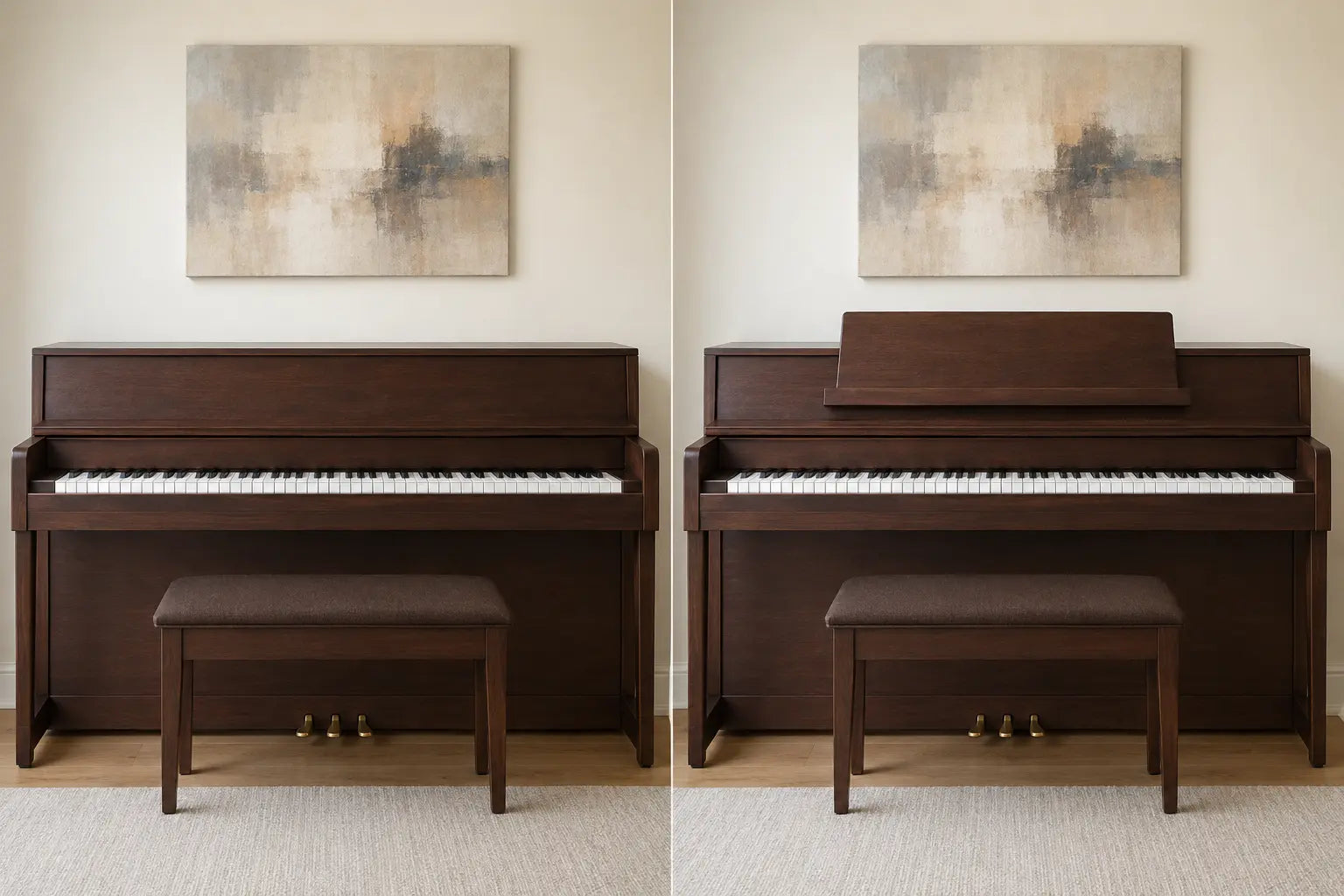
Restore the music rest, score and regular lamp. View the same outline from the entrance, normal playing position and one meaningful secondary sightline, by day and under ordinary evening light. Its role should remain legible as the foreground changes.
Change only one variable per retest. If the art feels detached, compare a different footprint without changing the image. If piano and artwork compete, compare a different tonal hierarchy without moving the outline. If the lower image feels compressed by the score, compare a composition with more open lower space before changing height. General placement belongs to the wall-art height and spacing guide, not an improvised piano rule.
FUNCTION-CHECK output: keep, revise one variable, reject, or use another wall. “Buy nothing yet” is complete when no stable envelope exists.
Evidence before preference
Decision router: choose the first comparison
Use this router after CLEAR to identify the first controlled comparison and its rejection evidence.
On narrow screens, scroll horizontally to read all table columns.
| Room evidence | First comparison | Why it is informative | Reject or reroute when |
|---|---|---|---|
| Dark upright, pale wall, quiet top | One lighter-ground canvas against one more tonally compressed option | It reveals whether the piano or art should lead without changing footprint | Both become equally dense horizontal bands |
| Warm wood upright with warm floor or furniture | One shared secondary warm cue against one controlled cool counterpoint | It tests connection without copying the cabinet palette | Artwork merges into the piano and wall |
| Music rest, score or lamp enters the wall field | The same candidate in closed and normal playing states | It exposes a layout designed only for an idle photograph | Important image weight becomes cramped or obscured |
| Compact cabinet digital piano on a wide wall | A contained square against a moderate horizontal envelope | It distinguishes the instrument zone from the entire wall | Art dwarfs the setup or aligns with the movable bench |
| Piano between windows or inside an alcove | One contained work against the different-wall option | It tests whether architecture owns the artwork | Trim, curtains or uneven margins squeeze the outline |
| Shelves, records or instruments add small forms | One canvas against a segmented display of equal outer size | It isolates format complexity from scale | Divisions repeat the room's existing visual noise |
| Grand or angled instrument with no stable wall above | Independent wall envelope against no purchase | It prevents the lid from becoming a false width reference | Connection exists from only one staged angle |
If a pair or multi-panel composition wins, calculate its complete boundary before judging it. The one canvas versus three-panel decision guide owns the broader format trade-off; this router checks whether that format survives the piano's working states.
Six conditional rooms
Six real-room scenarios
Each scenario ends with a one-variable retest. That discipline prevents a new image, size, center and newly styled piano from being compared all at once.
Scenario 1 — glossy black upright on a pale wall
- Evidence
- The cabinet forms a strong dark base. The wall is comparatively quiet, the piano top usually remains clear, and the room entrance provides the main view.
- Decision
- Let the piano anchor the lower field and compare art with a lighter ground, broad forms and one restrained dark connection. Register the envelope to the fixed cabinet first. The artwork may lead through color, but it should not duplicate the piano's dense horizontal weight.
- Reject
- A dark canvas becomes a second heavy band, or a literal keyboard motif repeats the instrument without adding a distinct visual role.
- Retest
- Keep image geometry, footprint, furniture, viewpoint and light constant. Change only tonal contrast. Check which version preserves a clear leader by day and in ordinary evening use.
Scenario 2 — walnut upright with a lamp and framed object
- Evidence
- The cabinet, floor and nearby furniture share warm cues. A regular lamp makes the top asymmetrical, while a framed object is sometimes removed. The music rest changes the center during use.
- Decision
- Treat the lamp as regular-use evidence and the removable frame as temporary. Compare art repeating a small clay, cream or ochre cue with art introducing a controlled blue or green counterpoint. Center the envelope on the cabinet, not the objects.
- Reject
- A brown-heavy composition loses separation from the wood, or a symmetrical arrangement works only after the lamp is removed.
- Retest
- Keep every room element and the artwork composition fixed. Change only the bridge hue, then photograph both candidates with the piano closed and ready for use.
Scenario 3 — compact digital piano on a much wider wall
- Evidence
- The cabinet-style keyboard and fixed stand occupy one part of a broad wall. The bench moves, and empty plaster extends beyond the functional music zone.
- Decision
- Define the carrier from the fixed instrument setup and genuinely permanent speakers or storage. Compare a substantial square with a restrained horizontal work inside that zone. Do not scale a panorama to the full wall because blank space exists.
- Reject
- The art makes the keyboard look incidental, or its center follows the bench rather than the stable setup. Also reject a token canvas unable to establish an independent node.
- Retest
- Keep the artwork image and center unchanged. Alter only the outer footprint with exact templates, then compare the doorway and playing-position views.
Scenario 4 — upright piano between two windows
- Evidence
- Window trim, curtains and side daylight create an architectural bay. The piano may be slightly offset, and the open wall changes when curtains move.
- Decision
- Treat piano and architecture as joint evidence. Test one contained artwork that remains inside the bay, then compare it with the alternative of another wall. A centered canvas works only if its center belongs to the bay as normally seen.
- Reject
- Canvas edges press visually into trim, curtains must stay unnaturally staged, or the art appears balanced only in one daylight condition.
- Retest
- Keep artwork, piano, camera and room light unchanged. Move only the curtains between their normal positions. If the envelope loses ownership, reroute the artwork.
Scenario 5 — busy music room with shelves and instruments
- Evidence
- Records, book spines, equipment, instrument silhouettes and shelf divisions already create many small repeated forms. The wall is informative before new artwork arrives.
- Decision
- Give the piano zone one continuous canvas with broad structure and a declared support role. If a group remains under consideration, hold its outside dimensions equal to the canvas so format complexity is the only changed variable. The measured gallery-wall planning guide should own later group construction.
- Reject
- Numerous small images, panel breaks or literal musical symbols add another layer at the room's existing visual tempo.
- Retest
- Keep palette, total envelope and center constant. Compare only uninterrupted versus segmented presentation from the entrance and the listener's usual position.
Scenario 6 — grand piano or angled instrument without a literal wall above
- Evidence
- The piano projects into the room, its lid or curve changes direction across views, and no stable wall section belongs to it from both primary and secondary sightlines.
- Decision
- Treat the visible wall as an independent architectural carrier, or attach the artwork to another real anchor such as a separate seating or storage zone. The piano may remain in sight without determining artwork width. Another wall and no purchase are valid.
- Reject
- The artwork relates to the piano only from one staged angle, floats from ordinary views, or needs the instrument photographed in an unusual state.
- Retest
- Keep the template unchanged and move only its proposed wall location. Compare the primary and one secondary view; reject a location whose ownership reverses between them.
The decision record
Build the pre-purchase brief
Write the brief before opening a large shortlist. It should describe evidence and failure, not merely taste.
- Instrument type: upright or cabinet digital piano against a wall. For a grand or angled instrument, name the independent wall carrier.
- Fixed anchor: the stable cabinet and components that remain part of the setup.
- Regular-use silhouette: music rest, open score, piano lamp and persistent objects.
- Temporary elements: bench position, mail, seasonal items and objects removed during use.
- Primary view: the entrance, seating position or location from which the relationship matters most.
- Secondary view: one meaningful check, not every angle averaged together.
- Leader sentence: which element claims attention first and what role the other plays.
- Bridge cue: one hue, tonal relationship, material temperature, direction or amount of open space.
- Candidate envelope: exact outside dimensions of the complete proposed display, including every piece and gap.
- Architecture: windows, trim, alcove edges, shelves or return walls that may overrule the cabinet center.
- Everyday states: closed and normal-use piano; ordinary daytime and evening conditions.
- Failure sentence: the reason to reject—detached, crowded, merged, falsely centered or dependent on staging.
- Fallback: revise one variable, choose another wall, or make no purchase.
For a multi-panel finalist, record open spaces as part of the envelope; the canvas-panel spacing guide owns that calculation. Verify product-specific details separately. The brief does not promise that every image, shape or size exists in every configuration.
Eight final checks
Frequently asked questions
What size wall art should go above a piano?
Start with the fixed cabinet or defined architectural bay, then compare exact outside outlines. Do not select a universal piano percentage. A canvas, pair and panel set with the same listed image width can create different complete envelopes, so judge the actual proposed display.
How high should wall art hang above an upright piano?
Choose the footprint and identify the highest normal-use silhouette first. Then route numerical placement to the dedicated height guide linked above. A gap that looks generous over a cleared cabinet may behave differently when the music rest, score and regular lamp return.
Should the artwork be centered on the piano or on the wall?
Center on the fixed cabinet first when the piano clearly owns the zone. Center on an architectural bay when windows, trim, an alcove or built-ins create the stronger boundary. Avoid an unexplained midpoint between two centers.
Is one large canvas better than a group above a piano?
Neither is automatically better. A single work often remains clearer when shelves, music and equipment provide many divisions. A group can work when its full outer boundary reads as one object and passes idle and normal-use checks without staged emptiness.
Does artwork above a piano need a music subject?
No. Subject is a personal choice, not a structural connection. Abstract forms, landscapes, portraits or other imagery can belong through a controlled hue, contrast relationship, directional cue or level of detail. Literal music imagery should earn its place like any other subject.
What colors work above a black piano?
There is no preset palette. First decide whether the dark cabinet leads or supports. Compare one tonal relationship at a time under ordinary room light. A lighter artwork can separate from black; a darker one can also work when another cue preserves hierarchy.
Can CLEF be used with a digital piano?
Yes, when the instrument has a stable cabinet-style setup against a wall. Include fixed stands, speakers or storage that remain visibly part of the zone. Exclude the movable bench and temporary accessories unless architecture gives them a persistent boundary.
Can wall art hang above a grand piano?
Sometimes a wall remains visible beyond a grand, but the piano rarely provides a stable wall-width reference. Define the artwork from that wall's architecture or another fixed anchor. If the relationship works from only one camera angle, another wall—or no purchase—is stronger.
Choose only after the room passes
The decision should form one short chain: the field is clear, the leader is named, the complete envelope belongs to a real carrier, and the unchanged candidate survives everyday use. If one link fails, revise only that variable. The piano wall may already be complete.
After the CLEF brief passes in both room states, browse Artesty canvas art and canvas prints and compare only designs whose exact options fit the approved envelope.