

Wall Art and Mirrors: How to Balance Reflection, Scale, and Sightlines
Quick answer
Plan wall art and mirrors as two image fields, not two frames. The canvas has stable content; the mirror changes with viewpoint, doors, daylight, lamps and everyday room activity. Before choosing size or finish, stand at the entrance, primary seat and main walking route, then record what the mirror actually returns. Count a reflected canvas as a second visual event rather than free decoration.
Use ECHO — Examine / Choose / Hold / Observe. Examine the reflected scene; choose whether art, mirror or a deliberate pair leads each important view; hold the complete outer boundaries while testing one spacing or contrast variable; then observe the same shortlist in motion and under normal day and evening light. Keep the pairing only when its hierarchy survives the views that matter. Do not let matching frames replace a tested reflected view. Separate walls, a quieter canvas, a relocated mirror, more empty wall—or no purchase—may be the stronger result.
the return
the leader
the boundary
in motion
Why a mirror is a second image field
A canvas remains visually stable as you cross a room. Its angle changes, but its image does not become a doorway, lamp or screen. A flat mirror returns part of the room according to the relationship among mirror, viewer and scene. Move to another seat, open a door or switch on a lamp, and its content changes without moving on the wall.
That difference makes the usual question—“Do these frames match?”—too narrow. The larger decision is whether the direct canvas and changing reflection cooperate. A mirror can repeat the artwork until one focal point becomes two, or support it with a quieter return. The result depends on the actual room, not a styling rule.
Start with the whole room before narrowing to a wall. The general guide to choosing wall art for the whole home can resolve subject and room role. This guide owns the more specific relationship among direct art, reflected content, hierarchy and movement.
Same wall
Art and mirror share one physical field. Compare their combined outside footprint, the wall between them and which object leads.
Adjacent walls
The objects may never reflect one another, yet they can compete from an entrance or seat where both walls are visible.
Across the room
The mirror may reproduce the canvas. Count the direct and reflected appearances when judging density and focal emphasis.
Make a four-view evidence set. Photograph the proposed wall from the entrance, primary seat, standing use point and main route, plus the opposite room. Note windows, lamps, screens, doors and normal clutter. A front styling shot cannot reveal every reflected consequence.
ECHO: Examine / Choose / Hold / Observe
ECHO is an original editorial decision device, not an optics, installation or conservation standard. Each pass produces one decision. Keep the candidate objects and marked view stable, change one declared variable, and record both a pass and a rejection so the next comparison remains fair.
Examine the reflected return
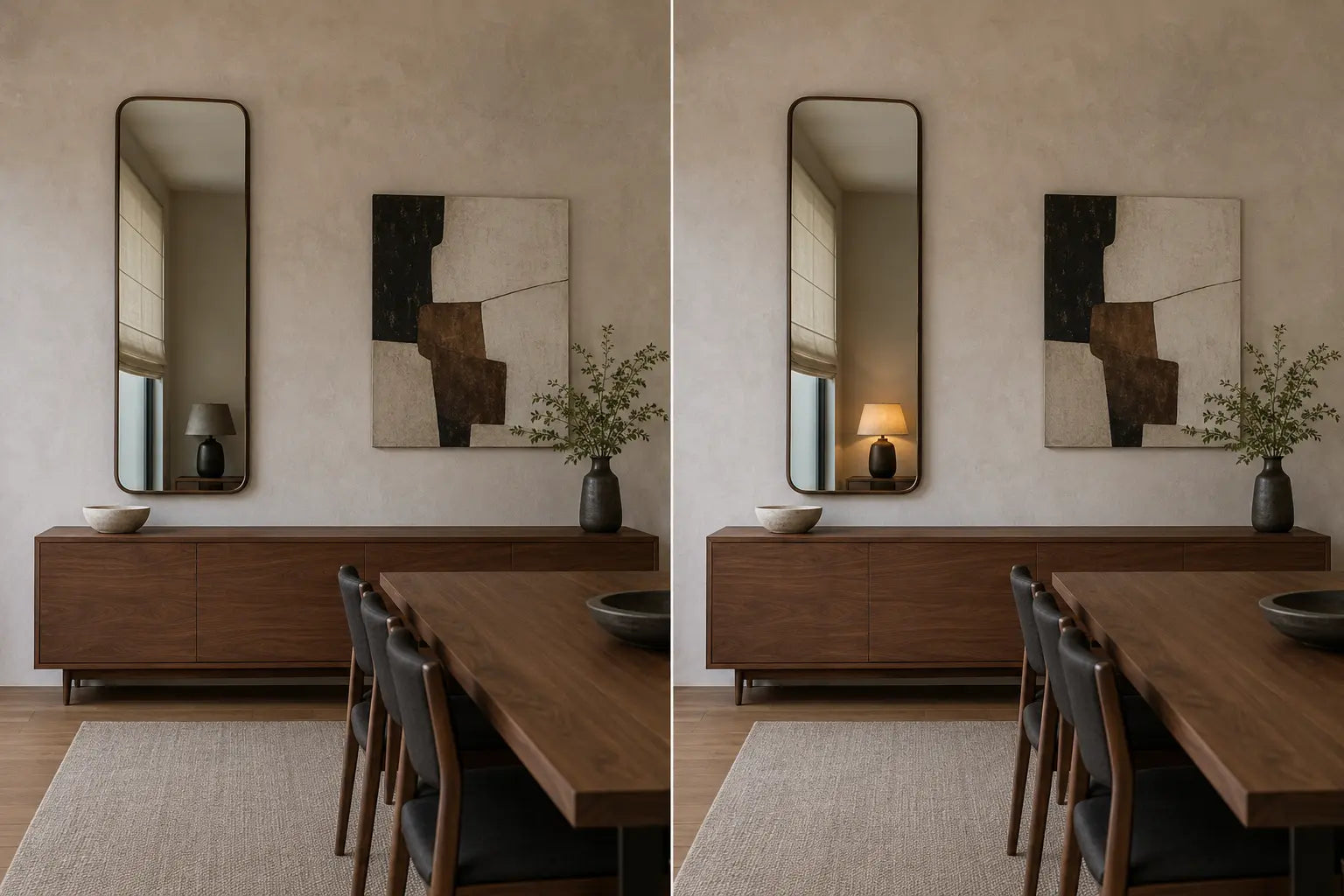
Inventory the mirror’s content from every priority view: windows, lamps, doors, shelves, screens, circulation and the canvas itself. Name the dominant reflected shape rather than writing “nice light.” A pale wall, screen and active doorway make different images even when the frame never moves.
Test room states separately. Hold position and objects constant, then compare daytime with the normal evening lighting state, or one door closed with the same door open. The aim is not to eliminate change; it is to decide whether the change remains acceptable.
- Evidence: a reflection log for entrance, seat, standing use point and route.
- Held constant: mirror, canvas, placement and chosen camera mark.
- Changed variable: one room-light or door state at a time.
- Pass: the return supports the intended mood without hiding function.
- Reject: an unwanted bright source, screen or repeated canvas dominates.
- Retest: change mirror location or choose another wall before changing art style.
Choose one visual leader
Assign a role for each important view: art-led, mirror-led or deliberately shared. A functional entry or dresser mirror can lead at close range while the canvas leads from the doorway. In a living room, a large canvas may remain primary and a quieter mirror may support the adjacent wall. Shared leadership is valid when symmetry or a paired composition is intentional, not when two objects merely demand equal attention.
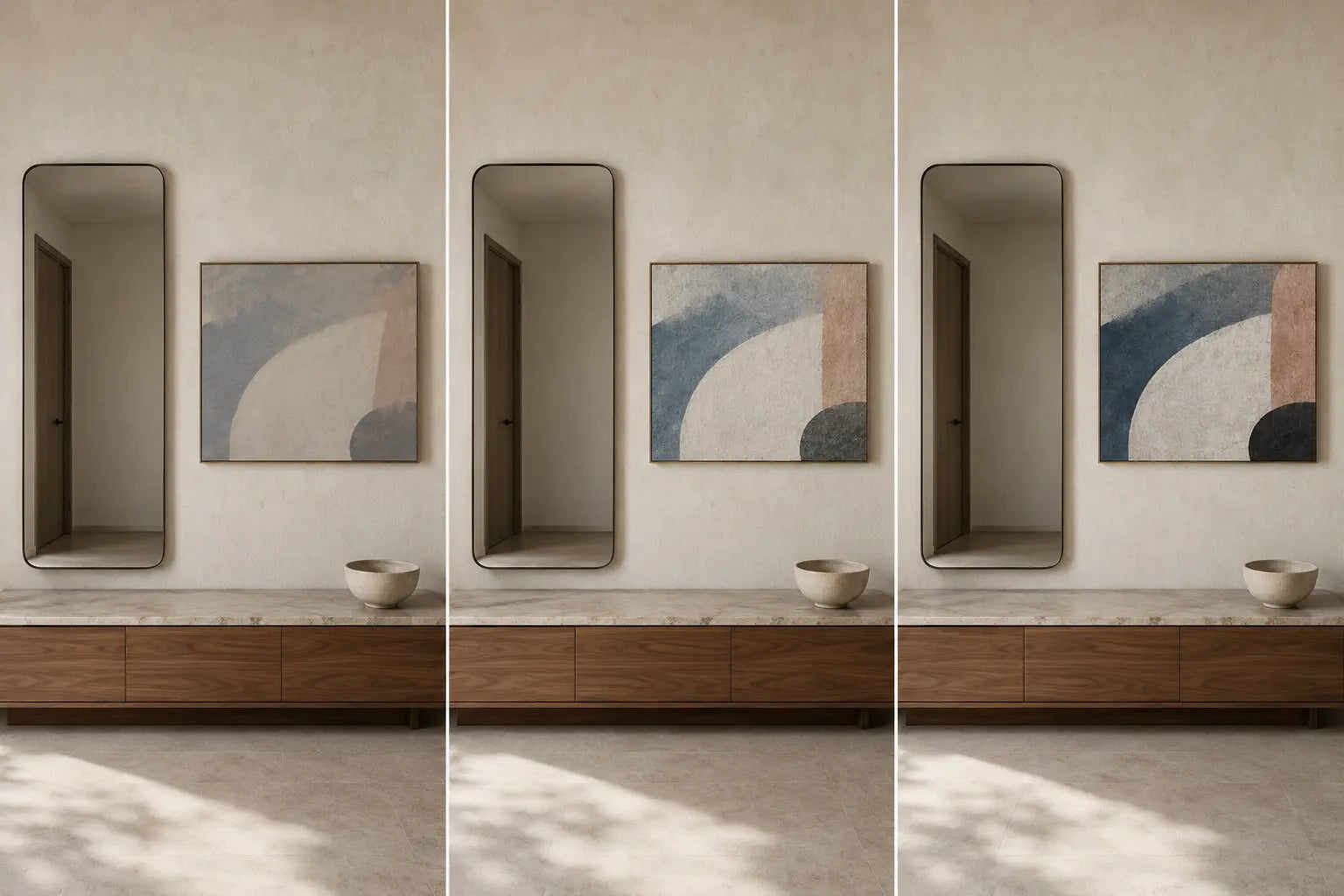
Compare hierarchy without changing everything. Keep both footprints, frames, view and reflection fixed; in a mock-up, change only the canvas’s tonal contrast while preserving composition geometry and palette family. What matters is whether attention lands where the room plan needs it.
- Evidence: the first object noticed from each priority view and the reason.
- Held constant: footprints, positions, mirror return, furniture and light.
- Changed variable: artwork tonal contrast or internal density.
- Pass: the named leader remains clear without erasing the support.
- Reject: both objects shout, or the intended leader disappears.
- Retest: compare the next contrast level at the same footprint.
Hold the complete boundary
Template the complete outside dimensions of both objects. For the mirror, that means the outer frame, not only the reflective glass. For the canvas, use the finished edge or frame rather than the image area. Include projection, nearby wall edges, furniture, switches and lights. Then read the pair as one combined footprint as well as two separate objects.
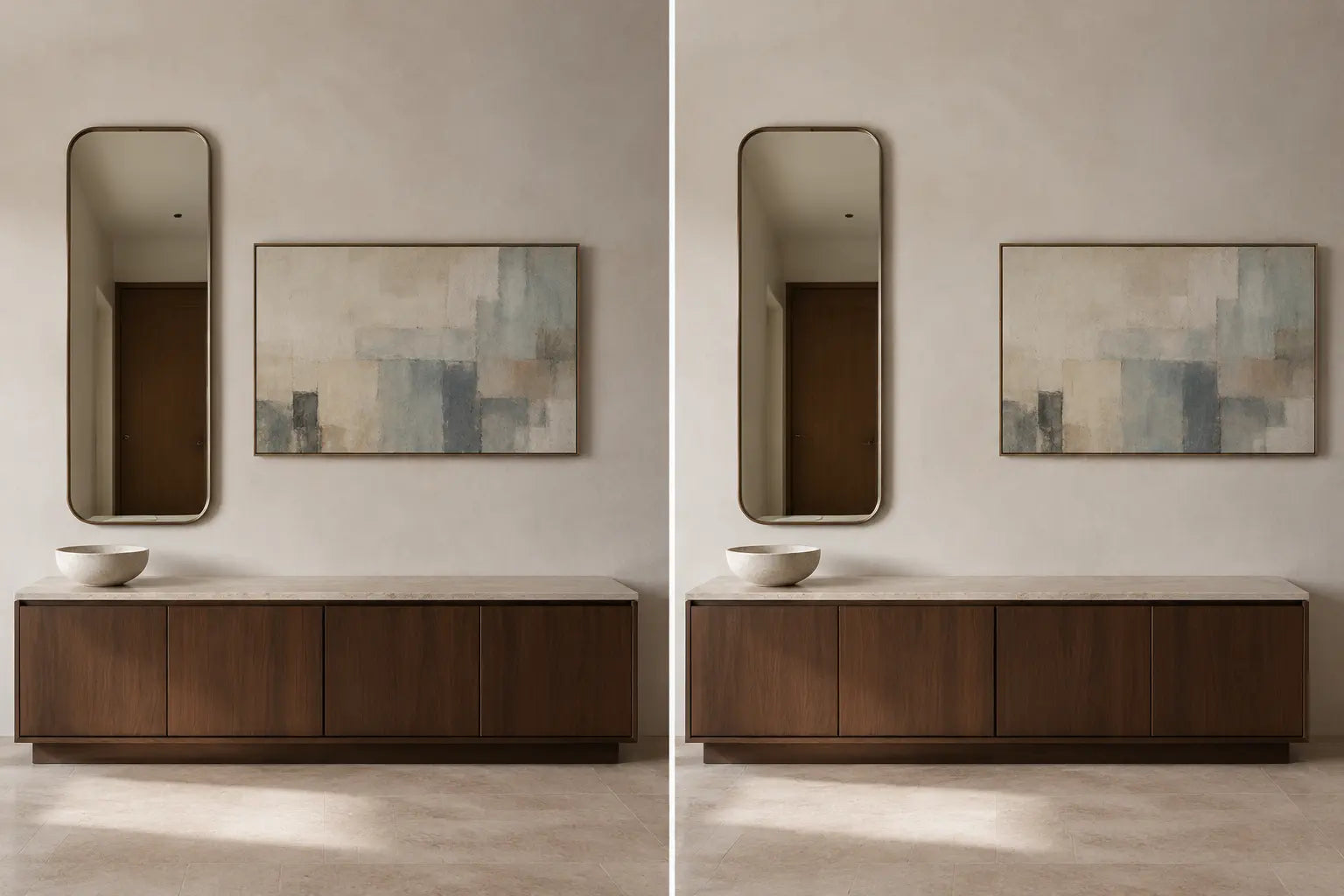
There is no universal art-to-mirror gap. A narrow quiet pair can tolerate a relationship that would feel crowded beside a highly contrasting canvas and ornate frame. Hold object size and height constant; move the canvas horizontally to compare a closer and wider interval. If overall art scale is still unresolved, delegate that variable to the wall art size guide in a separate round.
- Evidence: complete templates, wall reveal and the pair’s outside envelope.
- Held constant: mirror, art, sizes, height, reflection, view and light.
- Changed variable: horizontal offset or one edge alignment.
- Pass: both perimeters remain legible and the pair answers the furniture or wall.
- Reject: edges almost merge, create a wall sliver or drift into another zone.
- Retest: compare the next offset before resizing either object.
Observe in motion
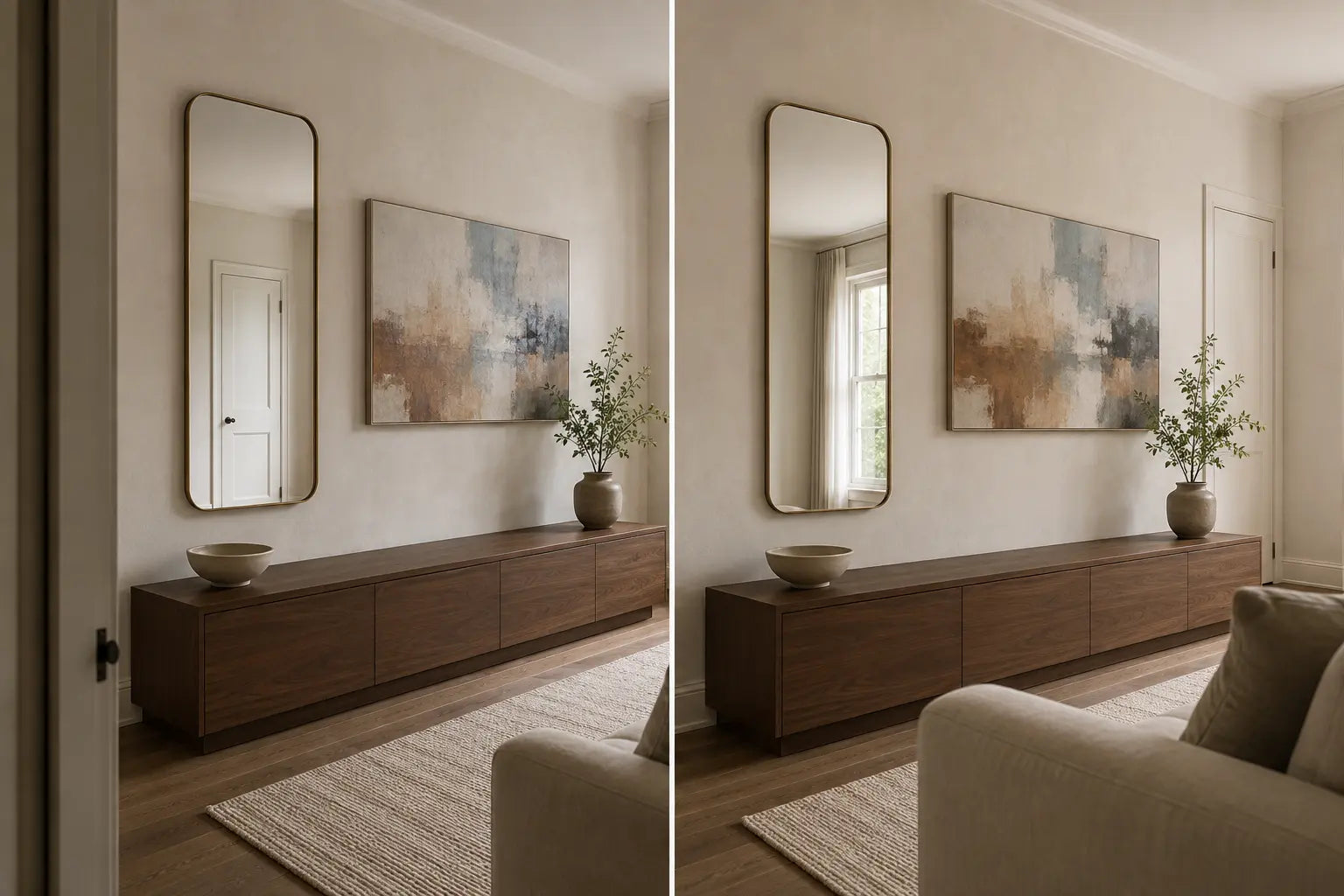
A front elevation is only one frame. Walk the ordinary route, pause at the entrance and sit in the primary seats. A mirror can show a calm wall from one mark and a screen or doorway from another. The canvas may become visible both directly and in reflection for part of the route, then disappear from the mirror as the viewer moves.
Use a short phone video or a sequence of marked photographs. Keep the installation and room state fixed; change only viewpoint. If several zones share the view, the open-plan wall art guide can resolve which zone should own the wider focal point.
- Evidence: entrance, seated, standing and passing views in a fixed order.
- Held constant: art, mirror, boundaries, room state and light.
- Changed variable: viewer or camera position.
- Pass: hierarchy stays intentional through the useful route.
- Reject: the mirror suddenly duplicates clutter or creates an accidental second focal point.
- Retest: adjust one location, then repeat the identical marked route.
Wall art and mirror decision router
Begin with the condition you can observe, then run only the next useful comparison. A different wall or an empty position is a valid decision, not a failed design.
Swipe or use the horizontal scrollbar to review all table columns.
| Observed condition | Likely role | Hold constant | Test next | Acceptable outcome |
|---|---|---|---|---|
| Mirror is functionally required | Mirror leads at its use point | Usable reflected field and finished footprint | Canvas contrast or adjacent wall | Art supports without blocking function |
| Canvas appears in the mirror | One direct and one reflected art event | Artwork, light and marked seat | Mirror location only | Deliberate echo or no duplication |
| Both objects demand equal attention | Leader is unresolved | Footprints, positions and reflection | Canvas tonal contrast only | One clear leader or intentional pair |
| Edges feel crowded or disconnected | Combined boundary is unresolved | Sizes, height, content and view | Horizontal offset only | Legible pair or separate walls |
| One view works; another fails | Route controls the decision | Installation and room state | Viewer position in a fixed sequence | Robust view or relocation |
| Weight, wall or hardware is uncertain | Installation gate is unresolved | Visual shortlist | Manufacturer and qualified assessment | Verified system or stop |
Evidence, decision, rejection and retest
Each scenario begins with room evidence rather than a preferred product. Preserve the four labels in your notes; they stop one attractive front view from becoming the only proof.
Entryway console
Evidence: The mirror is used before leaving, while the front door, coat storage and arrival route repeatedly change what it returns.
Decision: Let the mirror lead at close range. Test one quieter canvas beside it or on the adjoining wall, keeping the practical viewing field clear.
Reject: Two equal focal points created only because a symmetrical wall photograph looks tidy.
Retest: Door open and closed, coats present, daytime and the normal entry lamp on. Record whether the canvas remains support rather than interruption.
Living room with adjacent walls
Evidence: A large canvas anchors the sofa wall while a decorative mirror occupies a perpendicular wall; both appear from the entrance and primary seat.
Decision: Let the canvas lead the seated zone. Position the mirror so it returns a quieter wall field or light source that supports the wider composition.
Reject: A mirror position that reproduces the canvas or television from nearly every seat and creates an accidental second center.
Retest: Entrance, sofa, screen on and off, daytime, and normal evening lamps. If the wider sightline remains unresolved, separate the objects further.
Dining sideboard
Evidence: A central mirror and two small artworks can form a deliberate unit, but the return may include the pendant, table setting, doorway and seated people.
Decision: Approve shared leadership only when the full outer boundary and the changing reflected scene remain coherent. Symmetry is an option, not a default.
Reject: Assuming a vertical central mirror with matching side art works in every dining room regardless of return or furniture width.
Retest: Empty and in-use table, seated and standing views, door positions, daylight and dining lights.
Mixed gallery wall
Evidence: A small decorative mirror can interrupt a sequence of rectangular frames, yet its live reflection behaves differently from every printed image.
Decision: Use the mirror as a shaped interval or secondary rhythm unless a mirror-centered composition is deliberately required.
Reject: Making the mirror equal in scale and contrast to the art anchor when two centers were not intended, or applying a fixed spacing number without testing the complete edges.
Retest: Floor layout, full-size paper templates, direct view, reflected view, daytime and evening. Then resolve attachment independently.
Bedroom dresser
Evidence: The mirror has a functional standing field; wardrobe doors, bedside lamps and the bed approach alter both its return and the available wall boundary.
Decision: Keep art outside the useful reflective zone or place it in a separate wall bay. Let close-range mirror function outrank a forced centered composition.
Reject: Generic adhesive advice, an unverified heavy installation or art placed where it interrupts normal mirror use.
Retest: Standing use, wardrobe open, bed approach and both bedside lamps on. Stop if wall or hardware evidence is incomplete.
Open-plan or opposite walls
Evidence: The canvas and mirror may be visible directly and through reflection during one route, so a single artwork can occupy two apparent zones.
Decision: Let the canvas define one zone and the mirror serve another. Use reflected artwork only when the echo remains intentional from the principal paths.
Reject: Filling both walls with equally dense compositions to solve a problem created by duplication.
Retest: Record an entrance-to-seating video plus both principal seated views. Moving one object, selecting another wall or leaving a field blank can all pass.
Write the brief before selecting the canvas
Record the decision
- Room, wall and functional mirror role
- Priority entrance, seat and walking route
- Day and evening reflected subjects
- Art-led, mirror-led or shared hierarchy
- Maximum tested complete canvas footprint
- Accepted boundary and one rejected offset
- Wall and installation questions still open
- No-purchase or alternate-wall fallback
Keep the test order clean
- Map the mirror return before selecting artwork subject or color.
- Assign the leader before adjusting the relationship between edges.
- Template complete outer footprints before calculating attachment points.
- Check normal routes and light states before approving a styled front view.
- Only after the visual shortlist passes, verify exact finished dimensions, weight, supplied system, wall material and local conditions.
General placement height and attachment-point planning belong in the wall art height guide. Surface reflection and finished-load differences between formats belong in the canvas versus framed print guide. Keeping those questions separate prevents one attractive mock-up from pretending to solve installation.
Installation boundary
Do not infer anchors, screws, D-rings, cleats, stud requirements or adhesive suitability from these illustrations. Confirm the exact finished weight of each object, supplied hanging system, wall construction, concealed services and manufacturer instructions. Use qualified installation when the load, substrate, location or hardware is uncertain. For a floor-standing or leaning mirror, check its product instructions for anchoring requirements.
When the ECHO brief has identified the canvas role, tested footprint and acceptable reflected relationship, browse the Artesty canvas art collection with those written constraints in hand.
Wall art and mirror FAQ
Can wall art and a mirror hang on the same wall?
Yes, when the wall supports their complete footprints and their roles are clear from the views that matter. Template both outer boundaries, decide which object leads, and inspect what the mirror returns. A same-wall pair is not automatically better than adjacent walls. If the pair feels crowded, mechanically symmetrical or functionally awkward, increase the interval, reduce one role, separate the objects or leave one position empty.
Does a mirror need to sit in the center of a gallery wall?
No. A central mirror can organize a symmetrical arrangement, but a small mirror can also work as an off-center shaped interval. The important question is whether it becomes the intended anchor from direct and reflected views. Test the collection on the floor and with full-size templates. Do not let an easy geometric center override mirror function, changing reflections or the actual wall and furniture relationship.
Should mirror and artwork frames match?
Matching finishes are one optional cohesion strategy, not a requirement. Frames can relate through temperature, thickness, shape or restraint without being identical. First solve reflection, hierarchy and complete footprint. If those decisions pass, compare finishes under the room’s real day and evening light. A perfect metal match will not repair a mirror that returns clutter or a canvas that unintentionally competes with it.
How much space should be left between a mirror and wall art?
There is no universal gap. Use two or three full-size template offsets while holding object size, height, artwork and viewpoint constant. Judge whether each perimeter remains legible and whether the combined envelope relates to the wall or furniture below. Record an accepted and rejected interval for that room. A number from another wall can be a starting comparison, but it is not proof for yours.
Can a mirror face or reflect a canvas?
It can, but count the reflected canvas as another visual event. From some seats the repetition may create a deliberate echo; from others it may double contrast or confuse which zone leads. Mark the exact positions where the canvas appears in the mirror, then repeat the check as you walk. Approve the reflection only when it remains intentional across the useful views and normal light states.
Should a mirror be placed opposite a window?
Not automatically. A window may produce a useful reflected view, a bright high-contrast field, privacy concerns or uncomfortable glare depending on sun, shade, season, lamps and viewpoint. A mirror reflects existing light; it does not generate light. Template the location and inspect it at relevant times. If the reflected window overwhelms the artwork, compare another mirror position before changing the canvas.
How many mirrors can one room have?
There is no reliable fixed count. Inventory every direct and reflected mirror appearance from the main routes. Two modest functional mirrors may be visually quieter than one large mirror that repeats a bright screen or another mirror. Add one at a time to the evidence set. Stop when returns begin to multiply focal points, confuse circulation, reveal unwanted views or create unresolved installation conditions.
What hardware should be used for a mirror and canvas arrangement?
The answer depends on the exact finished load of each object, supplied hanging system, wall material, fastener specifications, condition and location. Do not transfer a canvas method to a mirror or assume generic adhesive is suitable. Follow current manufacturer instructions and obtain a qualified assessment when weight, wall construction, concealed services, overhead exposure or local requirements are uncertain.
Sources and qualification note
The reflection discussion is consistent with the distinction between directional and diffuse reflected light described by NASA’s electromagnetic spectrum education resource and with NIST’s account of measuring specular and diffuse reflection. The Canadian Conservation Institute’s painting-display guidance supports considering the complete framed object and an appropriate hanging system; mirror installation still defers to its current product instructions.
Room aesthetics remain conditional. The generated studies isolate editorial variables for comparison; they are not optical measurements, product photographs, engineering evidence or installation instructions. In a mirror-heavy commercial setting, use the dedicated guide to beauty salon wall art for zone-specific constraints.