

Street Art for Home Interiors: Scale, Color, and Placement
Choose graphic pressure, not an “urban” theme
Street art works at home when its marks remain legible at the room’s real viewing range, its visual pressure has somewhere to resolve, and the complete canvas belongs to one furniture or architectural anchor. The final gate is not decorative: the source, depicted work, words, logos, and people must withstand a rights review.
This guide uses four checks—RANGE, PRESSURE, ANCHOR, and RIGHTS. The first hard failure eliminates a candidate. That is more useful than trying to rescue an unsuitable image with extra cushions, signs, or industrial accessories.
Test what survives, not what the thumbnail promises
A product image is usually inspected close to a screen. A room does not behave that way. Street-art-inspired compositions may contain broad blocks, fine scratches, layered fragments, drips, silhouettes, or lettering. Each element has a different distance at which it stops reading as a distinct signal and becomes general texture.
Declare two real views before selecting the subject: the primary range where the wall is experienced most often, and one secondary range such as the doorway or adjacent seating position. Make an exact-footprint mockup on a photograph of the real wall. At the primary range, identify what arrives first: one figure, one color mass, a directional line, or merely an even field of marks. At the secondary range, confirm that the work still forms one coherent event rather than a small busy rectangle.
The three-second reduction
Look at the mockup for three seconds, then turn away. Write down the first shape and color you remember. Repeat after reducing the mockup. If the answer changes completely, the composition depends on detail that may not survive the intended view. That does not make the image weak; it makes it a closer-range candidate.
Scale cannot be judged from the longest side alone. Use the exact listed footprint and compare it with the clear wall field, furniture, lamps, openings, and circulation route. For numerical sizing and tape-mockup mechanics, use the Wall Art Size Guide; this article owns the graphic reading decision, not universal width formulas.
Map the room’s edges before adding the canvas
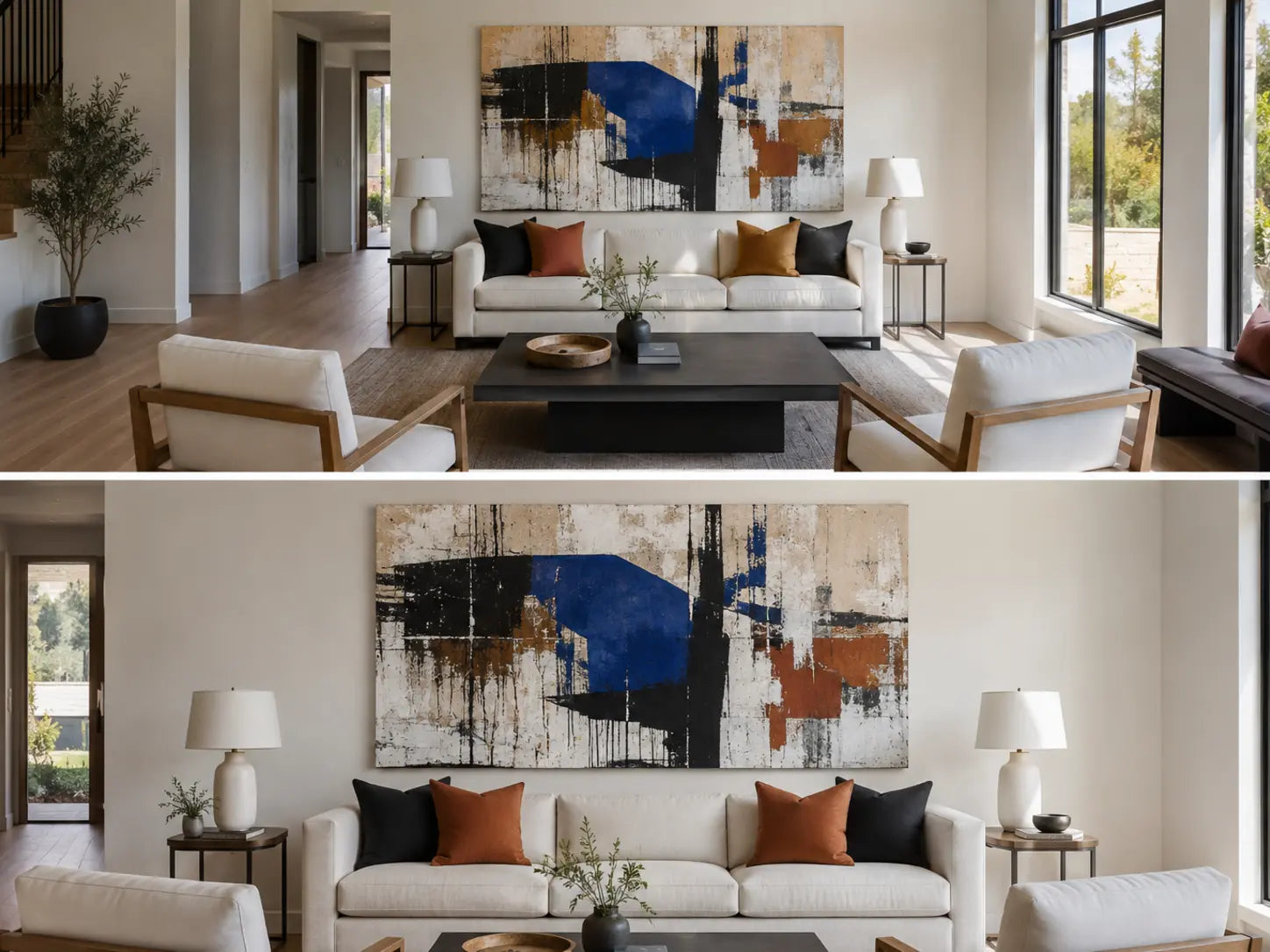
Graphic pressure is the combined demand created by visible boundaries, contrast changes, repeated objects, patterns, and internal artwork marks. It is not a score and it is not the same as “bold color.” A large canvas with three broad shapes may exert less pressure than a smaller work filled with tiny high-contrast fragments.
Stand at the primary range and list the room edges already active in the same view: shelving uprights, window grids, brick joints, rug pattern, screen perimeter, plant silhouettes, lamp stems, books, cushions, and neighboring art. Then inspect the candidate for its own major edges. The question is not whether the totals are high or low; it is whether one system clearly leads.
Reduce the room before reducing the artwork
If the candidate works after a patterned throw, crowded console, or secondary picture is temporarily removed, the failure belonged to the installation field—not necessarily to the canvas. Conversely, a low-density canvas can fail on a broad quiet wall when it is physically too timid. “Quiet artwork for a busy room” is therefore a test direction, not an automatic answer.
Color belongs inside this pressure audit. Separate the canvas into three roles: its largest field, its structural dark or light, and its strongest accent. Connect only one of those roles to the room. Repeating every saturated color across cushions and objects creates several new signals and can turn a clear focal wall into a distributed theme.
Name what carries the complete outside shape
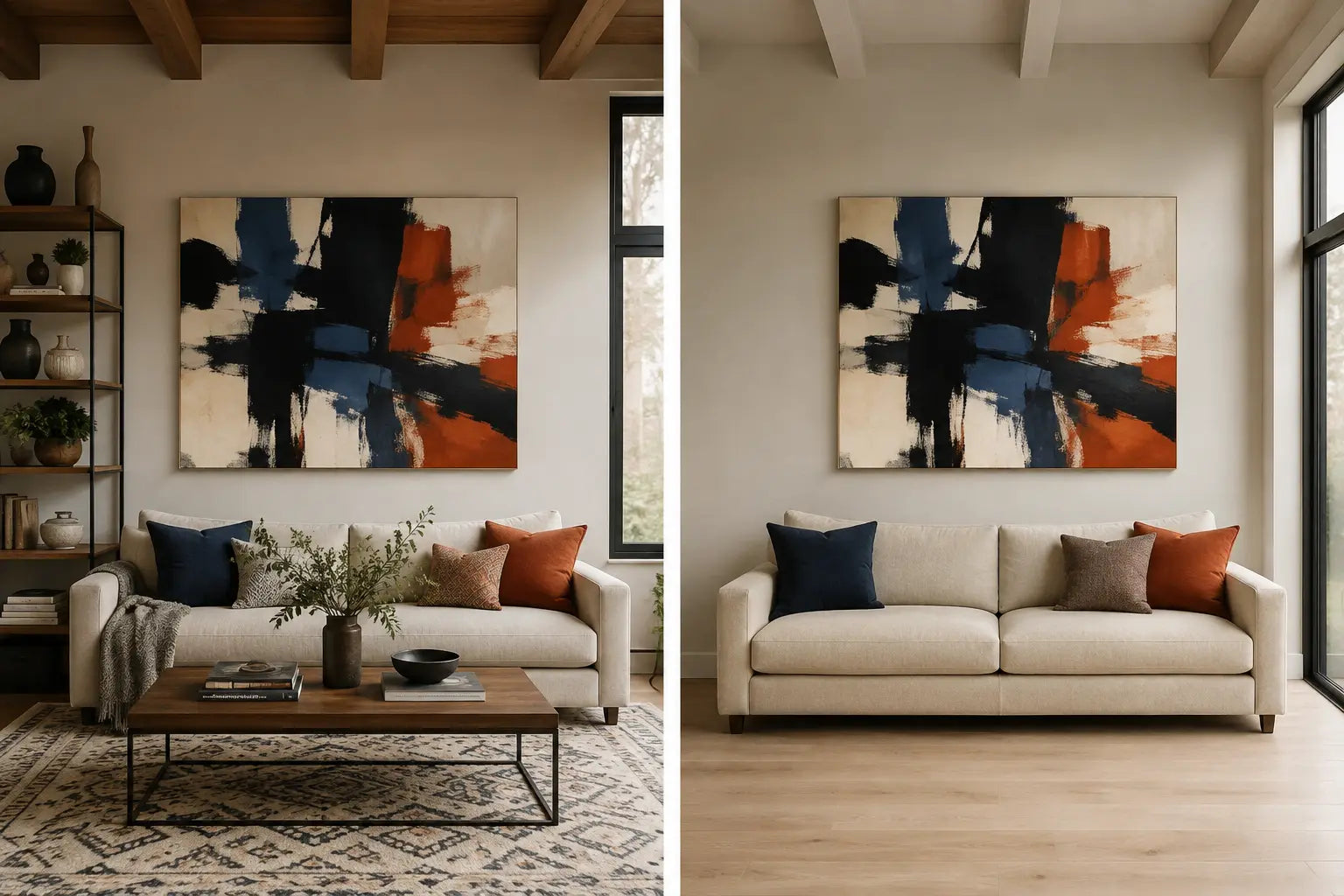
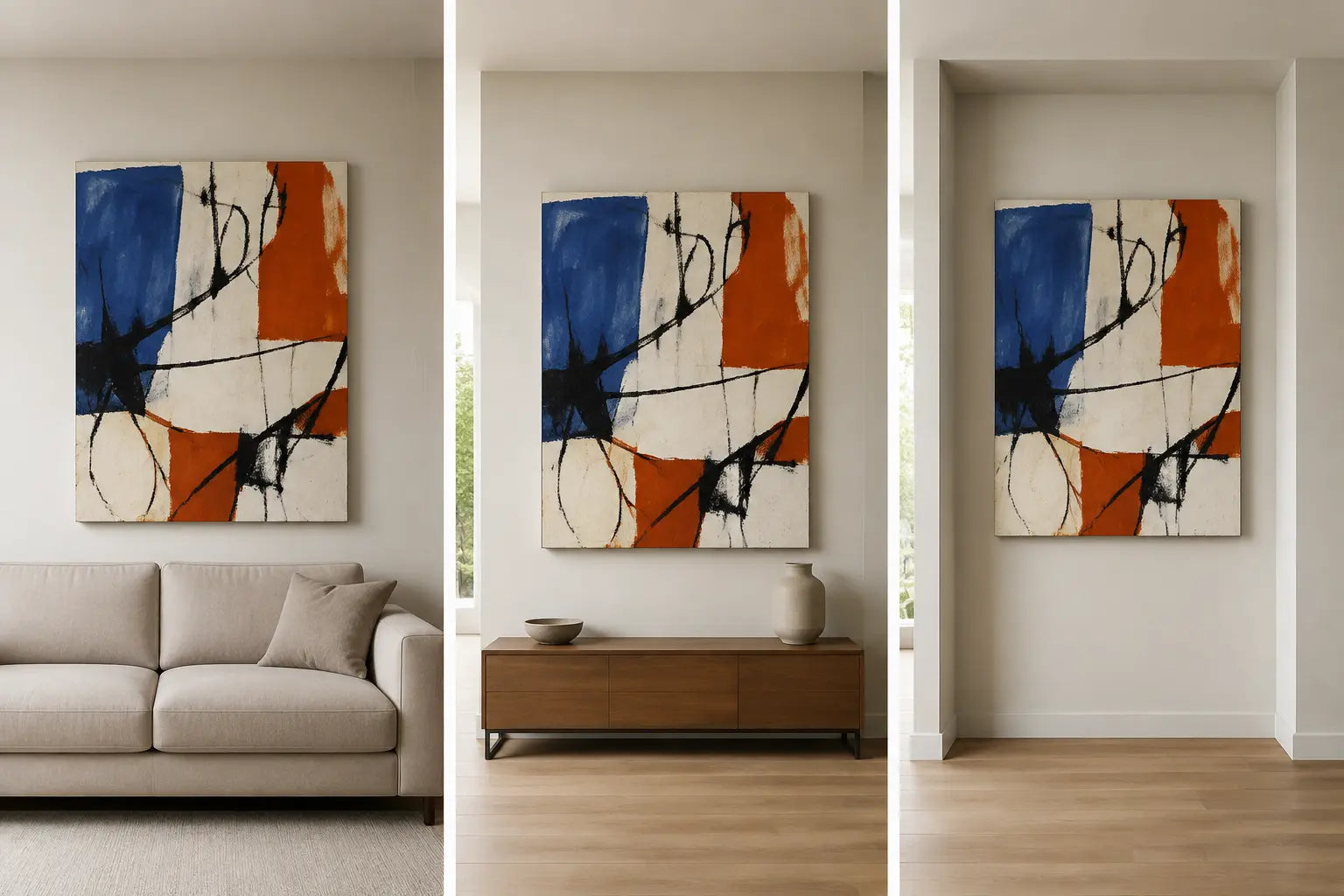
The artwork does not belong to “the wall” in the abstract. It usually belongs to a sofa group, console, desk, architectural bay, or terminal sightline. Name that anchor in one sentence. If two candidates survive the range and pressure checks, the stronger option is the one whose complete installed outline connects to the declared anchor without crowding its edges.
Use the entire installed envelope: canvas, optional outer frame, and every panel plus every gap if the product is a set. A triptych may carry one continuous image, but the room first encounters the complete group outline. Panel composition belongs in One Large Canvas vs. Three Panels; do not let a split image become an accidental substitute for a single work.
Three legitimate carriers
- Furniture anchor: the canvas completes a sofa, headboard, desk, or console group.
- Architectural anchor: a bay, pier, recess, or field between openings sets the outside limit.
- Sightline anchor: a corridor, stair, or entrance approach makes the work a destination.
Reject the placement when the canvas floats mid-span with no deliberate relationship, when a lamp or plant obscures the principal signal, or when the outside edge crowds trim. Do not “fix” the connection by adding unrelated signs, faux brick, industrial props, or several more canvases.
| Observed evidence | Likely reading | Next test | Reject when |
|---|---|---|---|
| Signal disappears at entry | Fine detail exceeds the useful range | Test larger footprint or broader marks | Only the close product view works |
| Room and canvas have equal edge load | No clear graphic hierarchy | Temporarily edit one room layer | Everything still demands attention |
| Strong canvas above broad furniture | Possible furniture anchor | Mock the exact complete envelope | It floats or crowds side objects |
| Narrow architectural bay | Architecture may be the carrier | Check trim clearance and crop | The format is squeezed against edges |
| Color works only with many accessories | The bridge is becoming a theme | Keep one repeated color role | The canvas loses purpose without props |
| Recognizable mural, tag, logo, or face | Elevated source complexity | Run creator, image, and rights review | Any required status remains unresolved |
Use source verification as a veto
Public visibility is not permission to reproduce a wall, tag, portrait, photograph, logo, or character on a commercial canvas. Street-art-related products can combine several layers of authorship: the person who painted the wall, the photographer, a portrait source, a type or logo owner, and the maker of the final layout.
The U.S. Copyright Office explains that copyright protects original works fixed in a tangible medium, including visual art and photographs. The USPTO separately explains how words, phrases, symbols, and designs can identify the source of goods or services. These references do not decide the status of a specific product; they show why “it was painted outside” is not a sufficient clearance method.
Photographs of real murals or graffiti; signatures and tags; famous names; living artists’ recognizable works; copied stencils; celebrities; characters; team marks; logos; slogans; album or poster imagery; and product photographs whose source is not documented.
Do not assume that recoloring, cropping, adding “inspired by,” removing one logo, or finding the image on a marketplace establishes authorization.
A practical product-level record
Record the identified creator, the image source, the photographer when relevant, the status claimed by the seller, and the exact recognizable elements shown. If the evidence is absent or contradictory, reject the candidate before styling the room. Product availability is not proof of permission.
When rights confidence matters, an independently created abstract urban composition built from generic shapes and original marks can remove some subject-specific questions. It does not eliminate the need to review the actual listing, seller claims, and source documentation.
Compare pressure at the same footprint
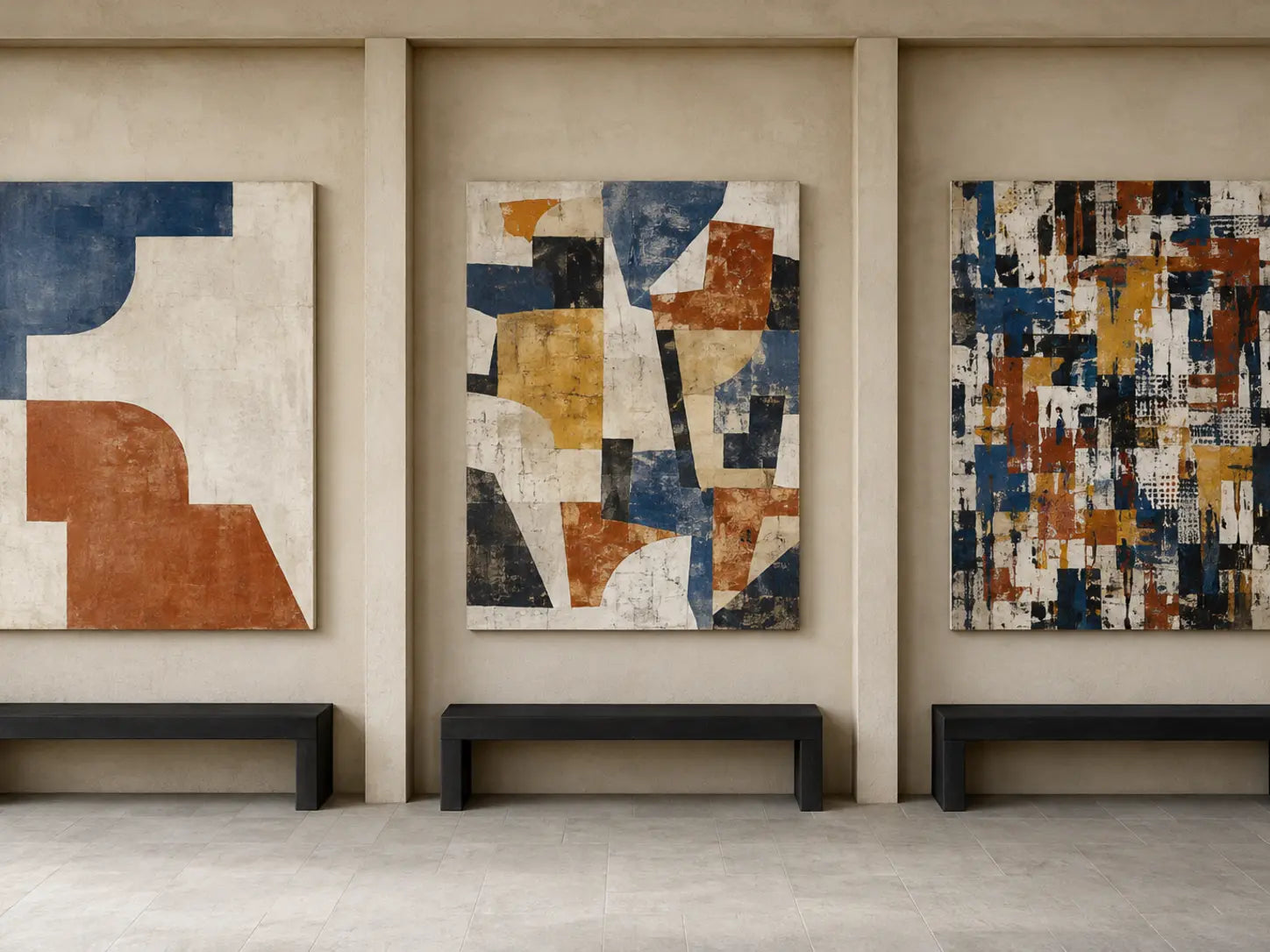
Build three candidates within approximately the same installed outline and color coverage. Candidate A carries a few broad marks; candidate B combines several scales; candidate C uses many small transitions. Holding the footprint steady prevents a small dense image from losing simply because it occupies less wall.
Run the candidates through the four gates in order. A candidate that fails rights review is out, even if it photographs well. A candidate that survives only after multiple decorative additions has not passed the pressure test. If two remain, choose the viewing behavior you want: immediate recognition from across the room or slower discovery at closer range.
Make the comparison with the same room photograph and lighting. Do not let one candidate use a premium styled mockup while another is judged as an isolated product image. Record the failure, not a vague preference: signal lost at range, pressure collision, broken anchor, poor crop, weak contrast, or unresolved source. A named failure produces a usable next step.
Six room situations, without room-name formulas
Write the wall decision in six lines
Primary rangeFrom __________, the first signal must be __________.
Secondary rangeFrom __________, the complete work must still __________.
Room pressureThe active room edges are __________; the rest field is __________.
AnchorThe canvas belongs to the __________, not the gross wall.
Color bridgeRepeat only the artwork’s __________ role through __________.
Rights vetoReject if creator, source, photograph, words, marks, logos, or people remain unresolved.
RANGE / PRESSURE / ANCHOR / RIGHTS is an Artesty editorial selection tool, not a standardized design or legal classification. For a general subject-and-style process, use How to Choose Wall Art for Your Home.
Choose the wall behavior first, then review the exact image, size, configuration, source information, and current availability.
Browse Street Art Canvas PrintsStreet art at home: practical questions
Is street art the same as graffiti?
No single label represents every practice or practitioner. Graffiti often gives particular importance to writing, names, letterforms, hand styles, and repeated marking; “street art” is frequently used more broadly for murals, stencils, posters, figures, installations, and other public-space work. Use the documented creator’s terminology when it matters.
How large should street art be above a sofa?
Start with the exact clear wall field and the complete listed product footprint, then mock it against the sofa, lamps, openings, and primary view. This guide avoids a universal percentage because furniture groups, wall interruptions, and internal image density change the result.
Can a dense street-art canvas work in a busy room?
Yes, if one hierarchy remains clear. A restrained frame, one stable anchor, limited color repetition, and an uninterrupted wall area can let a dense work lead. Reject it when shelves, textiles, screen, and canvas continue to compete equally after editing.
Does a bright canvas require neutral furniture?
No. Furniture can carry color while remaining a quiet field if it is visually continuous. Connect one canvas color role—field, structure, or accent—and avoid distributing every hue through many small accessories.
Is a photographed mural safe to reproduce because it is public?
Public visibility alone does not establish reproduction rights. The photograph and the depicted mural can involve separate creators and permissions, while faces, logos, words, and architecture may add further questions. Require product-level source evidence.
Should street art hang on exposed brick?
It can, but brick already contributes repeated edges and color variation. Test whether the artwork’s principal forms remain clear from the main range, and confirm suitable mounting for the actual wall construction and finished artwork weight.
Can I use several street-art works together?
Yes, after deciding that the wall should distribute attention across several independent objects. Give the group one repeatable relationship and enough rest. Use the Gallery Wall Guide for layout and installation mechanics.
What is the fastest fair comparison between candidates?
Place three exact product images into approximately equal installed footprints on the same photograph of the real wall. Keep the view and room unchanged, then compare signal survival, graphic pressure, anchor connection, color role, crop, and source status.