

Wall Art Above a Sectional Sofa: How to Balance the Chaise, Corner, and Main Wall
Quick Answer
A sectional sofa does not create one simple rectangle beneath the wall. Its long back, return, chaise, corner, open end, and nearby architecture can point in different directions. Before choosing wall art, decide which part of that geometry the artwork should belong to. Use BEND: BOUND the real wall-facing edges; ELECT one wall or seating zone as the visual owner; NARROW the complete outer footprint of the artwork; then DISTANCE-TEST the same candidate from the entry, the primary seat, and across the room. Keep the artwork itself constant while testing each variable. This prevents color, subject, and shopping excitement from disguising a weak placement.
The right result may be one wide canvas over the active back, a compact work on the short return, a gallery arrangement contained within one elected zone, or no art behind the sectional at all. Do not automatically center art over the sectional’s total L-shaped footprint, count every chaise as display width, or assume the longest wall must win. Let the room reveal its owner first.
Why a Sectional Changes the Wall-Art Problem
A straight sofa usually offers one dominant back and one wall-facing direction. A sectional introduces a bend. That bend may be functional, architectural, or both: one run can face the television while the chaise opens toward daylight; one arm can sit against a wall while the other projects into circulation; a corner sectional can visually occupy two walls even when only one wall has enough uninterrupted field for art.
This is why a familiar rule such as “center art over the sofa” becomes ambiguous. Center over what—the longest upholstered run, the whole sectional including the chaise, the people who actually sit there, or the wall between a window and an opening? Each answer produces a different axis. A size formula cannot resolve that ownership question. Use the wall-art size guide only after you know which wall field and seating run you are sizing for.
The sectional also changes what the eye meets first. From the doorway, the chaise may dominate. From the primary chair, the long back may read as the anchor. From the sofa itself, the art can disappear above and behind the viewer. Windows, a television, built-ins, and passageways can claim more visual authority than the upholstery. The goal is therefore not to decorate every empty wall. It is to form one legible relationship without creating a second accidental focal point.
Think of the sofa as a set of directional clues, not a single measurement. When those clues agree, placement feels inevitable. When they conflict, the strongest decision may be a smaller work on an adjacent wall, art serving another conversation zone, or leaving the wall quiet.
The BEND Method
BEND is a sequence, not a style prescription. Photograph the room from the entrance and primary viewing positions, make simple paper or digital mockups, and change only one variable at a time. Do not shop by subject or palette until the first three stages produce a stable placement.
BOUND: Map the Sectional and the Available Wall
Record the sectional’s actual wall-facing backs separately from the chaise or return that projects into the room. Mark the inner corner, open ends, modular seams, windows, doors, vents, sconces, shelves, and wall breaks. Then draw the usable wall fields as distinct zones. A chaise belongs in the map, but it does not automatically expand the art field above the long wall. Its direction may instead point toward a window, walkway, or secondary wall.
The output is a boundary map: long back, short return, projecting chaise, interrupted wall, and circulation path. If the sectional is reversible or frequently reconfigured, map both likely arrangements. A placement that works only for today’s module order is not yet robust.
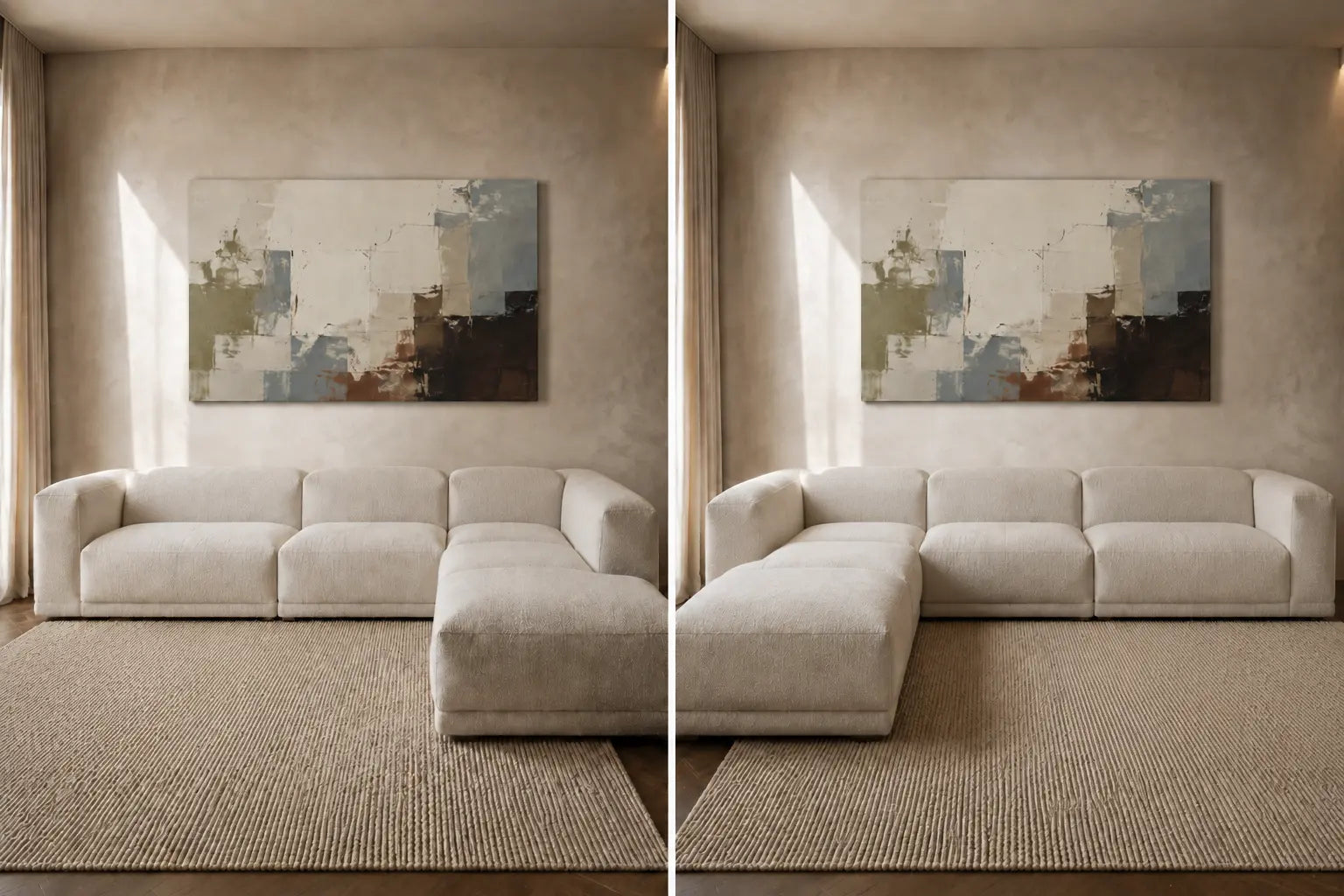
ELECT: Choose One Visual Owner
Place the same neutral art mockup in one candidate zone at a time: above the long back, above the short return, on the adjacent wall, or aligned with a nearby conversation area. Keep its size, height, and image unchanged. Ask which version makes the room easier to read on entry and which version supports the way people face and move.
The elected owner can be a wall, a wall-facing seating run, or a room zone. It does not have to be the sectional’s longest dimension. Reject any position that makes the eye bounce between competing centers or requires the artwork to wrap a corner merely to acknowledge every sofa module. If no candidate establishes a clear relationship, elect no wall behind the sectional and test elsewhere.
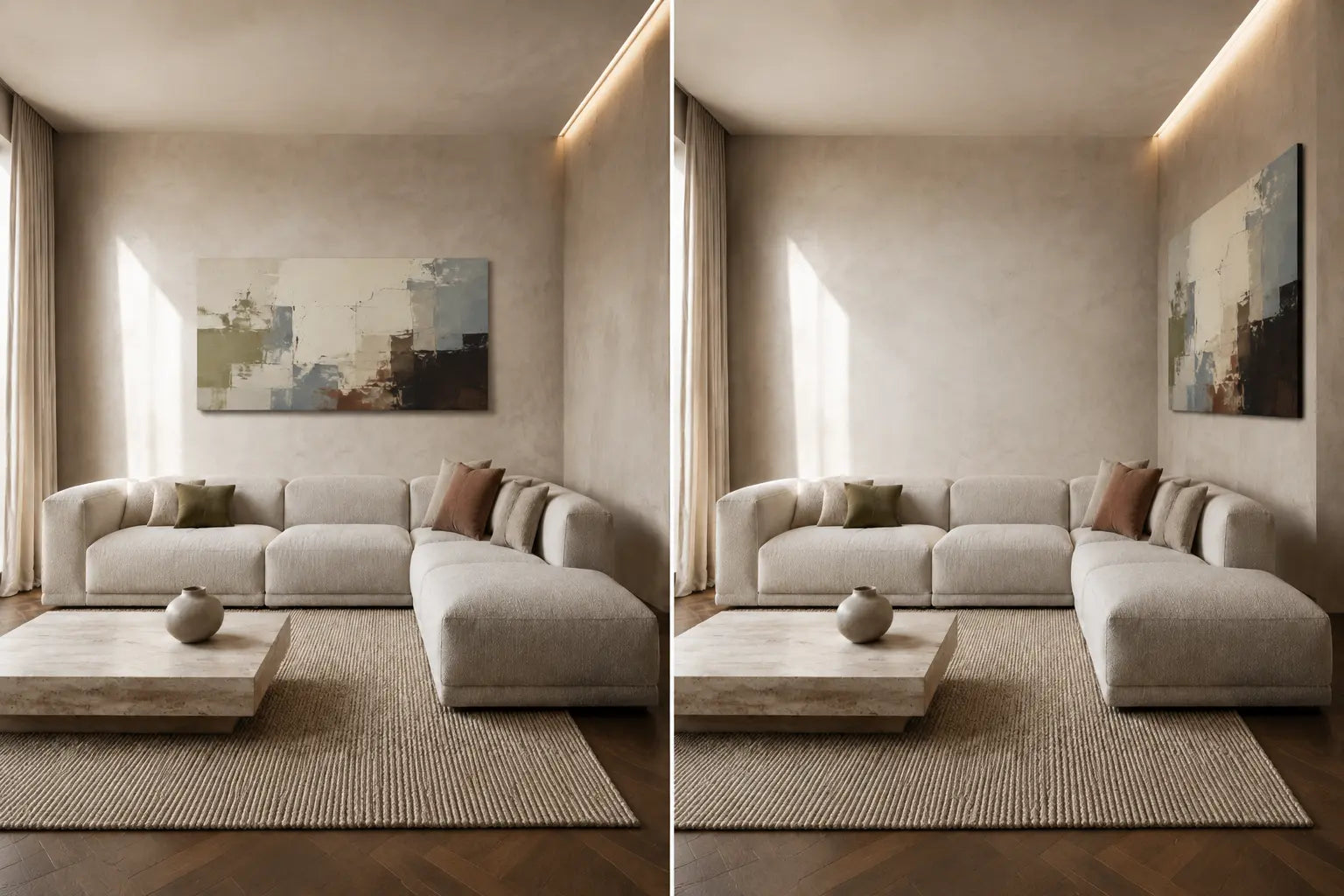
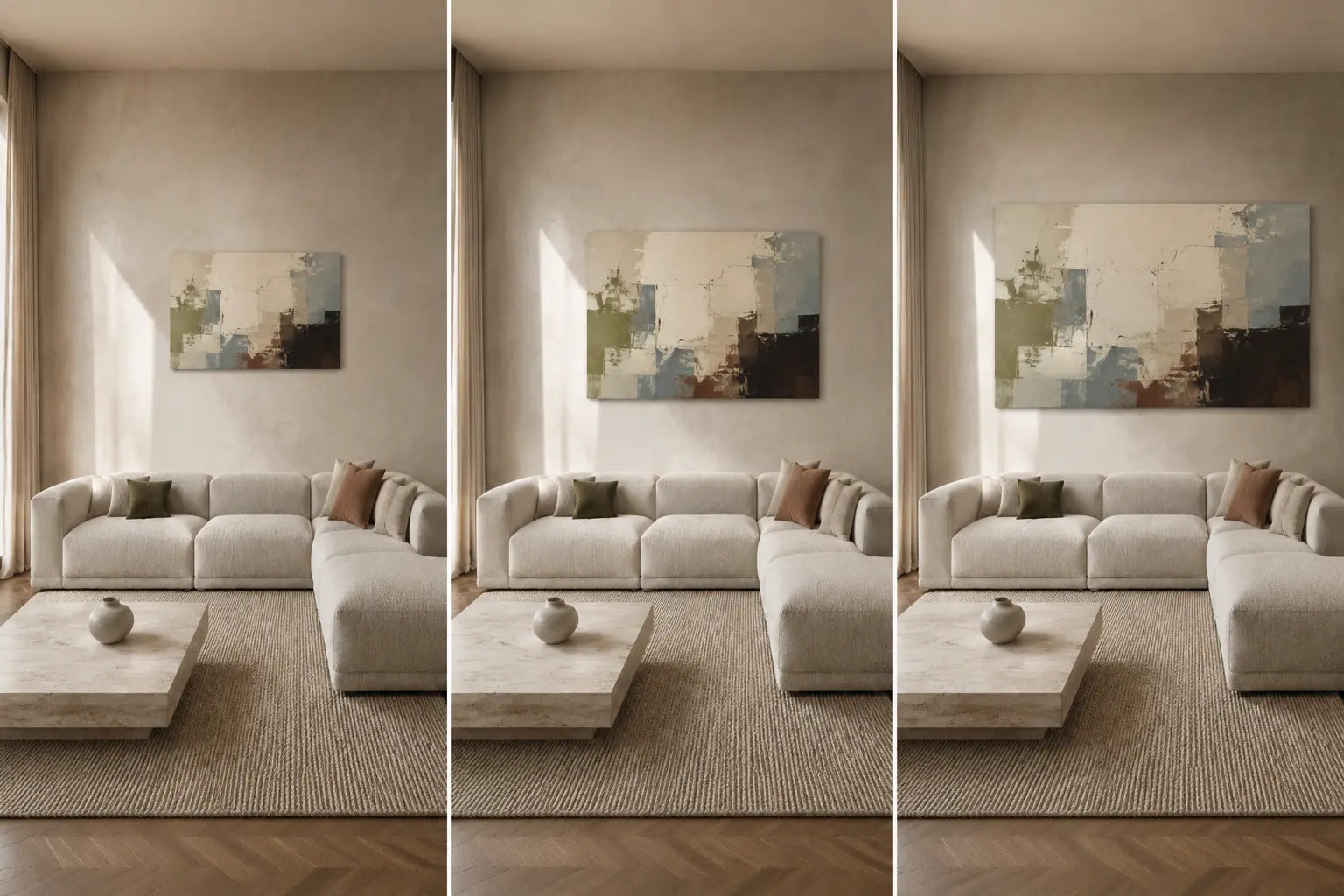
NARROW: Test the Complete Art Footprint
Once the owner is fixed, test the artwork’s complete outer footprint, not just the printed image area. For one canvas, that is the full edge-to-edge silhouette. For a diptych, triptych, or gallery arrangement, it includes every panel and all the spaces between them. Keep the center, wall, artwork, and viewing position constant while trying compact, moderate, and expansive envelopes.
Look for a footprint that reads with the elected seating run without drifting toward the chaise, doorway, or adjacent focal point. The correct envelope can be intentionally narrower than the sectional and still feel anchored. If a wide work only appears balanced when mentally counting a projecting chaise, return to ELECT: the wall owner may be wrong. Guidance on vertical, horizontal, and square formats becomes useful only after this envelope is visible.
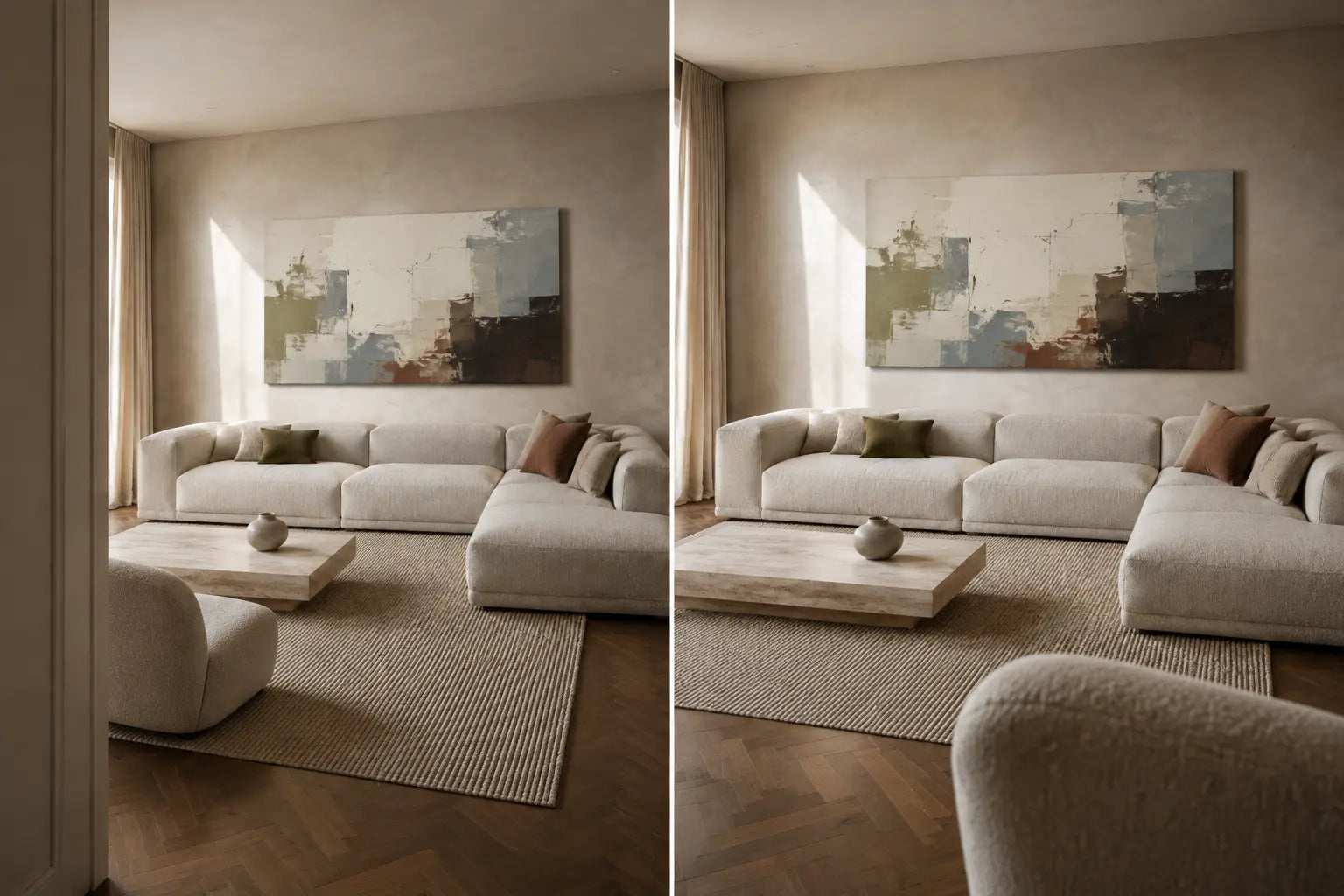
DISTANCE-TEST: Verify the Decision From Real Views
Hold the shortlist still and change only the viewpoint. Check it from the threshold where the room first appears, from the main seat across the room, from the end of the sectional, and along the normal walking route. Repeat in daylight and in the evening, without changing multiple lamps or furnishings between comparisons.
A placement passes when the elected relationship remains clear from the views that matter. It need not look perfectly symmetrical from every angle. Reject a candidate if the art seems to slide into a window, hover over circulation, vanish behind a tall back, or fight the television whenever you step away from the styling viewpoint. Distance-testing can confirm the shortlist, send you back to NARROW, redirect the art to another wall, or validate buying nothing.
Decision Router
Use this table after BOUND. It routes the next test; it does not prescribe a purchase. If two rows describe the room, begin with the condition that dominates the entry view, then distance-test the other condition separately.
Swipe or use the horizontal scrollbar to review all table columns.
| Observed condition | Elect first | Hold constant | Retest trigger |
|---|---|---|---|
| One uninterrupted wall behind the long back | The active wall-facing seating run | Wall, center, and artwork | Art drifts toward the chaise or open end |
| Sectional wraps a room corner | Each wall independently | Art mockup size and image | Two competing focal points appear |
| Chaise projects toward an opening | The wall-facing back, not the projection | Chaise position and circulation | The entry view becomes visually lopsided |
| Sectional floats away from walls | A room zone or independent wall | Sofa layout and sightline | Art looks attached to no readable zone |
| Windows or a television interrupt the field | The remaining quiet wall, if any | Architecture and focal point | Artwork competes in normal viewing conditions |
Six Sectional Scenarios
1. The Sectional Sits Fully on One Main Wall
- Evidence
- The long back and most occupied seats face one uninterrupted wall field; the chaise projects forward but does not create a second wall relationship.
- Decision
- Elect the wall-facing seating run. Center the first mockup on that active run, then narrow its outer footprint until it feels connected from the doorway and across the room.
- Reject
- Reject mechanical centering on the total L-shaped footprint if it pulls the art toward empty air above the chaise.
- Retest
- Move the same mockup only along the elected wall, then test a different footprint. Consult hanging-height guidance only after the horizontal relationship is stable.
2. The Sectional Wraps Two Walls
- Evidence
- Both upholstered backs touch or closely follow adjacent walls, and the inside corner is visible from the entrance.
- Decision
- Treat the walls as separate candidates. Elect the wall with the clearer viewing distance, quieter architecture, and stronger relationship to occupied seats. A single work on one wall often gives the corner room to breathe.
- Reject
- Reject the assumption that both walls need equal decoration. Also reject a corner-spanning arrangement if it makes two planes read as one distorted display field.
- Retest
- Keep one artwork mockup unchanged and move it from one wall to the other. If both remain equally persuasive, test one wall with art and the other intentionally empty from the entry.
3. A U-Shaped or Pit Sectional Encloses the Room
- Evidence
- Two returns or deep modules create a U-shaped conversation field. Several backs may face walls, yet the inner seating well—not one straight run—organizes how people sit and look.
- Decision
- Elect the wall field that remains visible from the greatest number of active seats and from the entry. Keep the first artwork contained on that plane; let the enclosed seating zone supply cohesion rather than asking art to span multiple walls.
- Reject
- Reject adding equal works above every upholstered run merely because the sectional is visually substantial. Repetition can turn an already dense seating enclosure into a perimeter of competing displays.
- Retest
- View the fixed mockup from the open side of the U, the most-used seat, and the far return. If it disappears from all but one position, test a more independent wall or accept that the sectional needs no artwork behind it.
4. The Sectional Floats in an Open-Plan Room
- Evidence
- There is a walking path behind the sofa, and the nearest wall belongs partly to dining, entry, or another functional zone.
- Decision
- Elect the room zone before the sofa. Art may anchor the wall seen across the seating group without being centered on the sectional at all. Preserve the sightline that separates living from dining.
- Reject
- Reject any placement that borrows a neighboring wall simply because it appears behind the sofa in one photograph. That wall may have a different owner in everyday movement.
- Retest
- Walk the transition between zones and view the mockup from both functions. The open-plan wall-art guide can help resolve boundaries without forcing symmetry.
5. The Sectional Is Off-Center Because Architecture or Media Leads
- Evidence
- A window, curtain stack, door, media unit, or passage forces the sectional away from the wall center. The open plaster fields are unequal, and the room may already have a strong focal rectangle.
- Decision
- Elect one complete, quiet wall field rather than correcting the furniture offset. A compact or vertical work on a return can be stronger than a wide canvas squeezed between openings; near a media wall, keep the art subordinate or move it to a clean sightline.
- Reject
- Reject an arrangement that treats glazing, curtains, a doorway, or a screen as invisible extension space. Also reject a second dominant rectangle that makes the entry view alternate between unrelated focal points.
- Retest
- Check the same candidate with curtains open and closed, the door in normal use, and media on and off. If the screen is the conflict, use the separate wall-art-around-a-TV guide rather than expanding this test.
6. The Sectional Is Modular or Reversible
- Evidence
- The chaise can swap sides, ottomans can close an open end, or the modules are moved for guests and seasons. More than one realistic configuration changes which seats face each wall.
- Decision
- Map the two most likely arrangements and seek a wall relationship that survives both. An independent wall field, a restrained footprint, or an axis tied to architecture can be more durable than one calibrated to a temporary module seam.
- Reject
- Reject a purchase justified by only the showroom configuration or today’s chaise side. If a modest module change makes the art hover over an open end, the current placement is not robust.
- Retest
- Photograph every likely arrangement from the same entry and seated marks, then place the identical art mockup into each image. Choose the candidate that remains legible across configurations, or delay the purchase until the layout settles.
Choose Format Only After Wall Owner
Once BEND identifies a stable owner and outer envelope, compare formats inside that same boundary. One large horizontal canvas can produce a calm, legible relationship with a long seating run. A vertical work can suit a narrow return or the wall field beside a window. A multi-panel composition can introduce rhythm, but its footprint includes every gap and outside edge. The one-large-canvas versus three-panel comparison is most useful at this stage, not before.
A gallery arrangement is not a shortcut around an unresolved axis. First contain the complete arrangement within the elected zone; then plan hierarchy and spacing with the gallery-wall guide. If individual pieces begin following different sofa modules, the composition may fragment the wall rather than unite it.
Subject and color come last. They should answer the room’s daylight, materials, and desired energy without being asked to repair weak geometry. For a neutral sectional, undertone testing can refine the palette; the separate gray-sofa wall-art guide covers that color decision. Keep the approved footprint on screen while comparing art so every candidate is judged in the same placement.
Pre-Purchase Brief
Write a one-page brief before opening product pages. Name the elected wall or room zone; describe the sectional configuration; record the usable outer envelope; note the entry and seated views that must pass; identify windows, wall breaks, and competing focal points; and state whether the modules may move. Add one sentence about desired atmosphere and two or three palette cues from finishes already in the room.
Create a full-footprint mockup for each shortlisted format. Tape paper shapes to the wall or composite the silhouette into room photographs. Test one variable per round and date the images so earlier judgments are not lost. Do not treat a close-up product crop as proof of room scale, installation, texture, or color under your light. Confirm current product details separately before ordering.
If the brief survives BEND, Explore canvas prints with your tested brief. Use the elected wall, tested footprint, and preferred atmosphere as filters. If no candidate survives, keep the wall open and retest after the room layout settles.
FAQ
Should wall art be centered over the whole sectional or only the long back?
Usually, begin with the wall-facing seating run rather than the sectional’s total L-shaped footprint. Then compare that axis with the wall field and primary view. If centering on the whole sectional pushes art over a projecting chaise or circulation space, it is weak evidence. BEND may still elect another wall or zone.
Does the chaise count when choosing the width of art?
The chaise belongs in the boundary map, but it does not automatically count as wall-facing display width. Count its effect on sightlines, balance, and circulation. If it runs along the same wall, it may influence the elected envelope; if it projects into the room, test the long back independently first.
Can I hang art on both walls behind a corner sectional?
You can, but test each wall as a separate owner before filling both. Two works can create competing centers or make the corner feel crowded. Start with one constant mockup on each wall in turn. Add a second artwork only if the first relationship remains clear from the entrance and seated views.
Is one large canvas better than a gallery wall over a sectional?
Neither format is inherently better. One large canvas offers one clear outer footprint; a gallery wall offers adjustable rhythm but also more edges and gaps. Elect the wall and test the complete envelope first. Then compare both formats within exactly the same boundary instead of letting the gallery expand to fill uncertainty.
What if the sectional is not centered on the wall?
Do not correct the furniture offset automatically with wall-centered art. Compare an alignment tied to the active seating run with one tied to the available wall field. The entry view and circulation route should decide which relationship reads more intentionally. Sometimes an adjacent vertical work is cleaner than a wide canvas over an offset sofa.
What should go above a floating sectional?
A floating sectional may not own any wall directly. Identify the living zone’s principal sightline and test art on a wall that genuinely belongs to that zone. If the nearest wall serves dining or entry, leaving the sofa without art behind it can preserve the open-plan boundary better than forced alignment.
How do windows behind a sectional affect the decision?
Windows divide the wall into real fields and change contrast across the day. Test one complete field rather than measuring across glass or curtain stacks. View the same mockup with curtains open and closed. If the art becomes squeezed, obscured, or dependent on staged drapery, try a return wall or another room zone.
What if I plan to reverse or reconfigure the sectional?
Mock up the likely configurations before buying. A robust artwork may remain attached to the wall or room zone even when the chaise changes sides. If the relationship works only with one temporary module order, choose a smaller independent wall field, delay the purchase, or accept that the placement must be retested after reconfiguration.