

Wall Art Above a Dining Table: How to Balance Table Length, Chairs, and Sightlines
The dining wall is read through moving chairs, occupied seats, table states, and changing approaches. A canvas succeeds when one stable relationship survives all of them.
Quick Answer
Wall art above a dining table should relate to the table people actually use, not to a generic percentage or an empty-room photograph. First, record the daily arrangement and any hosted or extended state separately, including chair backs, occupied seats, pendant, normal centerpiece, sideboard, and the views from which the wall is seen. Then let one stable carrier own the canvas relationship: the table axis, a defined architectural wall bay, or, when it sits between table and wall, the sideboard. Scale the complete artwork footprint with full-size paper templates, changing registration, size, and orientation one at a time. Finally, test the unchanged option while seated, entering the room, and looking from an adjoining space in normal daylight and evening light. Reject a candidate that works only with chairs removed, the table closed, the centerpiece absent, or the camera directly in front. A different wall, a smaller or broader footprint, postponement, or no artwork can be the correct result. Use separate Artesty guides for exact size, height, panel spacing, and installation planning.
Why a Dining Wall Is a Stateful Placement Problem
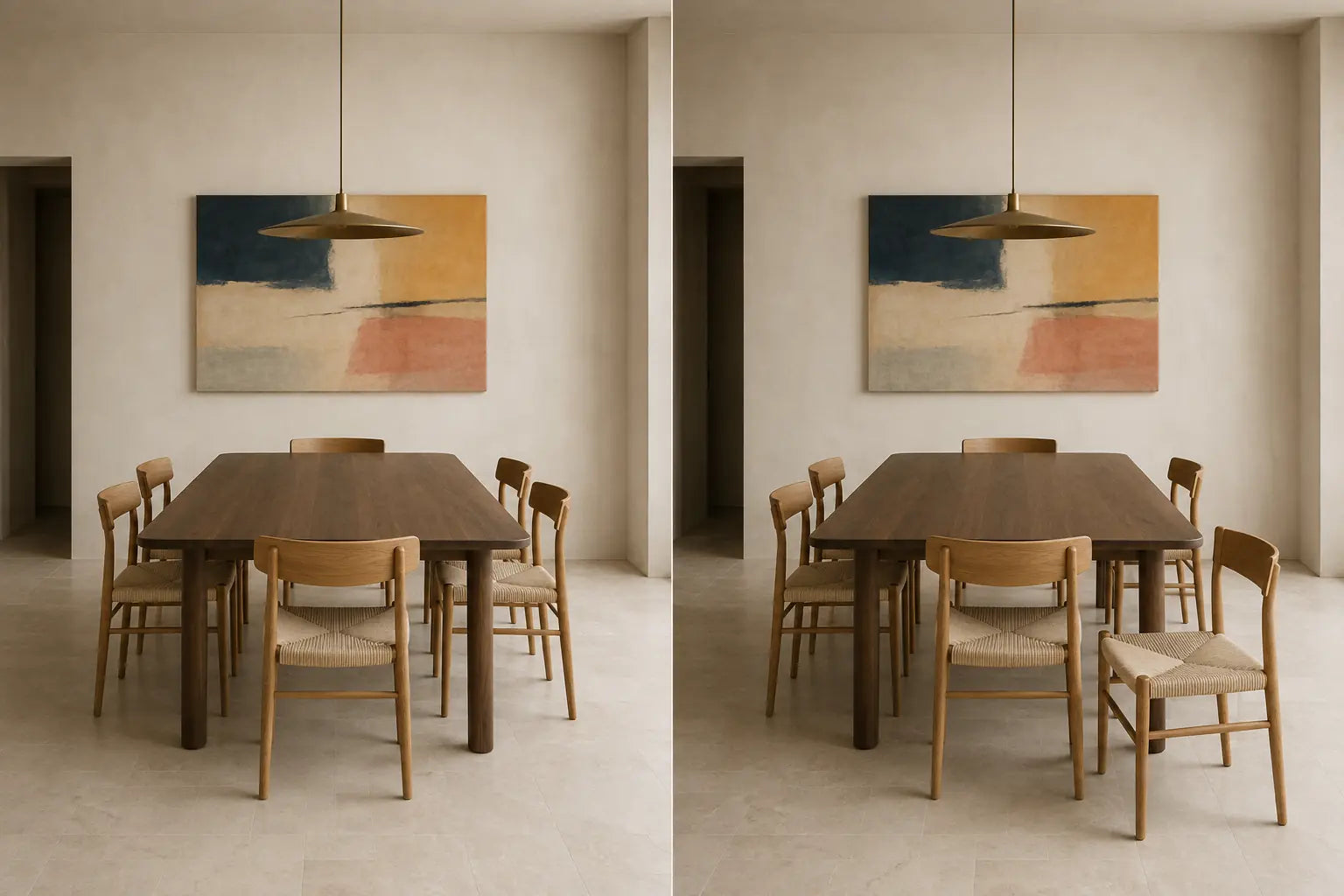
A dining table changes state. Chairs pull out, people occupy the lower view, leaves extend, centerpieces appear, and a pendant may cross the canvas from one seat but not another. The arrangement used for a meal can therefore differ materially from the clean frontal photograph used to shop for art.
That is why “center it on the table” and “center it on the wall” are incomplete. Each names a possible carrier; neither proves which relationship remains intentional. The table may lead, a bounded wall bay may be more stable, or a sideboard directly below the canvas may become the immediate anchor. The artwork must also be treated as a complete outside footprint—including all panels and installed gaps—not merely as an appealing image.
Begin by deciding whether this is the right wall. Artesty’s guide to choosing wall art for your home separates that room-level choice from the local dining-table decision. Reject a location in a routine impact path, sustained direct sun, or recurring food, beverage, or cleaning contact that the selected product and care instructions do not support.
HOST means HOLD the dining field, OWN one stable carrier, SCALE the complete footprint, and TEST the unchanged candidate. It does not replace product dimensions, wall assessment, electrical guidance, or professional installation. It turns a styling opinion into observations that can support a purchase—or prevent the wrong one.
Use HOST to Make One Decision at a Time
HOST separates room facts from artwork variables. Document the field, choose one relationship, compare complete footprints, and then try to disprove the preferred option.
HOLD — Record the Complete Dining Field
Record the ordinary meal state before tidying for a photograph: table edge, tucked and pulled-out chairs, high backs or bench, pendant, normal centerpiece, openings, sideboard, rug, and useful seated views. If the table extends, record the real hosted state with its leaf and extra chairs.
Mark each element as fixed, moving, or temporary. The table center may stay fixed while its ends move; chairs move within a predictable active envelope. Prioritize the closest diner, most obstructed seat, doorway, and adjoining-room approach. The purpose is to show what must remain legible when the room is in use.
OWN — Name One Stable Carrier
A carrier is the stable line or bounded field to which the art registers: table centerline, visible table field, architectural bay, or an intervening sideboard. Name one carrier and one primary view in plain language.
Do not average competing centers automatically. Place the same full-size template first on the table axis and then on the wall-bay axis, holding size, height, orientation, and image constant. If neither position looks intentional, this wall may not offer a stable carrier.
Registration comes before format preference. A rectangular table does not require horizontal art, nor does a round table prescribe round or square art. Once the carrier is stable, use the orientation guide to compare actual crops within the accepted field.
SCALE — Compare the Complete Outside Footprint
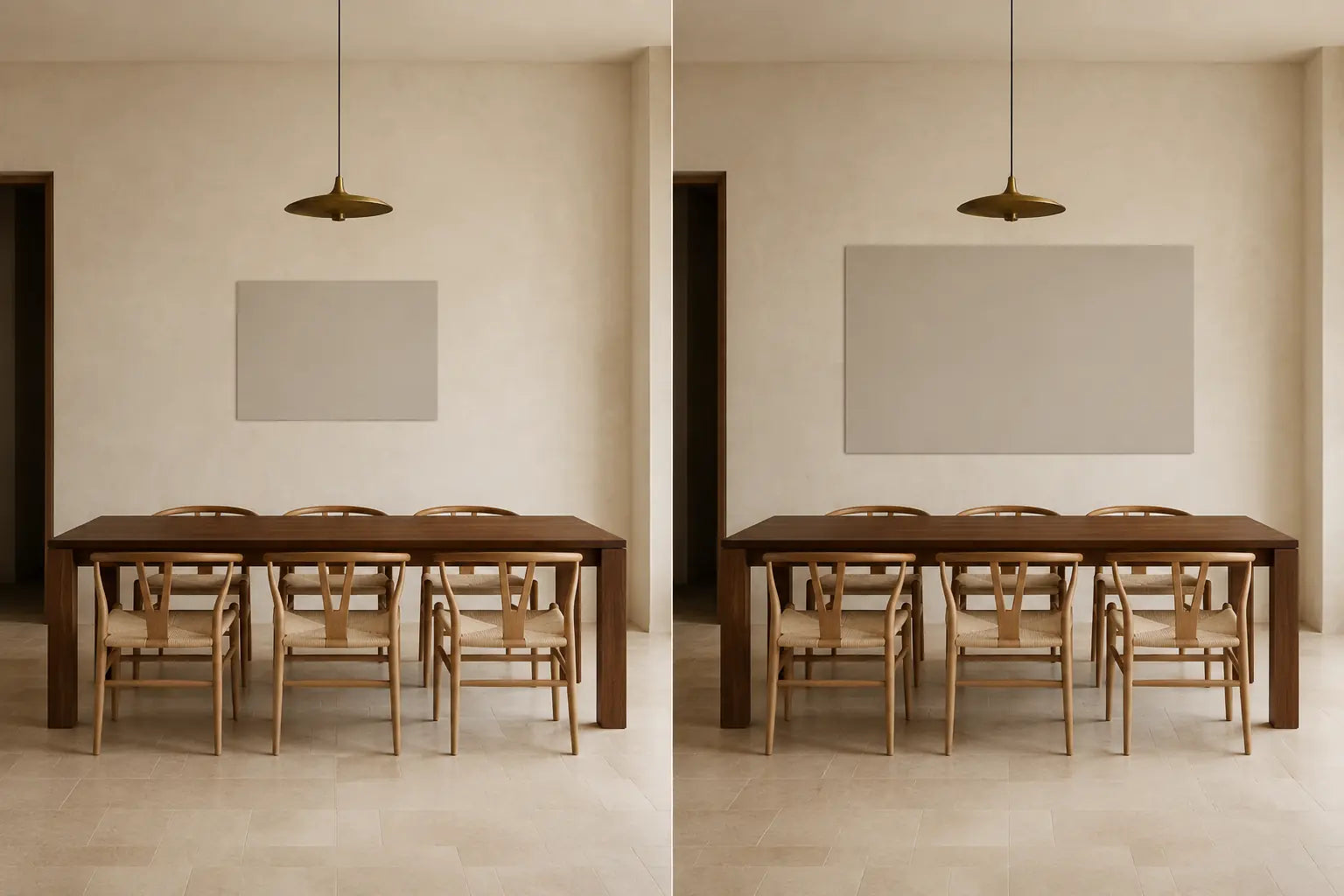
Make full-size removable-paper templates for plausible candidates. Outline the complete installed group, including panel gaps. Preserve center and aspect while comparing compact and generous footprints. Inspect the wall left around each template and the important subject field; a balanced boundary can still place a focal area behind a chair back or pendant.
Use Artesty’s wall art size guide for dimension calculations after HOST narrows the range. If deciding between one work and a divided format, review one large canvas versus three-panel wall art, then return the complete boundary to this test.
TEST — Try to Disprove the Unchanged Candidate
Leave the template unchanged. Review it from the most obstructed chair, doorway, and adjoining-room approach, then in ordinary and extended table states and normal light states. Reject an option that works only from a centered standing camera, an empty room, or after ordinary objects are removed. For the next trial, change registration, footprint, crop, or wall—only one.
After carrier and footprint survive, use Artesty’s height and spacing guide and the selected product’s information. HOST tests seated and standing readability; it prescribes no universal centerline, fixture gap, hook, or fastener.
What Should Control the Next Test?
Use the observed condition, not a favorite rule, to choose the next variable. The table below routes each common condition to one controlled comparison and names the signal that should stop it.
On narrow screens, scroll this table horizontally to compare every decision column.
| Observed condition | Stable carrier to test | Change only | Reject signal | Delegated owner |
|---|---|---|---|---|
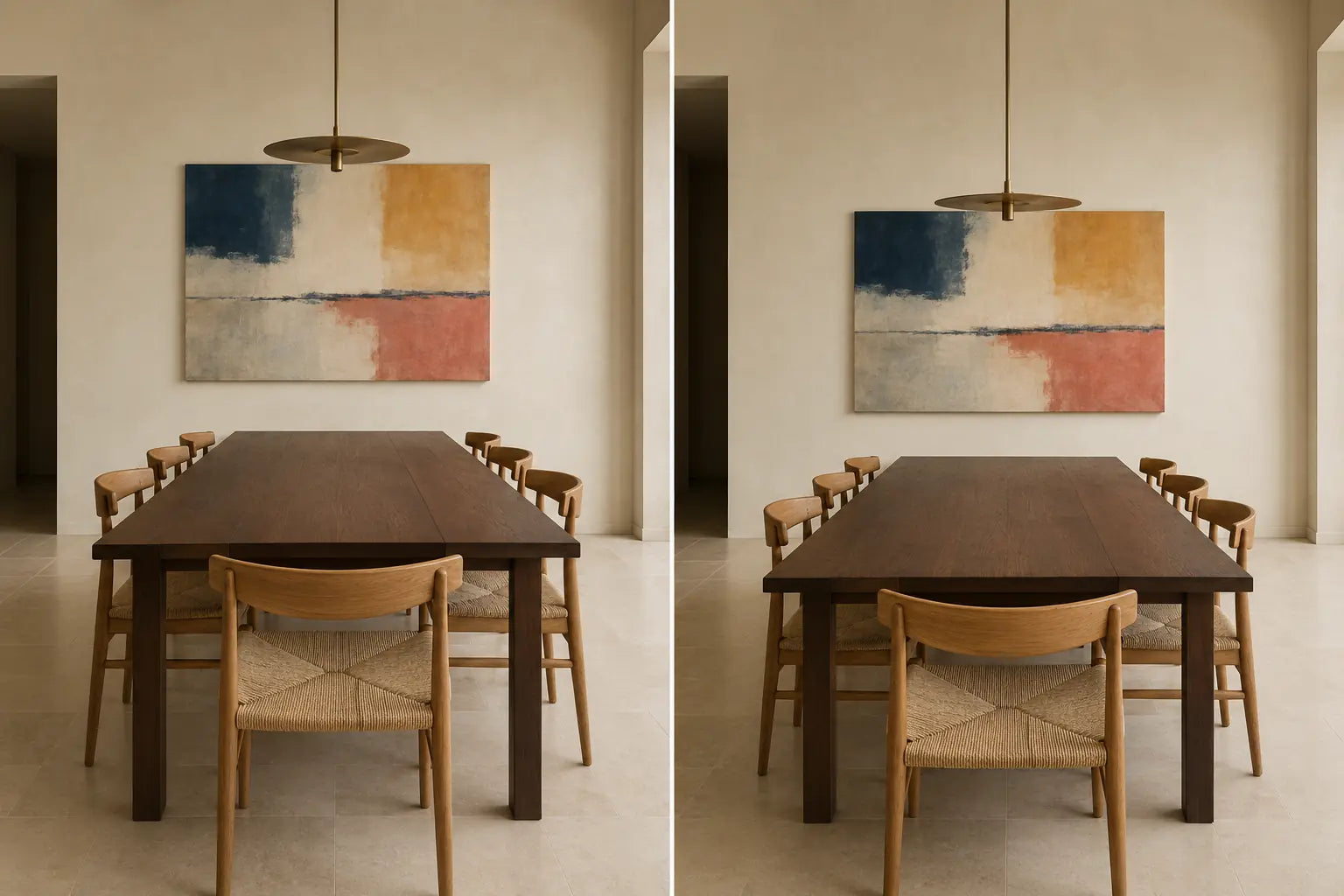
| Fixed rectangular table and clear wall | Table centerline and visible daily length | Complete artwork footprint | Art floats beyond the table field or crowds the usable wall | Exact dimensions: size guide |
| Extendable table | Unchanged centerline or stable wall bay | Daily versus extended table state | Candidate works in only one state | HOST |
| Round table on a broad wall | Defined wall bay or verified fixed axis | Registration before orientation | “Round table means round art” is the only rationale | Format guide |
| Table offset by doorway or window | Priority sightline plus table axis | Table-centered versus wall-centered registration | A compromise midpoint looks accidental from both views | HOST |
| Sideboard between wall and table | Sideboard rather than distant table | Sideboard-based footprint | Art is sized to the table while visually attached to the sideboard | Size and height guides |
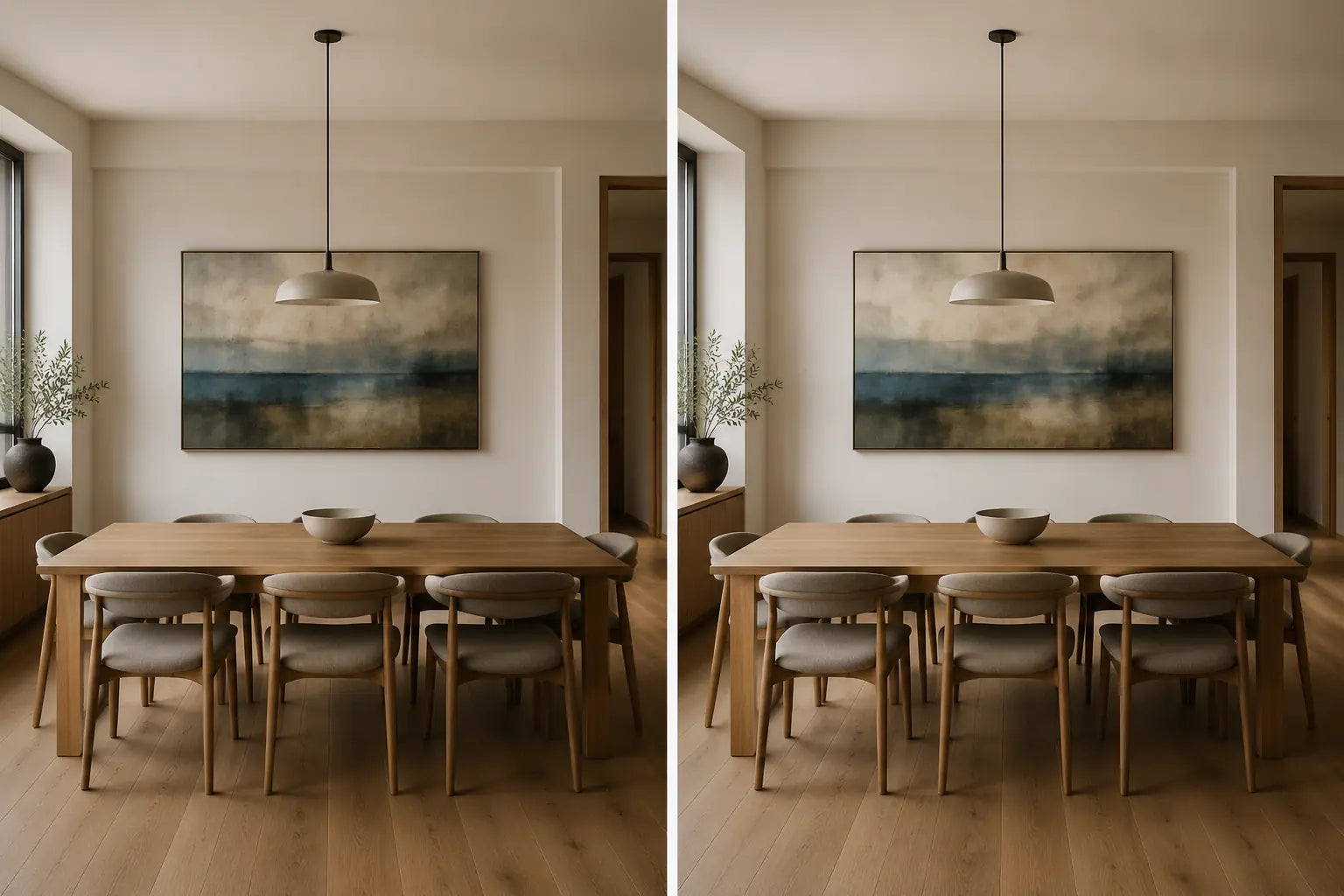
| High backs, bench, or occupied seats | Clear subject field above normal occupancy | Occupied versus empty state | A key subject disappears during meals | HOST |
| Pendant or recurring centerpiece crosses the view | Unobstructed field from priority seats | Same installation in its normal object and light state | Art reads only after ordinary objects are removed | Local sightline; fixture work excluded |
| Open-plan dining zone | Stable dining carrier plus adjoining-room view | Viewing position | Dining art competes with the primary living-room art | Open-plan guide |
Six Dining-Room Scenarios
Fixed Rectangular Table on a Clear Wall
- Evidence
- Table position and chair count are stable, the wall is clear, backs are low, and the doorway and primary seat reveal the table axis.
- Decision
- Register one template to the table axis. Compare compact, middle, and broad footprints while holding subject, vertical coordinate, and orientation. Preserve wall at the boundaries and a connection to the occupied dining field.
- Reject
- Reject a generic percentage, a broad template that consumes the wall boundary, or a compact one that disconnects from the table ends.
- Retest
- Occupy the chairs and view the unchanged template in normal evening light from both ends and the doorway.
Extendable Table Used in Two Lengths
- Evidence
- The centerline stays fixed, while outer edges, end chairs, and occupancy change when a leaf opens. This is a recurring state with real extra chairs.
- Decision
- Hold one artwork footprint against both records. Let the unchanged centerline carry the relationship instead of chasing temporary edges.
- Reject
- Reject a canvas resolved only in one table state, or a test in which the art moves between states.
- Retest
- Build the genuine hosting arrangement and repeat the seated and doorway views. If no footprint survives, test a stable wall bay or another wall.
Round Table Against a Broad Rectangular Wall
- Evidence
- The table has no long edge, while a wall return, doorway, molding bay, or fixed pendant may offer a clearer line.
- Decision
- Register a neutral template to the stable wall field. After accepting its boundary, compare actual crops while keeping the axis fixed.
- Reject
- Reject the claim that a round table requires round, square, or “soft” art, or a crop that works from only one seat.
- Retest
- Walk around the table, sit in every common chair, and check the doorway and pendant silhouette.
Table Intentionally Offset for Circulation
- Evidence
- A doorway, window, radiator, or walking route makes the table center differ from the usable wall center. The offset is permanent.
- Decision
- Name the priority view, then compare table and architectural registration with the same template. Shift only its horizontal center.
- Reject
- Reject a midpoint aligned with neither carrier, or a test that changes size or height while moving the template.
- Retest
- Open the door or curtain, walk the route, and review the unchanged candidate while entering and seated. If views conflict, name the owner or choose another wall.
High Backs, Dining Bench, Pendant, or Centerpiece
- Evidence
- Chair backs, people, a bench, pendant, or normal centerpiece covers part of the image from a used seat. It is ordinary dining, not removable clutter.
- Decision
- Protect a clear subject zone. Change footprint, crop, orientation, or wall while keeping the carrier fixed for each comparison.
- Reject
- Reject a staged decision with chairs removed, table bare, or pendant absent when those states are abnormal. Do not alter electrical fixtures from this test.
- Retest
- Fill the seats, restore the centerpiece and normal light, and inspect the most obstructed position. If the subject disappears, change one variable or location.
Open-Plan Dining Area Seen From Another Room
- Evidence
- The dining canvas is seen close while seated and obliquely from another zone, where a different artwork may already lead.
- Decision
- Give it a clear local role, then test the unchanged option from the connecting route. Artesty’s guide to wall art in open-plan living spaces owns the wider hierarchy.
- Reject
- Reject a candidate that works only at the table or creates two equal focal demands from the approach.
- Retest
- Walk the route in daylight and evening light. Preserve an artwork that is distinct nearby and supportive at a distance.
Build a Pre-Purchase Brief You Can Retest
Before choosing a product, reduce the observations to one short brief. Record the daily and hosting states, the elements that move, the stable carrier, the primary and most obstructed views, the accepted outside footprint, and the first reject signal. Add daylight and evening photographs taken from the same positions. The brief should be specific enough that another person can repeat the test without being told which answer you prefer.
List the candidate artwork separately: exact product dimensions, orientation, complete multi-panel boundary if applicable, subject areas that must remain visible, supplied hanging information, and the care notes relevant to the location. If a multi-work arrangement is still under consideration, pause and use the gallery wall planning guide before treating the group as one completed footprint.
Existing room materials are evidence, not commands. Photograph the wall finish, timber, upholstery, flooring, and normal light with the candidate image at a realistic scale. If a rug already defines the dining zone, keep it present during the test; Artesty’s guide to wall art with an area rug handles the separate relationship between pattern, color, and visual priority. Do not buy a new rug to make an unproven canvas work.
Finish the brief with an outcome, not a wish list: proceed to installation planning, compare one revised footprint, use another wall, postpone, or buy nothing. “No stable carrier” and “subject remains obstructed” are useful findings. They prevent a product decision from outrunning the room evidence. When the brief supports a purchase, verify current product details and obtain appropriate advice for wall construction, fasteners, property rules, and any electrical or high-access work.
Frequently Asked Questions
Should wall art be centered on the dining table or the wall?
Use the axis that stays intentional across normal table states and the priority view. Test the same full-size template centered first on the table and then on the bounded wall field. Keep size, height, and orientation unchanged. Do not average the two centers automatically; a midpoint can look unrelated to both. If a sideboard sits directly below the artwork, it may become the more immediate carrier.
What size wall art should go above a dining table?
Compare the complete outside footprints of realistic candidates against the actual table-and-chair field, including any extended state. Furniture percentages may help generate templates, but they do not guarantee a result. Preserve the footprint that remains connected without crowding wall boundaries or losing its subject behind normal occupancy, then use the dedicated sizing guide for exact calculations and panel gaps.
How high should art hang above a dining table?
No single height fits every table, chair, viewer, wall, and fixture. First stabilize registration and footprint. Then test the unchanged template from seated and standing positions and follow the selected product’s information and the dedicated height guide. Final mounting must account for wall construction, hardware, property rules, and safe access; this article does not specify a hook or fastener position.
What if the dining table extends?
Document the ordinary and extended arrangements separately. If the centerline remains fixed, test whether one canvas footprint still reads as intentional in both lengths, including extra chairs. Do not slide the art for hosting. If no unchanged candidate survives, use a stable architectural bay, another wall, postponement, or no artwork rather than designing only for the table’s photogenic state.
Does a round dining table need round or square wall art?
No. Table shape is one piece of evidence, not an orientation rule. A wall bay, doorway, molding, pendant, or approach sightline may provide the stronger geometry. Accept the carrier and outside boundary first, then compare actual crops. The successful format is the one that preserves a clear subject field and remains coherent from the seats and approach you use.
Should a pendant light and wall art share the same centerline?
Only when the pendant is genuinely fixed to the same stable dining axis and does not obscure the important image area from priority seats. Treat alignment as a candidate to test, not a requirement. Do not move, modify, or install electrical fixtures based on this article; keep the normal fixture state present while evaluating the artwork.
What if a sideboard sits between the table and the wall?
The sideboard usually becomes the immediate furniture carrier because it occupies the visual space directly below the canvas. Record the dining table as context, but test the artwork footprint and registration against the sideboard first. Delegate exact size and vertical placement to the relevant guides. If the sideboard and table propose conflicting centers, name the priority view instead of averaging them.
What color or subject works best in a dining room?
There is no universal appetite color, conversation subject, or mood guarantee. Compare a real candidate against the fixed wall, timber, upholstery, flooring, and normal daylight and evening light. Make sure its important subject area remains legible from occupied seats. Choose what you want to live with; reject broad psychology claims that promise a behavioral effect from one palette.
Sources, Qualification, and the Next Step
HOST is an Artesty editorial pre-purchase method, not structural, electrical, accessibility, conservation, or installation advice. It uses repeatable room observations and full-size templates to separate dining-table registration from the different questions of exact dimensions, height, format, and hardware. The controlled images above are generated decision aids, not product photographs, measured experiments, or records of a universal result.
For cautious location screening, the Canadian Conservation Institute’s basic care guidance for paintings supports avoiding physical contact and inappropriate display exposure. That source does not predict the durability of a particular Artesty product or create museum conditions for a home. Current product information, supplied care and hanging details, wall construction, fasteners, building rules, and qualified professional guidance control the final installation.
This article covers residential dining rooms. Public dining spaces involve different guest, staff, operational, maintenance, and regulatory questions; use Artesty’s separate guide to planning restaurant wall art for that context.
Once the HOST brief leaves one stable carrier and one footprint worth considering, browse Artesty canvas wall art and compare current product dimensions and imagery against the unchanged templates before making a final choice.