

Wall Art for a Reading Nook: How to Balance the Chair, Books, and Light
NEST field guide · Artesty editorial
A reading nook is a small use zone with several possible visual owners. Test the artwork against the chair, books, light and real sightlines without turning one staged view into a rule.
Quick Answer
Choose wall art for a reading nook by treating the nook as a working visual zone, not as leftover wall above a chair. First, NAME what owns the composition: the chair alone, the complete chair–table–lamp group, a window seat, or a defined alcove. Next, ENVELOPE every fixed and normally moving edge, including the chair back, lamp silhouette, bookshelf, trim, curtain, door and the complete outside outline of the artwork. Then SETTLE the hierarchy by comparing the same footprint with a quieter or stronger tonal range while the room stays unchanged. Finally, TEST the surviving candidate from the seat, the room entrance and an ordinary approach, with the lamp and window treatments in their normal states. Keep a piece only when its owner remains clear, its full outline has relief, and it does not depend on a single staged photograph. If books, a view or the architecture already completes the nook, another wall—or no purchase—is a valid result. NEST is a repeatable selection test, not a universal size, height or lighting formula.
What the Reading-Nook Wall Must Actually Solve
A reading nook can be an armchair in an open living room, a built-in window seat, a bedroom corner, a landing, or a shallow recess. Its identity comes from use and grouping rather than square footage. A chair may be the obvious anchor, yet the real composition often includes a reachable surface, a floor lamp, nearby books, a rug edge, trim, and the sightline from which people discover the nook. Wall art has to join that complete field without turning a useful corner into a display assembled only for a frontal photograph.
This article owns one decision: whether a canvas belongs in that compact reading-use zone, which visible owner should carry it, and whether the complete candidate survives normal views and states. It does not prescribe reading ergonomics, bulb specifications, wiring, shelf installation, furniture anchoring, window-covering safety, artwork mounting or a universal gap above a chair. Use the whole-home wall-art selection guide to decide whether the nook is the right wall at all. General dimensions belong to the wall-art size guide; attachment height belongs to the hanging-height guide. Fixed cabinetry belongs to the built-in-shelves guide, while wall-mounted lighting belongs to the wall-sconce guide.
The distinction matters because search results frequently collapse three different requests: art depicting a cozy reading nook, literary or quote art for book lovers, and art selected for a real chair-and-books zone. NEST addresses the third. Subject remains personal. A botanical image, abstraction, map or portrait can all pass if its object boundary and visual role work in the room. No genre is automatically more restful, intelligent or suitable for reading.
The NEST Method for Choosing Reading-Nook Wall Art
NAME — Declare What the Artwork Belongs To
Begin with a plain sentence: “The artwork belongs to ___.” The answer might be the chair, the complete chair–table–lamp group, the window-seat bay, or the open wall seen from the seat. Do not begin by centering on the entire wall. A nook inside a larger room often has a local axis that differs from the architectural midpoint.
Photograph the nook from its main entrance and mark the visible group. Hold the canvas size, height and image constant while comparing only credible horizontal registrations. One position may connect cleanly to the chair; another may acknowledge the complete furniture group. Name the visual leader as well: art, books, a window view, or the seat. Everything else should support rather than compete by default.
Pass when another person can identify the same owner without seeing your measurement marks. Reject a midpoint that belongs to neither the nook nor the room, or a placement justified only by empty plaster. NAME output: one owner sentence, one leader/support sentence and one registration line to test.
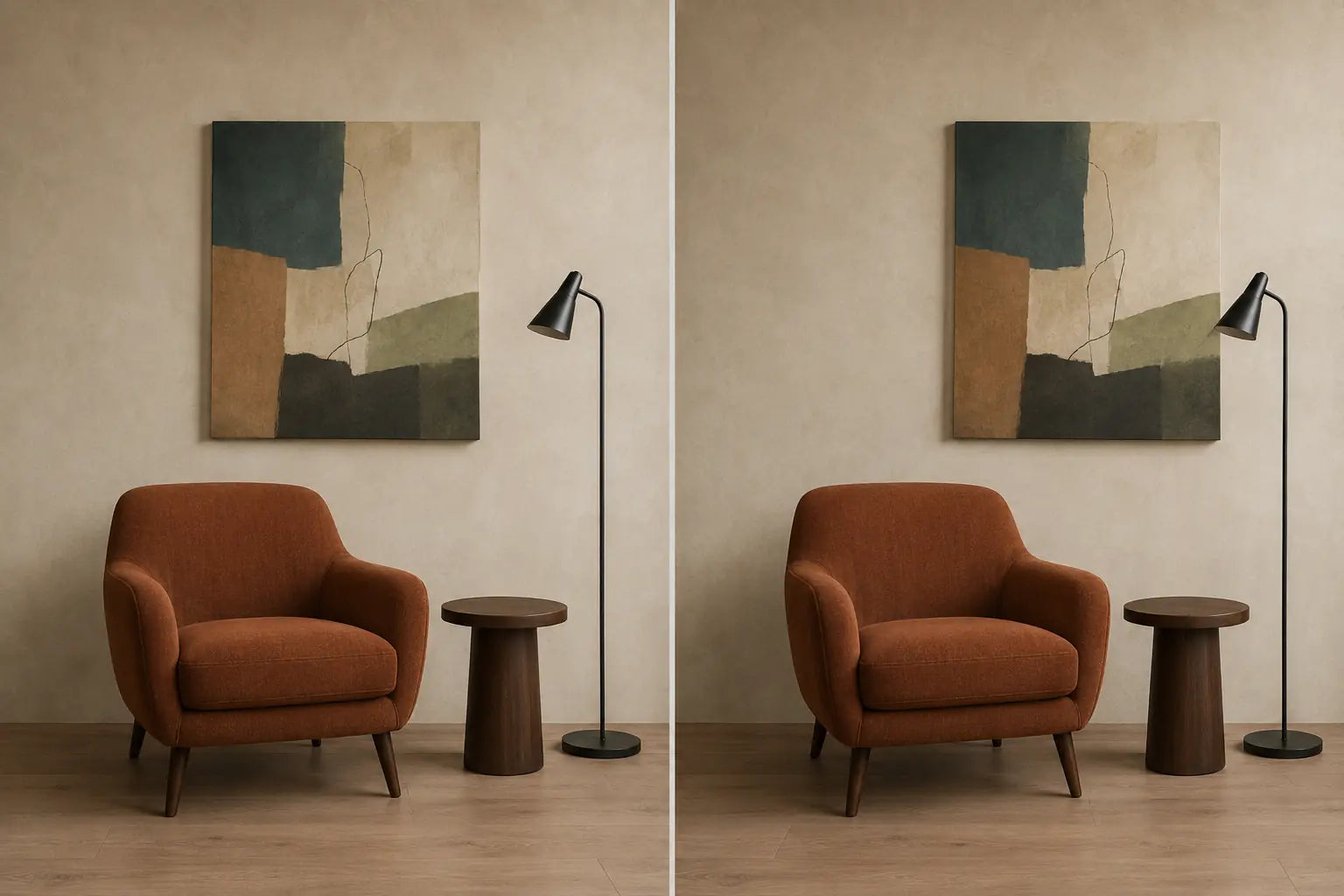
ENVELOPE — Map the Complete Stable Field
The visible canvas image is not the whole candidate. Record the outside edge of the canvas or frame; for a pair, gallery group or multi-panel work, include every panel and every gap. Make a removable paper outline for each shortlisted footprint and keep its aspect ratio honest. The orientation guide can narrow vertical, horizontal or square formats before NEST tests the resulting object in this particular zone.
Now map the nook’s ordinary operating field: chair back and normal recline, lamp stem and shade, side table, bookcase edge, door swing, window trim, curtain or shade movement, sloped ceiling and reachable shelf objects. Do not move a lamp or unload books merely to make an outline fit. When fixed casework forms the architecture, resolve that architectural field first; NEST then evaluates the surviving wall as part of the reading zone.
Change only proportional footprint or one registration at a time. Pass when the complete outline has visible relief in ordinary use. Reject a candidate that merely avoids physical overlap yet crowds the lamp, trim, shelf or chair silhouette. ENVELOPE output: one viable outside outline and a list of the edges that must remain clear.
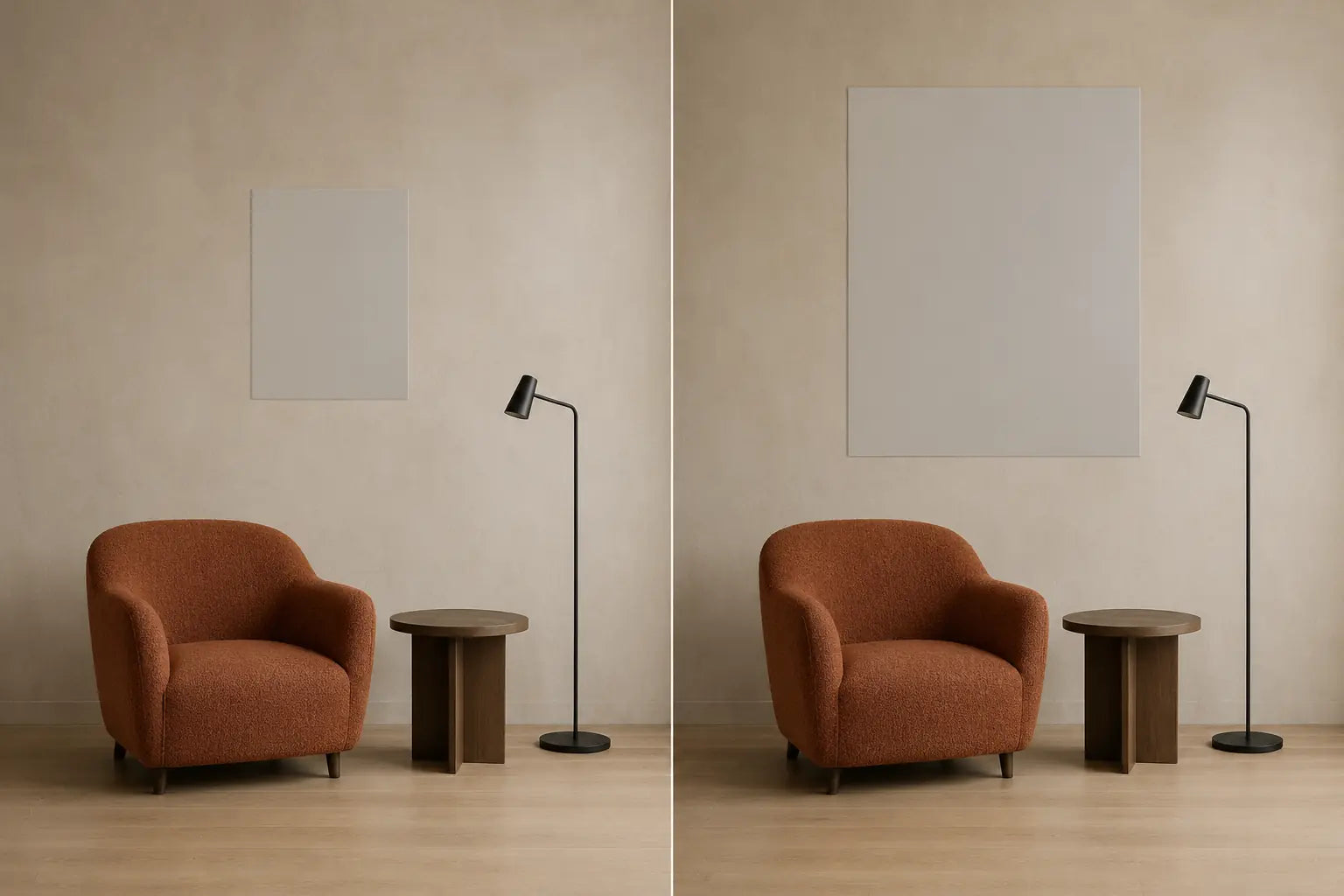
SETTLE — Choose the Nook’s Visual Tempo
“Cozy” is not a measurable art style. Translate it into a visible hierarchy instead. Decide whether the canvas should be first attention, a quiet pause beside dense books, or a supporting bridge between chair, lamp and wall. Keep footprint, position and main hue families fixed while comparing one artwork variable, such as light-to-dark range or internal mark density.
A bookcase already supplies many small edges, colors and repeated verticals. An equally busy canvas may create useful energy, but it may also leave no place for the eye to pause. Conversely, a very low-contrast work can disappear when the nook is seen from across the room. Neither result is universally wrong. The test asks whether the chosen hierarchy remains legible. If pattern owns the background, delegate that rivalry to the patterned-wallpaper guide.
Pass when you can state “___ leads; ___ supports; this visible cue connects them.” Reject a palette match that does not resolve crowding, or a subject chosen only because it repeats books. SETTLE output: one hierarchy sentence, one connecting cue and the single image variable that produced the clearer result.
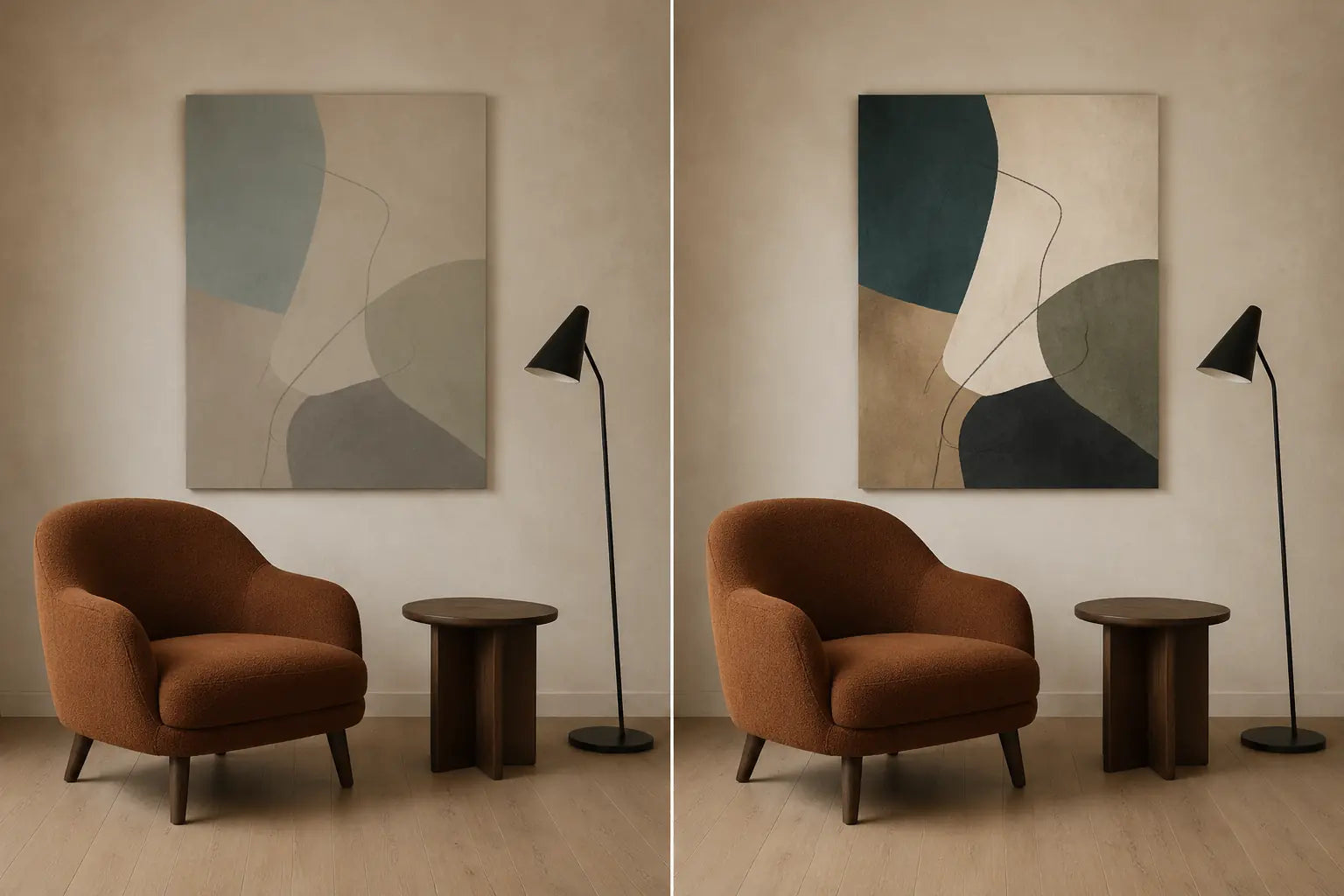
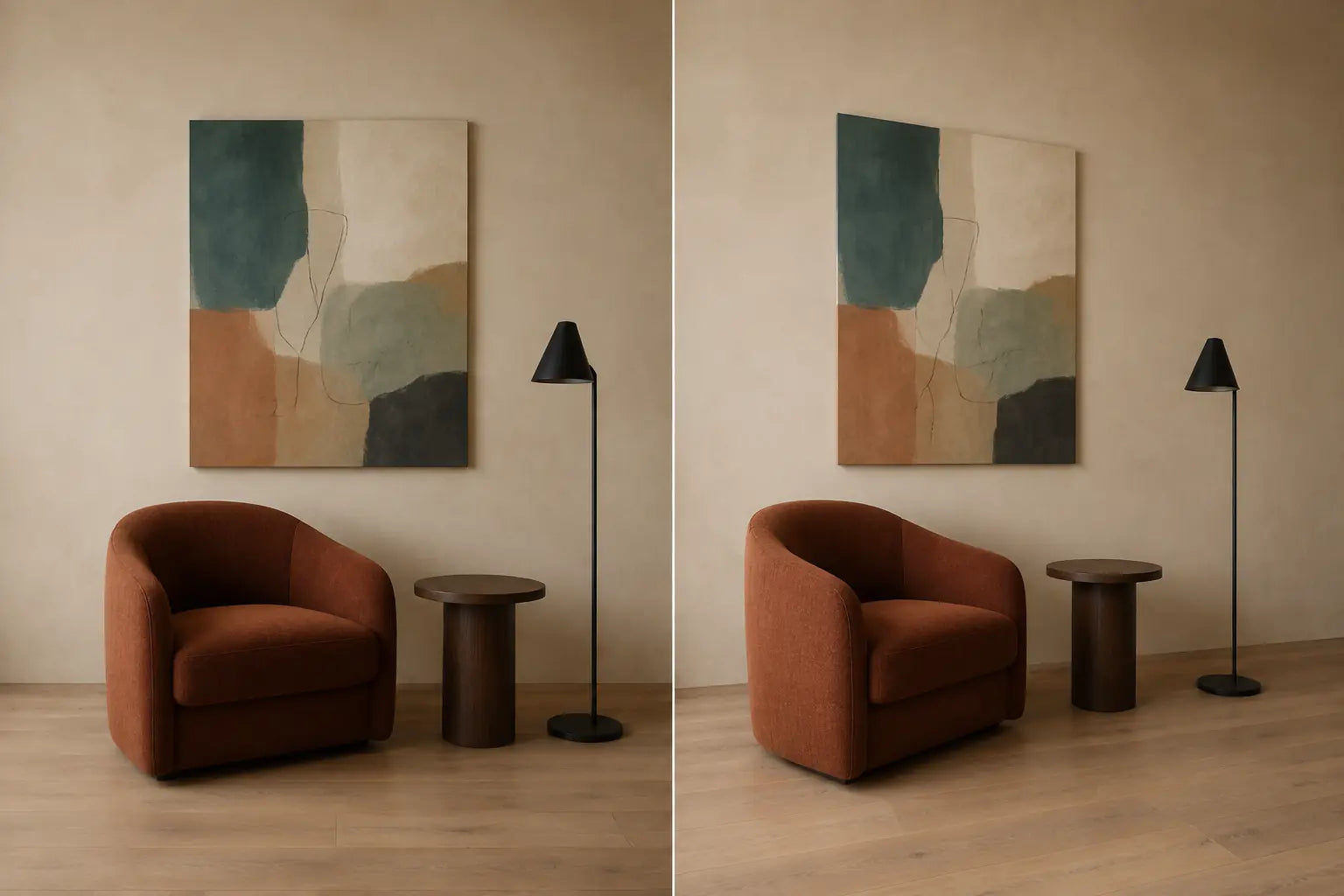
TEST — Keep the Candidate Fixed and Change the View
A reading nook is experienced from at least two places: inside the seat and on approach. Keep the artwork, footprint, position, furniture and styling unchanged. Check the near-frontal room-entry view, the seated glance, and one honest oblique approach. If the chair faces away from the art, decide whether the artwork is intended to mark the nook for the room rather than serve as the reader’s view. That can be a valid, explicit role.
Observe normal existing states: floor lamp off and on, curtains or shades in the positions actually used, and books at their ordinary load. If the canvas occupies a pier between windows, the between-windows guide owns trim, daylight and view competition. If a wall sconce shares the field, its dedicated guide owns fixture silhouettes and off/on effects. NEST does not rate a light source or prescribe changes to it.
Pass when the same candidate retains a clear owner and unobstructed content across the important views and ordinary states. Reject a result that succeeds only after furniture is shifted for a photograph, or one whose focal area disappears on approach. TEST output: keep, revise one named artwork variable, use another wall, or make no purchase—with the first failed view written down.
Decision Router: Start With the Condition You Can Observe
Do not run every possible comparison at once. Find the strongest visible condition, use the first NEST action in the router, and hold the listed variables constant. A successful row removes one uncertainty; it does not approve the purchase by itself. Carry the survivor through the remaining stages.
On a narrow screen, scroll this table horizontally to read every column.
| Strongest visible evidence | First controlled comparison | Hold constant | Reject or delegate when |
|---|---|---|---|
| Chair and furniture-group centers disagree | Same canvas on each declared registration | Footprint, height, image, room state | Neither line visibly owns the nook |
| Bookcase outweighs the chair | Quiet versus stronger art at one footprint | Normal book load, position, hue families | Art and books remain equal rivals |
| Lamp crosses the proposed field | One revised footprint or registration | Lamp model, ordinary position, chair | A wall fixture or electrical question owns the problem |
| Window treatment changes the field | Same outline through normal open/closed states | Canvas, seat, camera | No stable plaster remains or cords/safety are unresolved |
| One canvas and a grouping both fit | Compare their complete outside boundaries | Nook owner, center line, room state | Arrangement mechanics, not nook ownership, decide the result |
| Placement works standing but not seated | Same candidate from both views | Image, footprint, furniture | Height or mounting calculation needs its specialist guide |
If no row produces a stable candidate, stop. An empty wall inside a reading nook is not automatically incomplete; negative space may be what lets the chair, books or view remain legible.
Six Reading-Nook Scenarios
An Armchair and Floor Lamp in an Open Living Room
- Evidence
- The room’s architectural center and the chair group have different axes. The lamp adds a tall silhouette, while the nook is first seen from a doorway or sofa.
- Decision
- Register the same canvas first to the chair, then to the complete chair–table–lamp group. Name whether art or seating should lead.
- Reject
- Reject centering on the whole wall when the art reads detached from the nook, or moving the lamp only for the final photograph.
- Retest
- Hold canvas, furniture and styling fixed. Compare entrance, seated and across-room views; change only horizontal registration if ownership fails.
A Window Seat With Curtains or Shades
- Evidence
- Trim, fabric, controls, daylight and the exterior view alter the usable field. The nook may be strongest when the window, not art, leads.
- Decision
- Use only a wall section that stays stable through normal treatment positions, or test an adjacent return wall. Give the view a declared role.
- Reject
- Reject an outline measured with curtains staged open once, content masked by a normal fabric position, or a forced canvas above a complete architectural bay.
- Retest
- Keep the candidate unchanged and observe ordinary open/closed states from the seat and room approach. Reroute window-specific placement to its specialist guide.
A Narrow Bay Beside a Bookcase
- Evidence
- Book spines create dense small edges while the plaster bay limits width. A freestanding case may also move, unlike fixed millwork.
- Decision
- Decide whether books or art leads, then preserve enough visible wall for that hierarchy to read. Test one honest outside outline.
- Reject
- Reject matching every book color, filling every remaining inch, or evaluating an unusually empty shelf instead of its normal load.
- Retest
- Hold the book load, chair and lamp constant. Change only artwork contrast or footprint, then observe from the seat and main approach.
An Under-Stair or Recessed Alcove
- Evidence
- A slope, return wall, low ceiling and oblique approach define an irregular carrier. The opening can look larger in a straight-on photograph than in motion.
- Decision
- Name one stable line—the seat group, a vertical return or a usable rectangular field—and register a compact candidate to it.
- Reject
- Reject treating the alcove as a conventional rectangular wall, or selecting art whose upper corner crowds the slope from the approach.
- Retest
- Keep chair and art fixed. Walk the ordinary route and check the seated view. If ownership collapses, test another wall or leave the recess unfilled.
A Bedroom Reading Chair Competing With the Bed Wall
- Evidence
- The headboard may already be the room’s primary anchor. A second forceful composition can split attention even when both fit physically.
- Decision
- Make nook art deliberately supporting, or place it on the wall seen from the chair rather than automatically above the chair.
- Reject
- Reject two equal focal walls created without intent, or art whose apparent role changes unpredictably between doorway, bed and seat.
- Retest
- Keep the candidate and bedroom unchanged. Compare those three views; adjust only tonal contrast or choose the alternate wall.
A Child or Shared Family Reading Corner
- Evidence
- Low seating, reachable objects, freestanding storage and window coverings change the use boundary. Furniture and styling may change more often than in an adult nook.
- Decision
- Confirm safety and manufacturer instructions independently before visual selection. Use only a stable, approved field and treat art as optional.
- Reject
- Reject any layout that depends on unverified furniture stability, reachable cords, improvised mounting or moving safety-critical objects for appearance.
- Retest
- Resume NEST only after the furniture, window-covering state and mounting location are independently confirmed. Then change one artwork variable at a time.
Your Pre-Purchase Reading-Nook Brief
Write the brief before opening many product tabs. Use photographs and observable failure conditions rather than a mood-board adjective. A second person should be able to reproduce the comparison without guessing why one candidate survived.
- Nook type: chair group, window seat, alcove, landing, bedroom corner or another real use zone.
- Owner sentence: “The artwork belongs to ___.”
- Leader/support sentence: name art, books, view, seat or architecture as leader, then name the supporter.
- Primary view: entrance, sofa, doorway, bed or another position from which the nook is discovered.
- Seated view: record whether art is faced, peripheral, behind the reader or intentionally room-facing.
- Fixed field: chair back, table, fixed cabinetry, trim, slope and other durable edges.
- Normal variables: lamp position, curtain/shade state, door movement and ordinary book load.
- Complete footprint: outside width and height, plus every frame edge, panel and gap.
- Registration: chair axis, complete group axis, bay, return wall or view wall.
- Image variable: contrast, mark density or another single visible characteristic to compare.
- First failure: write the exact view or ordinary state where the candidate stops working.
- Next action: keep, revise one artwork variable, use another wall or buy nothing.
Do not assume that an online image is offered in every size, format or presentation. Verify the current product page for the exact outside dimensions and options you shortlist. If a pair, gallery wall or multi-panel work survives NEST, use the one-canvas-versus-three-panel guide or gallery-wall guide for arrangement mechanics rather than inventing spacing inside this article.
For children’s spaces, treat product and safety instructions as gates, not decor variables. The U.S. Consumer Product Safety Commission provides current guidance on furniture tip-over prevention and window-covering cords. NEST does not replace those instructions or provide installation advice.
Frequently Asked Questions
1. What kind of wall art works in a reading nook?
Any subject can work when the complete object has a clear owner, enough relief and an intentional visual role. Choose something you want in the room; do not rely on unsupported claims that one genre improves focus or calm. Test footprint and hierarchy before narrowing subject.
2. Should art hang behind the chair or on the wall seen from the seat?
Either can be correct. Behind-chair art may mark the nook for the room; faced art may serve the reader’s glance. NAME the intended audience and owner, then keep the candidate fixed while testing the seat and approach.
3. What size canvas works over one reading chair?
There is no universal size. Outline actual candidates and compare them with the complete chair–table–lamp group, not a generic chair width. Use the size guide for dimensional shortlisting, then return to ENVELOPE for the local fit.
4. How high should wall art hang above a reading chair or window seat?
Establish the owner and complete footprint first. Then use the hanging-height guide for vertical calculation and mounting planning. Retest the result from the seated and approach views; a standing-only view is incomplete.
5. Is one large canvas better than a small gallery wall?
Neither format wins automatically. Compare complete outside boundaries, including every gap, while holding the nook owner and center line constant. Prefer the option whose hierarchy remains readable beside books, lighting and architecture.
6. Should reading-nook art match the books, chair, rug or favorite genre?
It may connect through one secondary hue, direction or material cue, but literal matching is not required. State what leads and what supports. Repeating every book color can increase noise without creating ownership.
7. How should art work with a floor lamp, wall sconce, bookshelf or window?
Include each object’s normal silhouette and state in ENVELOPE. Keep a floor lamp in its ordinary position. Delegate fixed shelving, wall fixtures and window piers to their dedicated guides when those elements—not the reading zone—control the decision.
8. What changes in a child’s reading corner?
Safety confirmation comes before visual composition. Follow current product, furniture and window-covering instructions, and do not improvise anchoring or mounting from a decor article. Once the field is independently confirmed, NEST can test only the artwork decision.
Sources, Qualification, and Final Decision
Architectural Digest’s current reading-nook gallery demonstrates that the label covers many physical types—from alcoves and windows to landings and open corners. House Beautiful’s designer overview emphasizes that a nook must remain usable, with seating, light and storage considered together. These are design examples, not universal specifications. The CPSC resources cited above support the narrow child-space safety boundary; they do not validate NEST as an installation method.
The Library of Congress notes that light damage to collection materials is cumulative and that sunlight is difficult to control. That conservative preservation context supports checking ordinary light exposure and following applicable product-care information; it does not predict the life of every Artesty canvas or prescribe residential light levels. NEST is an original editorial decision aid. Its generated comparisons are illustrative, not measured experiments, product photographs, mounting instructions or evidence that a pictured work is currently available.
Keep the artwork only when the owner is legible, the full envelope has relief, the chosen visual tempo is intentional, and the unchanged candidate survives the seat and approach. Otherwise revise one named artwork variable, use another wall, or stop.