

Wall Art With Wall Sconces: How to Balance Light, Fixtures, and Canvas Space
HALO field guide
Quick Answer
Choose wall art with wall sconces by treating the fixtures as part of the composition both when they are off and when they are on. First, HOLD the fixed field: record every sconce body, shade, backplate, projection, direction of light and normal switch state before judging art. Next, ALIGN the complete artwork footprint—not just its printed image—to one visible owner such as the sconce pair, furniture axis, panel bay or intentional local zone. Then LEAD by deciding whether the art or the fixtures should attract attention first in each normal state. Finally, OBSERVE the unchanged candidate in daylight and evening, off and on, from the seated, standing and approach views that actually matter. Reject an option that crowds the fixtures, masks focal content, depends on one staged photograph, or produces distracting glare or shadows in ordinary use. If the fixtures are not finalized, pause the art decision. If no stable field remains, use another wall or buy nothing. HALO supplies a repeatable test, not a universal spacing formula.
Why Wall Sconces Change the Art Wall Twice
A sconce is never only a light source. When it is off, its shade, backplate, arm and material occupy the wall like a sculptural object. When it is on, the same fixture adds a bright source, a pool or direction of light, and sometimes a shadow. Wall art placed beside it therefore has to pass two related compositions without being redesigned between them.
This is why a canvas can look calm in a daylight photograph yet feel crowded in the evening. The fixture body may create one rhythm while the illuminated field creates another. A matched pair can frame a broad central zone; a single reading sconce can make asymmetry intentional; repeated corridor sconces can leave no bay that needs art at all. The useful question is not simply, “What size goes between the lights?” It is, “Which element owns this field, and does that ownership remain legible in normal use?”
HALO owns that combined decision. It begins only after the sconces are installed or their final locations and forms are confirmed. It does not select, wire, relocate or install fixtures; specify bulbs, wattage, lux, color temperature or dimming equipment; interpret electrical or building rules; or provide mounting instructions. If fixture work is unresolved, use the manufacturer’s documentation and an appropriately qualified professional before finalizing the artwork field.
The wider room choice still matters. Use the whole-home wall-art selection method to decide whether this is the right wall at all. HALO then tests the relationship among fixtures, artwork and the real viewing conditions. “Another wall” and “no purchase” are valid results, especially when the sconces already complete the architecture.
The HALO Method
HOLD — Record the Fixed Fixture Field
Photograph the wall from the primary view and one honest approach. Mark every sconce body, shade and backplate. Note normal arm or shade positions, light direction, and usual off, on or already-available dimmed states. Record the field in the room, not from a product image.
Separate fixed, regularly variable and temporary elements. Installed locations are fixed; a swing arm may vary; a styling prop is temporary. Only the first two categories control the boundary. The artwork must survive every ordinary position of a movable part.
Outline the complete art envelope: canvas or frame edges, or every panel plus every gap. Physical non-overlap is only the first gate; sconces can make clear plaster feel narrower. Compare exact outlines with the wall art size guide, but do not treat a ratio as proof.
Record molding, rails or panels as another fixed field. The guide to working with molding bays and wall panels helps identify whether a bay or the fixtures form the stronger boundary. HOLD output: an annotated photograph, a complete envelope and what can still change.
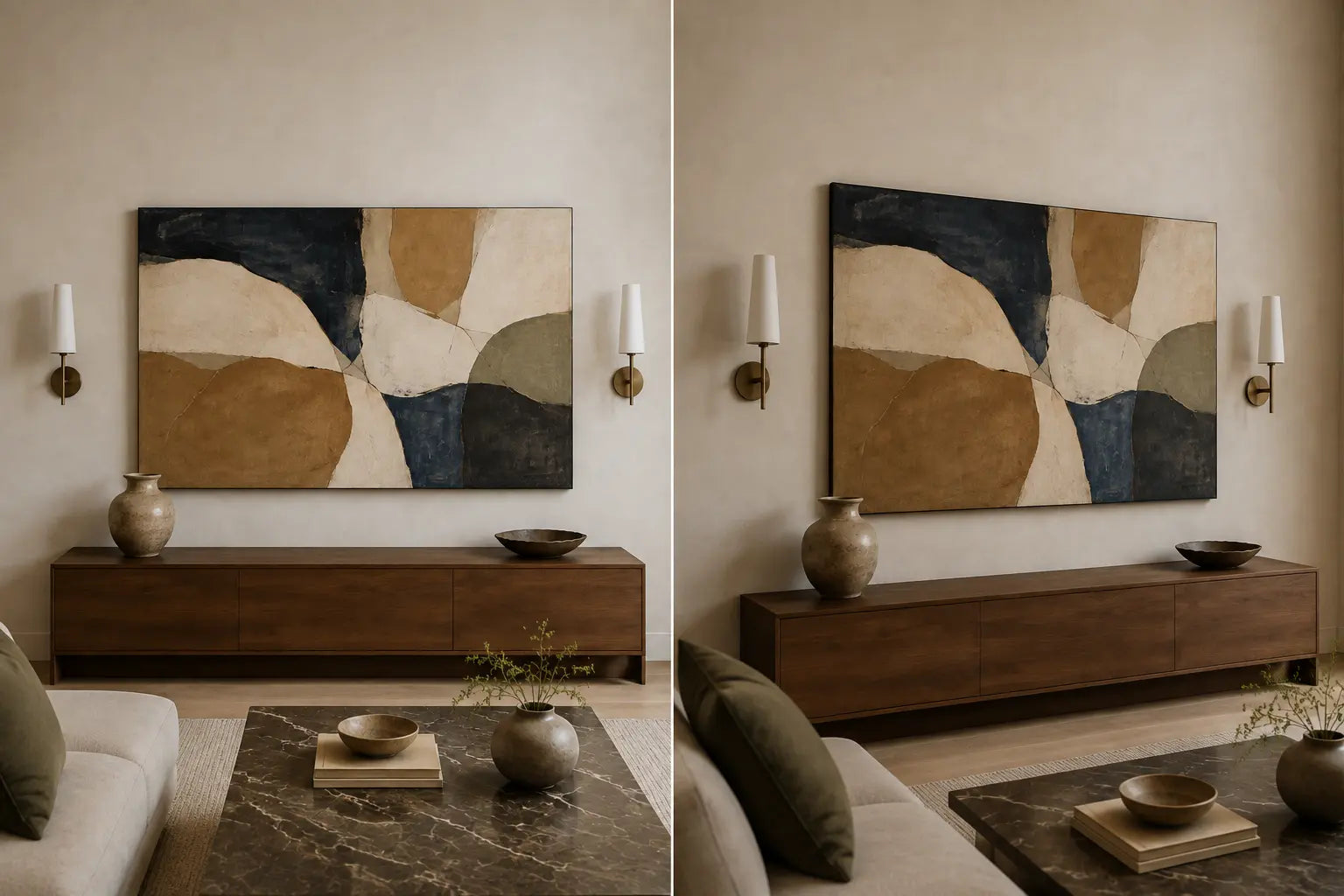
ALIGN — Give the Artwork One Visible Owner
Explain alignment in one sentence. A candidate may register to a matched pair, console, headboard, molding bay or asymmetric reading zone. Choose one owner rather than averaging nearby centers.
Test the same exact envelope on each credible line while size, image and light remain unchanged. One position may join the furniture group while another looks stranded between fixtures. Seek the reference the room makes visible, not a mathematical compromise.
Orientation is a separate variable. The vertical, horizontal and square wall art guide can narrow the shape choice, after which HALO tests the resulting outside footprint against the sconces. General vertical placement belongs to the guide on how high to hang wall art, only after the field and owner are accepted.
For multiple panels, compare the complete boundary with one continuous work. Use one large canvas versus three-panel wall art for format and the canvas-panel spacing guide for gaps. ALIGN output: “The artwork registers to ___,” supported by an exact outline.
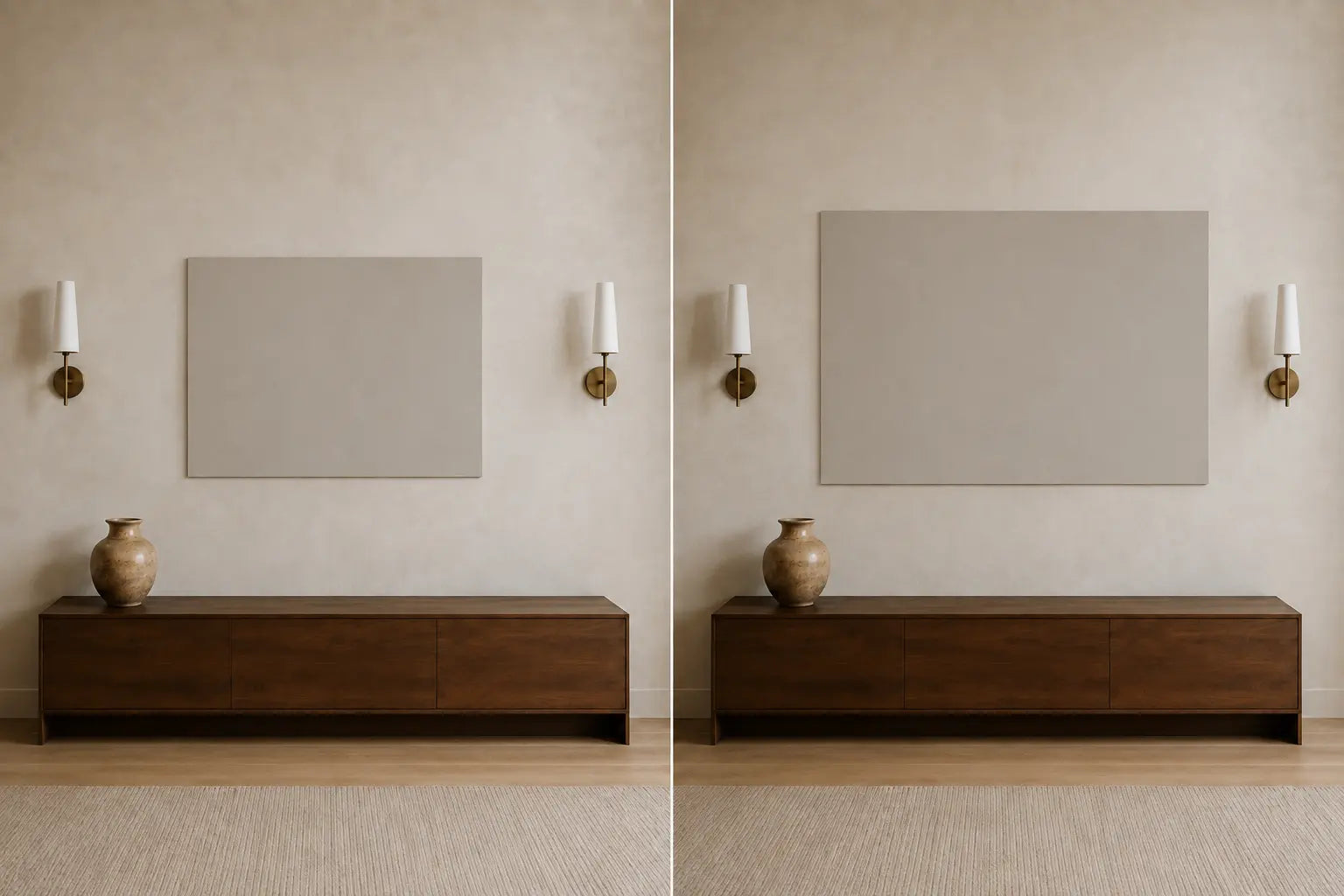
LEAD — Decide What Attracts Attention First
Artwork and sconces need not have equal visual weight. Name the leader with fixtures off, then test whether the on state changes that hierarchy acceptably. Sculptural fixtures may lead all day; a quiet pair may frame expressive art.
Write a hierarchy sentence for each normal state and name one bridge: a curve, secondary hue, direction or open space. Matching a fixture finish may connect objects, but it cannot resolve crowding or competing focal points.
Contrast can affect salience, not dictate taste. If art and sculptural sconces both carry dense detail and similar apparent weight, compare a quieter image without changing size or position. Let a fixture-led wall remain fixture-led.
Presentation affects the envelope and reflections. Use the canvas versus framed print guide for that comparison; HALO does not call either format universally less reflective. LEAD output: leader, support and one visible reason.
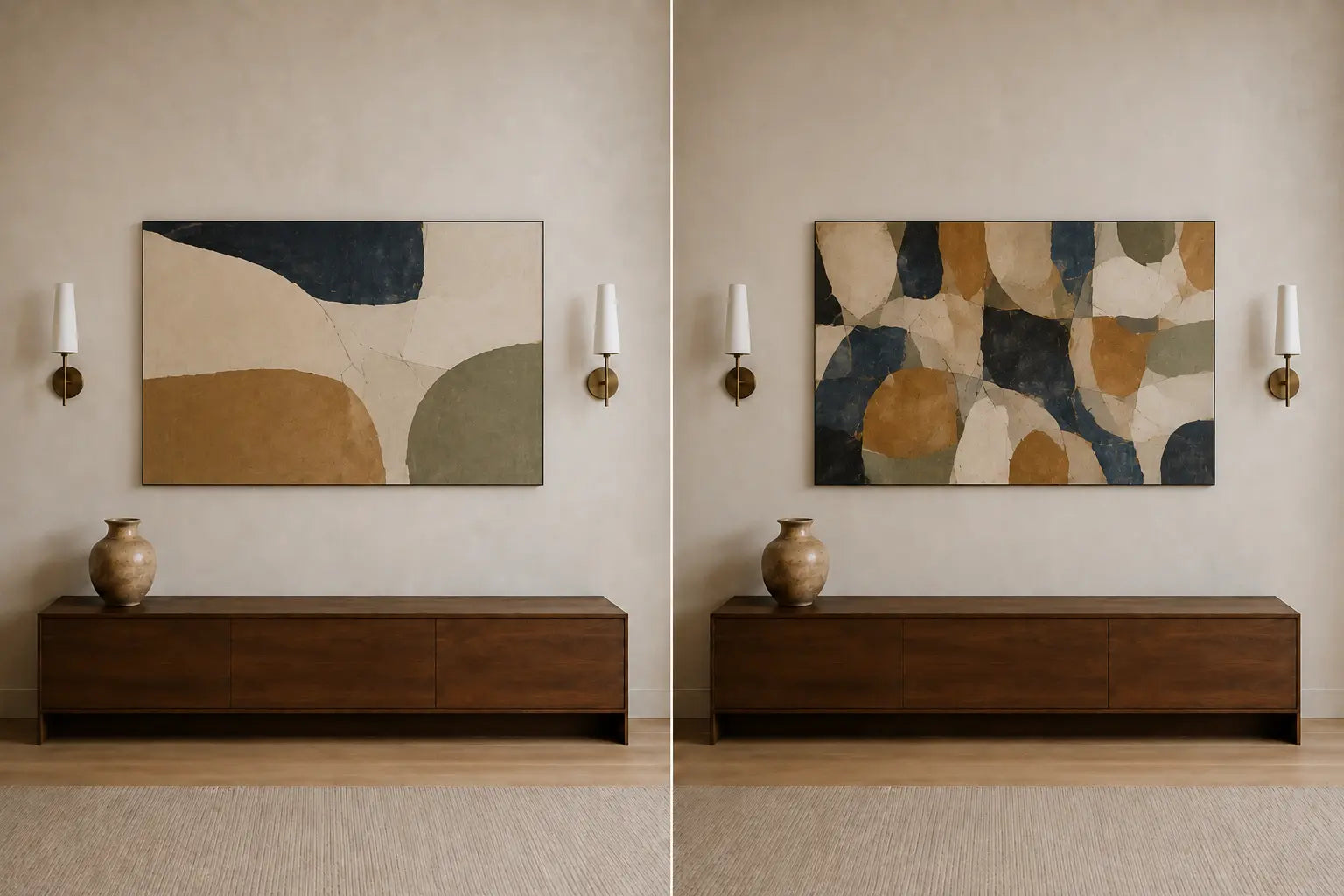
OBSERVE — Test Off, On, and From Real Viewpoints
Keep image, footprint, center and orientation unchanged through daylight, evening, off, on and any regular existing dimmed state. Check the primary seat, standing position and approach. The result may change, but its boundary and role must stay coherent.
The Illuminating Engineering Society defines glare in relation to the visual field and lists source size, position, luminance and adaptation among relevant factors. That supports checking real viewpoints; it does not let HALO certify a lighting installation. National Park Service exhibit guidance notes in its museum context that nearby objects and viewers can contribute shadows. Here it supports observation only, not a home-lighting specification.
Reject repeated glare, reflections or shadows that obscure content, and normal fixture movement that enters the art field. Revise the artwork, use another wall or refer fixture questions to the relevant professional—not improvised electrical changes.
Light exposure is a separate care boundary. Canadian Conservation Institute environmental guidance for paintings says materials vary in sensitivity and cautions that directed picture lamps can illuminate unevenly and sometimes overheat paintings. This conservative museum guidance is not a material-specific forecast for every Artesty canvas. Follow product care information and seek advice when strong directed light or heat is a concern.
OBSERVE output: keep, revise one artwork variable, use another wall or make no purchase, with the first failed state written down.
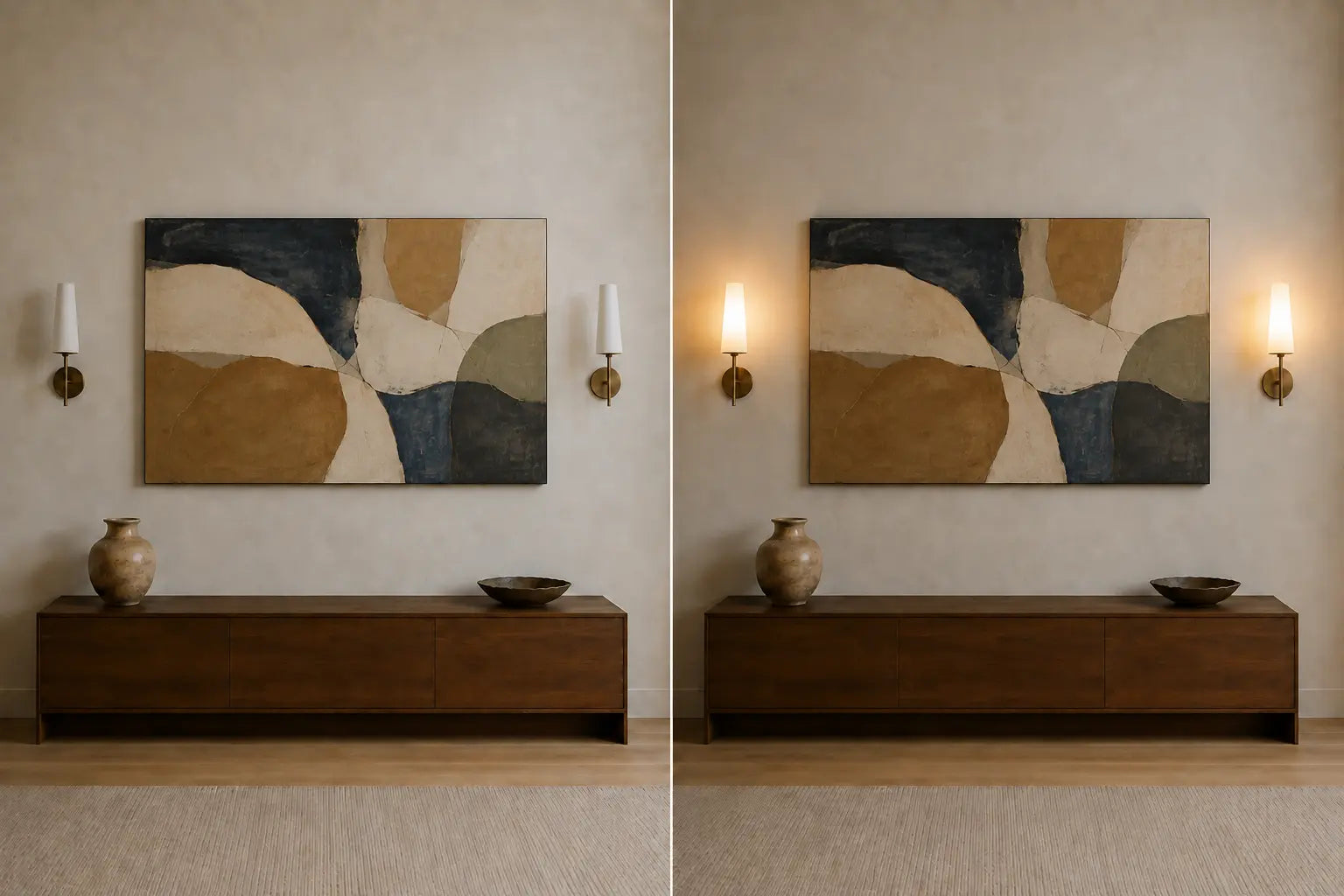
Six Sconce-and-Art Scenarios
These are controlled comparisons, not formulas. Keep the room stable and change only the stated variable. The proposal must pass real views and switch states, not one frontal photograph.
Scenario 1 — A Matched Sconce Pair Above a Console
- Evidence
- Two fixtures form a stable pair, while the console supplies another possible center. Their axes may agree or be offset; both sconces remain present when off.
- Decision
- Treat sconce–art–sconce and console as one unit, then choose one carrier. If axes differ, compare the same footprint on each.
- Reject
- Reject art that clears backplates but crowds shades, light fields or the group, and any center belonging to neither pair nor furniture.
- Retest
- Hold everything except horizontal center. Check off and on from doorway and primary seat.
Scenario 2 — One Sconce Beside a Reading Chair
- Evidence
- One functional sconce and chair create intentional asymmetry. Its arm or shade may move normally. Empty wall does not imply a missing pair.
- Decision
- Register art to the chair zone or another clear local axis. Preserve asymmetry instead of centering on arbitrary empty wall.
- Reject
- Reject an outline crossed during ordinary fixture use, a center that implies a missing sconce, or art that compromises the reading zone.
- Retest
- Keep chair, art and camera fixed. Move only the fixture normally; compare seated and approach views.
Scenario 3 — Bedside Sconces and a Headboard Wall
- Evidence
- Headboard, fixtures and wall band compete as anchors. Bedding changes, but the first two establish the durable field, which may be broad or compressed.
- Decision
- Test the headboard as carrier. Keep art only if its full envelope remains independent of both sconces and normal use.
- Reject
- Reject physical fit alone, accidental sconce brackets or any proposal requiring changed fixture use. Prefer another wall to forced symmetry.
- Retest
- Hold candidate and bed constant. Observe from entrance and both sides, off and on.
Scenario 4 — Sculptural Sconces That Dominate When Off
- Evidence
- Large silhouettes, patterned shades, expressive arms or reflective materials remain prominent in daylight. The wall is active before illumination.
- Decision
- Make sconces the leader and test quieter art, or deliberately reverse the hierarchy. Change image contrast or detail while preserving footprint and alignment.
- Reject
- Reject equal apparent intensity without a relationship. Do not add accessories merely to reconcile competing leaders.
- Retest
- Keep layout unchanged. Compare daylight/off with evening/on and record where leadership becomes confused.
Scenario 5 — Directional, Up–Down, or Exposed Light Near Art
- Evidence
- The fixture creates beam edges, uneven pools, raking shadows or a bright source in a normal sightline. These vary by viewpoint and cannot be proved by a product render.
- Decision
- Test one revised footprint or center. If interference remains, reject the wall. Do not assume a nearby sconce suits canvas illumination.
- Reject
- Reject repeated masking by glare, reflection or shadow, undocumented fixture changes, or unresolved care and heat concerns.
- Retest
- Keep normal fixture settings. Change only envelope or center; inspect seated, standing and approach views in usual states.
Scenario 6 — Repeated Sconces in a Hallway or Paneled Wall
- Evidence
- Repeated fixtures create rhythm and narrow bays seen while moving; molding may add another grid. Frontal openings can disappear on approach.
- Decision
- Use one genuinely clean bay or let lighting own the wall. Do not stretch a gallery group across fixture intervals.
- Reject
- Reject crossed sconce rhythms, masked image areas or equal demand from every interval. An empty bay is not automatically incomplete.
- Retest
- Keep ordinary room states. Walk both directions off and on. If ownership collapses, compare another wall or no purchase.
Decision Router
Use the router after HOLD. Select the row that matches the strongest visible evidence, run its first comparison, and keep the remaining variables fixed. Passing one row removes one uncertainty; it does not prove the full purchase. Carry the survivor through ALIGN, LEAD and OBSERVE.
On a narrow screen, scroll this table horizontally to read every column.
| Strongest visible evidence | First controlled comparison | What it isolates | Reject or reroute when |
|---|---|---|---|
| Stable matched sconce pair | Two complete footprints on the same pair axis | Whether outer scale, not alignment, causes crowding | Both fit physically but crowd shades, light fields or the group |
| Furniture and sconce axes conflict | Same envelope on each declared carrier | Which axis visibly owns the local composition | Both positions read as unexplained compromises |
| One sconce creates a functional zone | Local intentional asymmetry versus forced midpoint | Whether the art belongs to the actual use zone | The midpoint implies a missing fixture or ignores normal movement |
| Sculptural fixtures dominate while off | Same envelope with a quieter artwork candidate | Whether hierarchy, not size, is the failure | Art and fixtures still compete as equal leaders |
| Beam, source, reflection or shadow interferes | Same art with one revised envelope or center | Whether the artwork can avoid the observed interference | Focal content remains masked in a normal view or state |
| Repeated fixtures leave no stable bay | One clean-bay option versus another wall versus no art | Whether the wall needs another object | Physical vacancy is the only reason to add art |
If mirrors share the same sightline, treat their reflections as another state rather than a decorative afterthought. The wall art and mirror planning guide owns that broader relationship; HALO still tests the sconce field without quietly changing multiple elements.
Pre-Purchase Brief
Write the brief before collecting many images. Use observations and failure conditions rather than style adjectives. Photograph the same candidate outline from repeatable positions, and label each image with the relevant daylight or evening and off or on state. The brief should allow another person to understand why a candidate survived or failed.
- Fixture status: confirm that installed locations and ordinary operating positions are final enough for an art decision.
- Fixed field: list bodies, shades, backplates, projections, nearby molding and furniture that actually remains.
- Regular variables: record moving arms or shades and existing normal off, on or dimmed states.
- Primary view: name the seat, standing position or approach where the wall matters most.
- Secondary checks: choose two honest viewpoints, including any route that changes overlap.
- Alignment owner: complete the sentence, “The artwork registers to ___.”
- Artwork envelope: record full outside width and height, including frame, all panels and all gaps.
- Hierarchy off: name the first-attention element and supporting role when fixtures are unlit.
- Hierarchy on: state whether leadership changes and whether that change is acceptable.
- Bridge cue: identify one secondary hue, curve, direction or open-space relationship.
- Observed interference: note glare, reflection, beam edge, shadow, masked content or fixture movement without diagnosing the lighting system.
- Care gate: verify applicable product care information; pause if heat or concentrated light creates an unresolved concern.
- Failure sentence: write the first ordinary state in which the candidate stops working.
- Next action: keep, revise one artwork variable, use another wall or make no purchase.
Do not convert the brief into a universal spacing rule. The necessary clear field depends on the real shape and visual presence of the sconces, the complete artwork object and the views used in the room. Verify actual product dimensions and presentation details for every shortlisted work rather than assuming that an image is offered in every format.
Frequently Asked Questions
1. Can wall art hang between two sconces?
Yes, when the pair creates a stable field and the complete artwork footprint remains independent of the fixture bodies, normal moving parts and observed light effects. Treat sconce–art–sconce as one group, but align that group to one declared owner. If the pair and furniture disagree, compare both axes rather than splitting the difference.
2. Should art be centered between sconces or over the furniture?
Use the midpoint of a matched pair as one test and the furniture axis as another. Keep art, size, height and room state unchanged while moving only the center. Choose the line that visibly owns the composition from the primary and secondary views. There is no automatic priority that applies to every room.
3. How much space should be left between wall art and sconces?
There is no reliable universal number. Fixture shape, projection, light direction, artwork footprint and viewer position all change the perceived field. Make exact outlines and reject options that crowd the shades or illuminated field even when nothing physically overlaps. Preserve a legible relationship rather than chasing a preset gap.
4. Should the top, center, or sides of the art align with sconces?
Whichever line has a visible reason may work. A matched pair often supports a shared center field, while a strong console, headboard or panel bay may provide the clearer registration. Test one line at a time and state it explicitly. Do not combine top, center and side alignments merely to satisfy several objects at once.
5. Can ordinary wall sconces illuminate canvas art?
Do not assume so. A nearby fixture can create uneven light, glare, shadows or concentrated exposure depending on its design and position. HALO observes those effects but does not rate the fixture. Consult the fixture manufacturer’s documentation, the artwork’s care information and an appropriately qualified professional when the intended use is uncertain.
6. Do dimmers, up–down lights, or exposed bulbs change the choice?
They can change the visible hierarchy and interference pattern, so test only the normal states already available. Keep the artwork unchanged while observing each state from real viewpoints. HALO does not prescribe dimmer settings, lamp specifications or modifications. If an acceptable result depends on electrical changes, pause the art decision.
7. Can wall art work with one sconce or an asymmetric pair?
Yes. Register the art to a real local zone—a reading chair, desk, console end or architectural bay—instead of inventing symmetry. Check all normal fixture positions and the route into the room. Intentional asymmetry succeeds when the owner is legible; arbitrary empty space is not enough evidence.
8. When is another wall the better choice?
Choose another wall when no envelope survives both off and on states, fixture movement repeatedly enters the art field, focal content is obscured, or the sconces already complete the architecture. A forced purchase is not a better outcome than a stable lighting wall. Record the failed state so the same option is not revived after restyling.
Final Decision
Keep the artwork only when four statements are true: the real fixture field has been held constant; the full envelope aligns to one visible owner; art and sconces have clear roles off and on; and the unchanged candidate survives ordinary light states and viewpoints. If one statement fails, revise only the artwork variable connected to that failure. If the field itself is unstable, choose another wall or stop.